Exhibitions
Print Hacks from Frogman’s Faculty
Damp, not Dripping
By Raluca Iancu Mokuhanga with Scrolls, Session 2
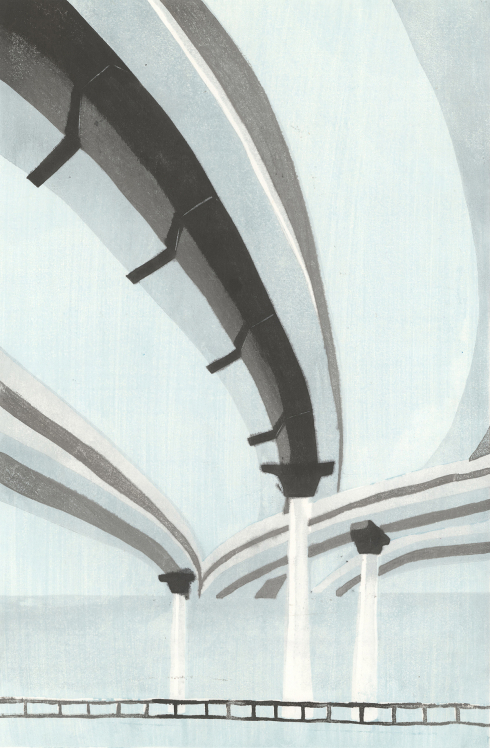
Mokuhanga beginners often work with too much water. One source of extra moisture is your paper. When preparing your damp pack, spray your newsprint first, wrap it in plastic, and let it rest for at least one hour. Next, put your printing paper inside your damp pack by interleaving the damp newsprint with the dry printing paper, then let it rest for at least another hour. Make sure to dehydrate all your paper after a maximum of 3 days in the damp pack, to avoid MOLD-POCALYPSE!
Bio:
Raluca Iancu is currently an Associate Professor in Art & Visual Culture, Printmaking, at Iowa State University (ISU). She earned her MFA from The University of Tennessee, Knoxville, and her BFA from the Nova Scotia College of Art and Design University, Canada. Recent awards include a 2026 Faculty Award for Outstanding Achievement from the College of Design (ISU), a 2026 Research Grant from the Center for Excellence in the Arts and Humanities (ISU), and a 2025-2026 Faculty Professional Development Appointment Sabbatical (ISU).
Her work investigates disaster, memory, and vulnerability through different media, ranging from printmaking to performance, to edible art and printed objects. She is interested in how our relationship with technology can simultaneously enhance our lives, while it can also leave us vulnerable.
Raluca’s work has been exhibited nationally and internationally, at venues including the International Print Center of New York (NY), the CICA Museum (Korea), the Art Museum of Cluj-Napoca (Romania), the Bradbury Art Museum (AR), the Art Institute of Boston (MA), and the Hunterdon Museum (NJ), among others. Artist Residencies include the Kala Art Institute (CA), the Hambidge Center for Creative Arts & Sciences (GA) and the Vermont Studio Center (VT), Art Print Residence (Spain), the Eugeniusz Geppert Academy of Fine Arts (Poland), St Michael’s Printshop (Canada), Studio Kura (Japan), BetterPress Lab and Scuola Internazionale di Grafica (Italy), and, most recently, MI-LAB and Letterpress Letters (Japan).
Where to Find Your Wood
By Joanne Price Wood Engraving, Session 1
Most printmakers have never done wood engraving. “Woodcut” and “wood engraving” terms have historically been used interchangeably because either the difference wasn’t known or someone didn’t care to distinguish the two techniques. Wood engraving is woodcut’s mature sister process –both are printed in relief – and metal engraving’s cowgirl half-sister that adopts metal engraving tools to end grain wood to match the level of detail and smaller scale perfect for books and publications. This marriage of techniques allowed wood engraving to dominate the visual culture of the Victorian era.
The most up-to-date list of supplies for wood engraving are on the Wood Engravers’ Network’s website: https://woodengravers.org/printexchange/supplies/
This lists North American, European and Asian suppliers for end grain wood blocks and other relief engraving substrates as well as tool resources. I personally love working with natural, round English boxwood. However, the most abundant and cheapest materials for relief engraving (a more generic term for wood engraving) in North America are maple end grain and a mounted countertop material (Jim Reynolds calls this “solid surface,”) finished to type high (.918 inches – same height as metal and wood type.) Both options are good alternatives to the more expensive boxwood.
Bio:
Joanne Price is the founder of Starpointe Studio, specializing in wood engraving, letterpress, and book arts. Price is President Emeritus of the Wood Engravers’ Network (2014 – 2020) and an elected member of the Society of Wood Engravers since 2017. Price also collaborates with letterpress publishers like Larkspur Press and October Press, doing book and broadside illustrations for authors, such as Wendell Berry, Barabara Kingsolver, Frank X Walker, and more. She exhibits nationally and internationally and has work in the collections of Yale University, Guangdong Museum of Art, St. Bride Library, Ashmolean Museum and many more.


Squeegee Brace
By Nathan Meltz Screenprint, Session 2
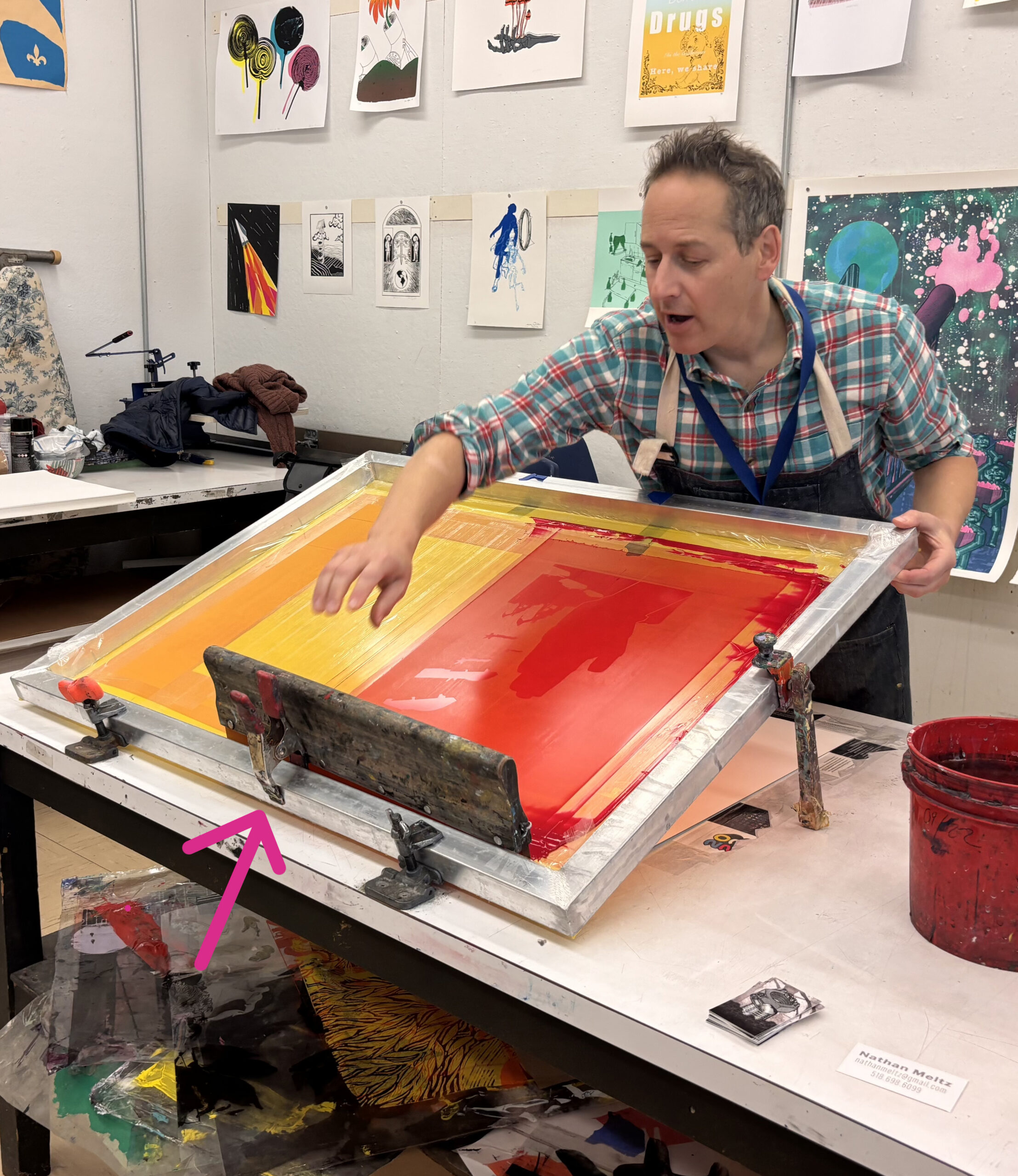
Tired of your squeegee falling into your screen and getting all inky? Clip a spring clamp on the frame adjacent to the hinges and lean your squeegee up against it after every flood or whenever you elevate your screen.
Bio:
Nathan Meltz uses printmaking, animation, sculpture, and performance to comment on the infiltration of technology into every facet of life, from politics and food, to family and war.
His solo exhibitions include the gallery at Atelier Presse Papier, Trois-Rivières, Canada, the Shircliff Gallery at Vincennes University, Indiana, Southern Illinois University’s Vergette Gallery, GRIDSPACE (NYC), the University of Florida – Jacksonville’s Andrew Brest Gallery, and more. His international exhibitions include the 2024 Taiwan International Print Biennial, the 16th International Printmaking Triennial Graphica Creativa Triennial, Jyväskylä Art Museum, Finland, and the 8th edition of the Graphic Art Biennial of Szeklerland, Romania. His art has been featured in publications including Art in Print, Printeresting, and the Mid America Print Council Journal. His series “Strangling the Fascist Viper” has received juror awards from the Louisiana International Printmaking Exhibition and the Political Impressions exhibition at the Rochester Institute of Technology, the Printworks Award from Artists Image Resource, Pittsburgh PA, and the Prix de Print award from Art in Print Magazine. His recent printmaking/animation hybrid work “The Golem Trilogy” has screened internationally at film festivals, earning the Special Jury Mention award at the Electric Dreams Film Festival in Milan, Italy.
Meltz is a Senior Lecturer in the Department of the Arts at the Rensselaer Polytechnic Institute in Troy, New York, and is the founder and curator of the Screenprint Biennial, a project highlighting the medium for over a decade.
L is for Locked In
By Emily Legleitner Color Woodcut, Session 1
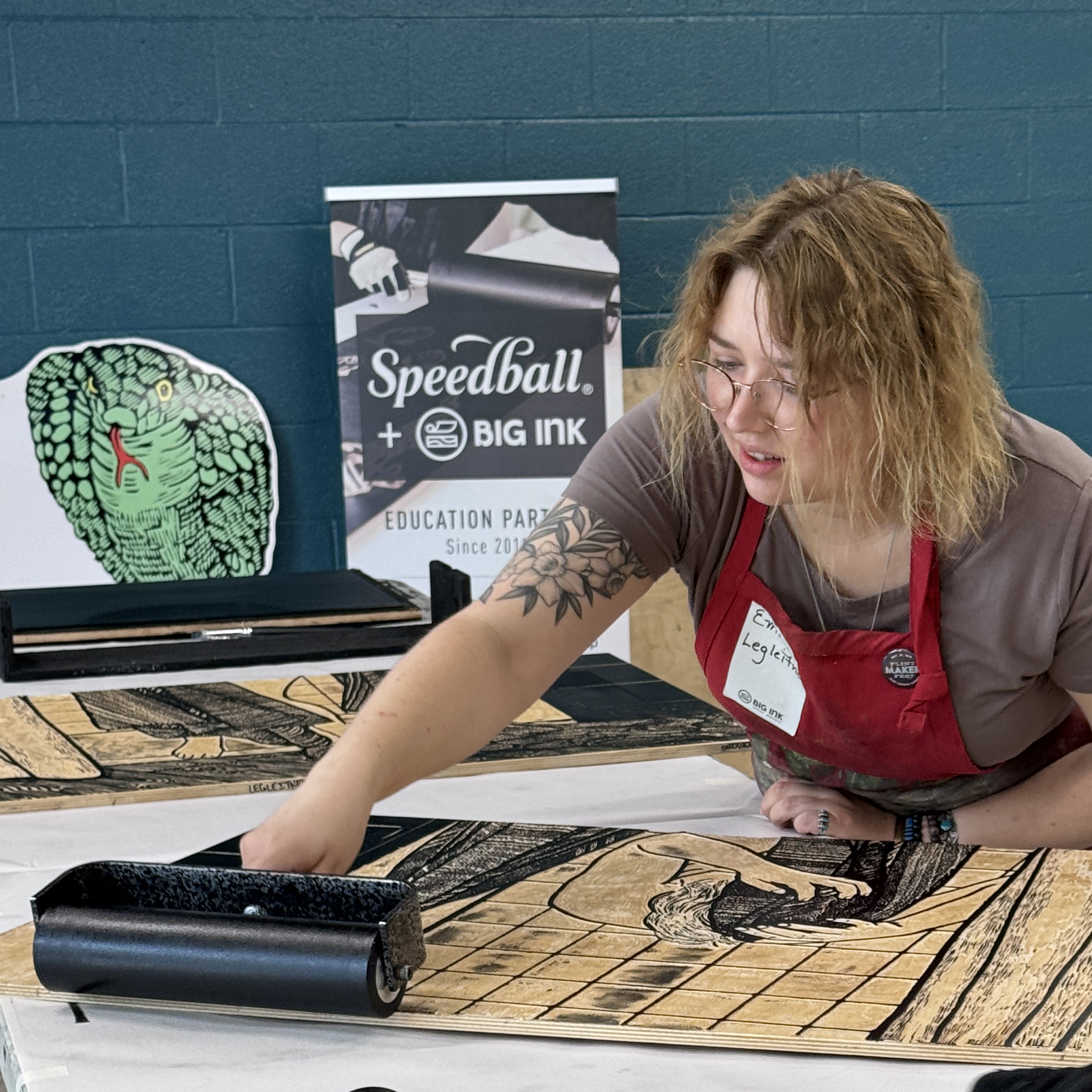
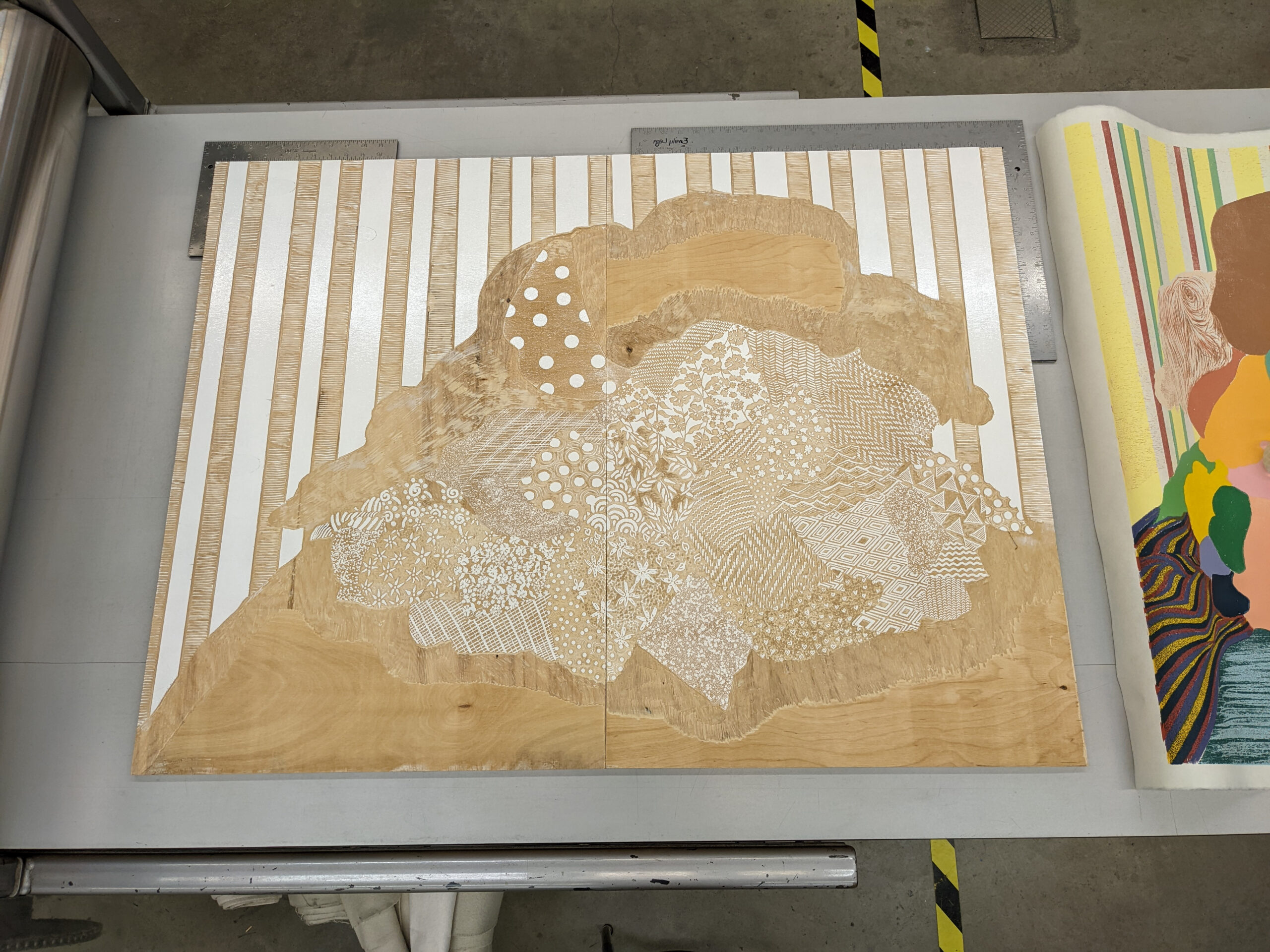
My print hack for perfect registration is surprisingly simple: an L-square ruler and tape. I tape my paper to the press bed (or table) and never remove it between printing blocks, allowing me to print every layer wet-on-wet. Because some of my prints involve seven or more blocks and upwards of 20 colors, I keep my inks thin and highly transparent so each layer can build without drying in between.
Before printing, I ink all of my blocks, tape the L-square in place, and secure my paper at least two inches from the ruler. As I print, I simply swap blocks, pushing each one snugly into the corner of the L-square for consistent alignment. If the ink begins to build up, I blot the print with an uncarved block and newsprint.
I love this method because it eliminates nearly every variable except placing the block against the ruler. It also lets me print varied editions intuitively, adjusting colors from print to print without committing to an entire edition one layer at a time. While I now use pin-and-tab registration for large editions, I still return to this reliable L-square method.
Bio:
Emily Legleitner is a Michigan artist and Assistant Professor of Art at Saginaw Valley State University. Working across printmaking, installation, and performance, her interdisciplinary practice examines autobiographical experiences of anxiety, solitude, and longing. Legleitner’s work has been exhibited nationally and internationally in prominent solo and group exhibitions, earning notable awards and funding. Her work has been published in numerous journals and publications, including Art in Print and Printmaking Today; and is held in permanent collections including the International Print Triennial Society (Kraków, Poland) and the National Taiwan Museum of Fine Arts (Taichung, Taiwan), among others. Legleitner received her MFA in Printmaking from the University of Alberta and her BFA in Studio Art from Stamps School of Art & Design at the University of Michigan.
Graphic Impressions is published by SGC International. SGC International is an educational non-profit organization committed to informing our membership about issues and processes concerning original prints, drawings, book arts, and handmade paper.
Graphic Impressions Updates
Submissions
We encourage your submissions to Graphic Impressions. Submission types include:
- Feature articles
- Reviews
- Interviews
- Studio visits
- Exhibitions
- Demonstrations or process-based content