
Interview
Established: Catching Up With Leslie Koptcho

Leslie Koptcho
Instagram: @leslie.koptcho
Website: Baton Rouge Gallery
https://lesliekoptcho.com/index.html
Leslie Koptcho studied art at Tyler School of Art, Temple University, and at Cranbrook Academy of Art, where she earned her MFA. Currently, she is a Professor of Art at Louisiana State University, where she teaches Printmaking, Papermaking and the Arts-of-the-Book. During her tenure at LSU, she was named the LSU School of Art Emogene Pliner Distinguished Professor, which is awarded to acknowledge sustained creative accomplishments, scholarship, and research.
Koptcho’s artwork is included in over 40 permanent collections including Bibliotheque National de France, Department of Prints & Photographs, Paris, FRANCE; Brooklyn Museum; Fogg Art Museum; Library of Congress, Artists’ Books Collection; Marion Koogler McNay Museum; Mino Washi Museum, Director’s Collection, Mino, JAPAN; New Orleans Museum of Art; The New York Public Library, Spencer Collection; Printmaking Museum of Duoro, Alijo, PORTUGAL; Queensland University of Technology Art Museum, Brisbane, AUSTRALIA; and the Fine Arts Museums of San Francisco/Legion of Honor Museum, The Reva and David Logan Collection of Illustrated Books.
Her work has been shown nationally and internationally in over 250 venues, 14 of which were solo exhibitions. Botanica Collectanea, her current body of work was recently presented at the Baton Rouge Gallery Center for Contemporary Art, and at the LSU Museum of Art.
Koptcho’s professional activities have taken her to Egypt, France, India, Italy, Japan, Kazakhstan, Mexico, Russia, and Spain. Notable awards include a Yaddo Fellowship; an American Cultural Specialist Grant, which was funded and administered by the US Information Agency; and 2 ATLAS awards, which were sponsored the Board of Regents of the State of Louisiana.
Koptcho was twice selected to participate as an artist in residence at Art Print Residence in Arenys de Munt, Spain; and at the Museu Molí Paperer de Capellades; the latter was sponsored by the Generalitat de Catalunya, Spain.
In the summer of 2025, she was a Resident Fellow at the American College of the Mediterranean in Aix-en-Provence, France.
Artist Statement
My work focuses on the complex variations of form found in nature. I see flora and fauna as potent metaphors representing growth and transition, as well as suggesting empathy and survivability. I gravitate to the out of doors but look deep within for emotional connections that remind us of what it means to be human and what qualities define individuality. By examining, replicating, adapting, and combining these elements, I aim to create compelling visual polemics and, in a small way, hint at the mysteries held within life itself.
My current project, Botanica Collectanea is inspired by botanical sources, herbals, and invasive plants specific to the Gulf Coast region of the United States. Many of these plants are in my own backyard competing with native plants. I have also created unique, hand formed papers with each of the plants I have studied.
The word herbal first appeared at the beginning of the 16th century. It is most basically defined as a book that describes plants. As an artist and educator, one who both practices and teaches the arts of the book, I have a profound appreciation for the various ways that hand formed paper, illumination, illustration, and printing have been combined for centuries to make beautiful herbals, be they medieval manuscripts, incunabula—herbals represent some of finest examples of early printing—or more recent iterations. I find herbals especially alluring because of their aesthetic qualities, and because they often comprise more than plant identification: they can embody storytelling and magic, provide insights into cultures and places, and reveal the mysterious operations of nature, malevolent or benevolent.
These prints are meant to serve as a contemporary celebration of the time-honored tradition of “botanical” prints while offering an expressive and creative point of view of the natural world—one that highlights current environmental challenges facing both local and global communities.
Each plant has a different story to tell.
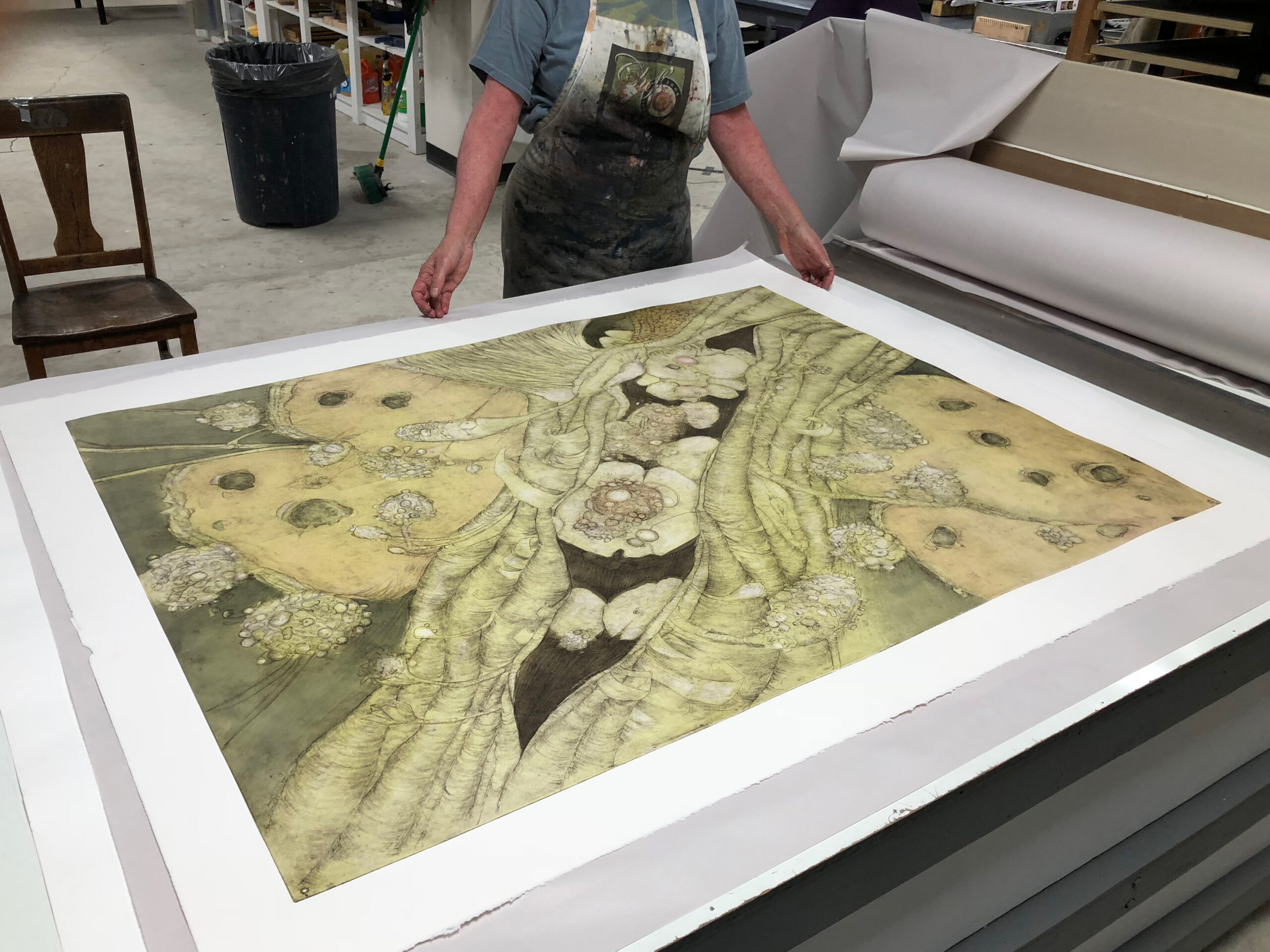
Koptcho with Cycas Revoluta Viridi Luce
Softground etching, aquatint and monotype
35.5” x 47.5”
2020
The Interview
Blake Sanders: What was your first printmaking experience? When did it become a consistent part of your practice?
Leslie Koptcho: My first printmaking experiences, and warm memories of printing, were at Bucks County Community College, under the tutelage of artist Selma Bortner, known for her innovative use of collagraphs, and moving works about both personal and social issues. I was inspired by her dedication to the medium and enjoyed the process-driven work.
It wasn’t until I took a lithography class from Dan Dallman at Tyler School of Art, that printmaking really became a focus of my practice. I began to see printmaking as a physical way to draw, and drawing was important to me. I learned lithography first by drawing on a full size (circa 30” x 40”) aluminum plate. I still remember my first lithographic image, a very gestural and expressive drawing of a green pepper, with exploding seeds and text. The greasy crayon did just what I wanted, and Dan was an excellent teacher, delivering the step-by-step technical knowledge. I even remember loving the machinery of the press, and that it was the same size laterally that I was. I was just hooked. I also worked with John Dowell, who taught me about color and registration methods. I came around to enjoying etching after taking classes with Romas Viesulas, and Evan Summer. They were so supportive, I felt I could continue in the field and be successful.
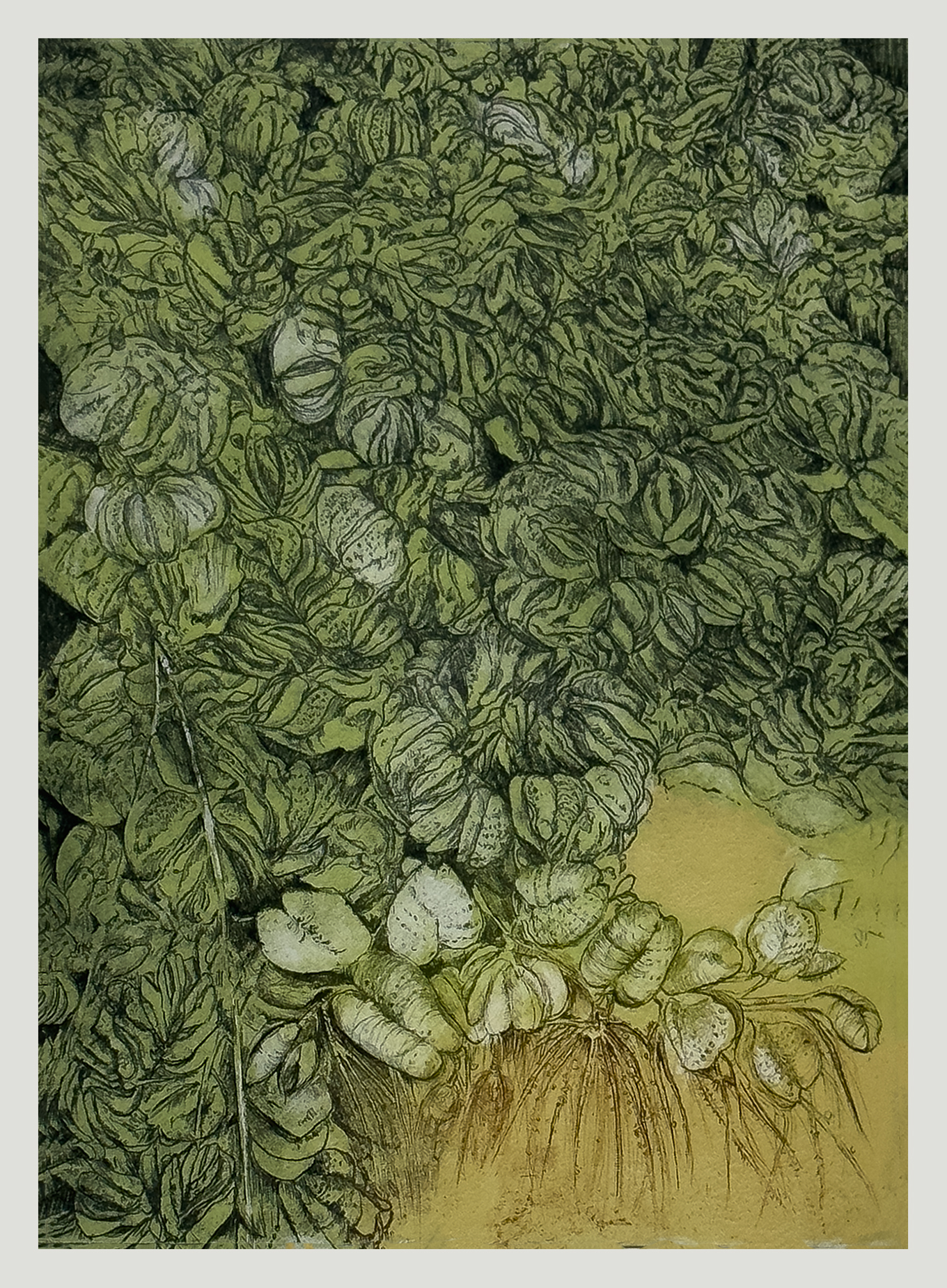
Giant Salvinia (Salvinia molesta)
Soft-ground etching, aquatint and monotype
14” x 10”
2024

Crested Floating Heart (Nymphoides hydrophylla)
Soft-ground etching, aquatint and monotype
14” x 10”
2024
BS: Your BFA was at the Tyler School of Art at Temple, and you earned your MFA at Cranbrook. How was printmaking taught and reinforced between those two elite programs? How were the experiences different?
LK: Thanks for asking about this, and my education overall, Blake. I think the biggest difference is that my undergraduate experience was framed more by traditional course work and curriculum, whereas my graduate studies were very independently driven, working with a single artist in residence. Lucky for me, at Cranbrook, I had the opportunity to study with the brilliant and equally inspiring artist, Steve Murakishi. His Zen approach really pushed us all to be better problem solvers as well as to work from the heart. I recall a few of us circling around and asking him what drives his own work, and him saying that he just wanted to “make a contribution”. At the time, his work included dealing with social justice matters, and his simple and direct answer deeply moved me.
While pedigrees look good on the resume, great mentors make a difference, as much or more than elite programs, I’d like to thank all the teachers I have had both in and outside of art school. I can only hope I have made a similar “contribution” via my work and my time with students.
Looking beyond the institution, my greatest teachers were my loving parents, who always had faith in me, and taught me to respect all living beings. My Dad, an avid summertime vegetable gardener and fisherman, showed me how to plant straight rows, and try to be patient. My Mom, to be kind and non-judgmental. And then there were the horses, and the track (I worked as a racehorse groom to put myself through university) and Nature itself. Each taught me to appreciate and consider the rhythms in the natural world, a recurring theme throughout my work.

Hydrilla (Hydrilla verticillate)
Soft-ground etching and aquatint
14” x 10”
2024

Water Hyacinth (Pontederia crassipes)
Soft-ground etching and aquatint
14” x 10”
2024
BS: Before you arrived at LSU you were at the San Antonio Art Institute and San Antonio College. How did your time in Texas help you grow as an educator, and prepare you for the shift to Louisiana?
LK: Before San Antonio I spent short temporary gigs at Ohio State University and the College of Charleston. I spent 8 years in Texas and loved it. San Antonio is a very special place, with an active arts community. It’s true the unique sense of place and warm climate was a good transition in finding myself in Baton Rouge. San Antonio artists were welcoming, and I immediately engaged with other creatives in the community. I taught myself how to write grants and find the things I needed to set up and run a print shop.

Alligator Weed with Apple Snails (Alternanthera philoxeroides)
Soft-ground etching and aquatint
14” x 10”
2024
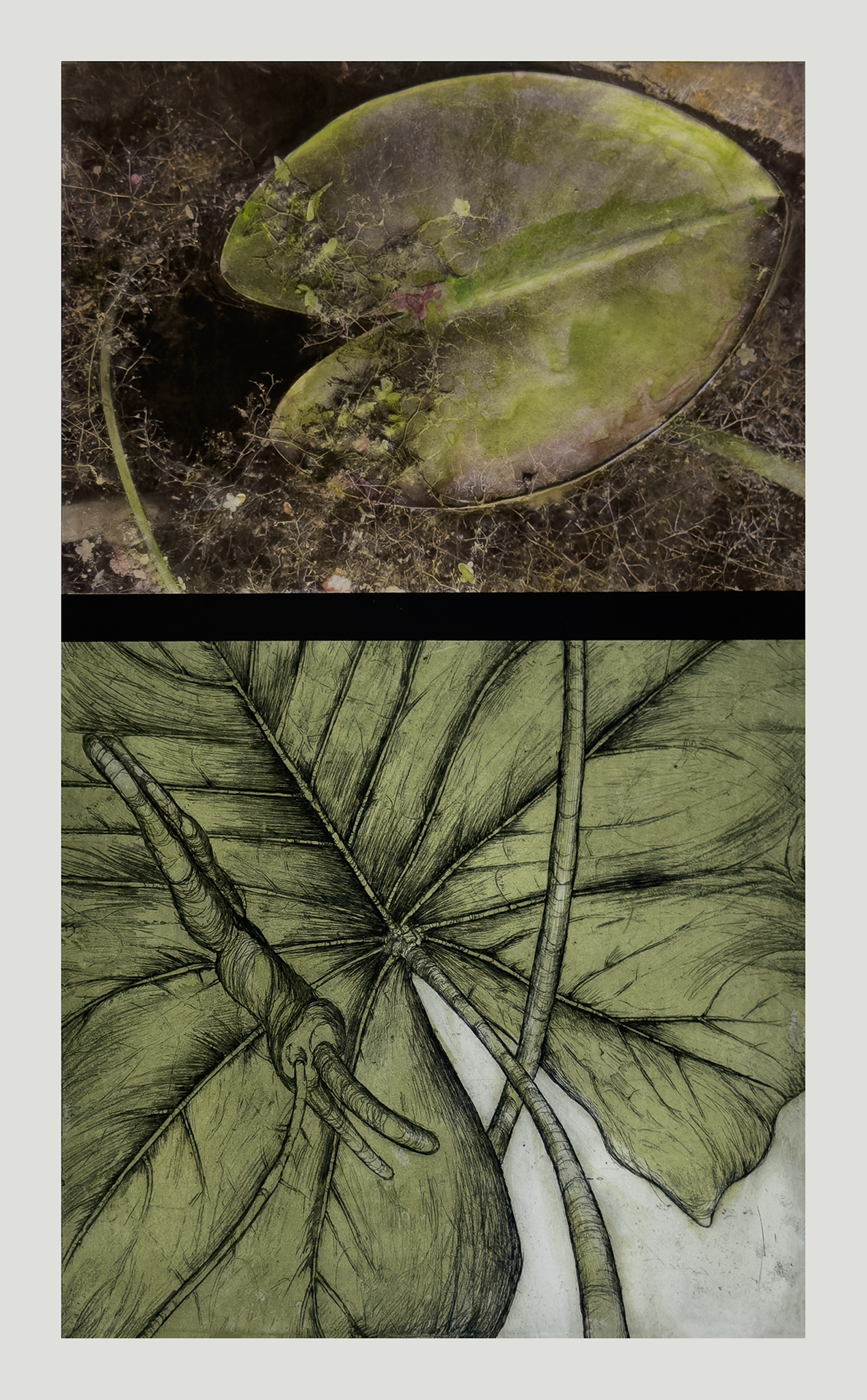
Above/Below
Softground etching, aquatint, and photopolymer gravure with watercolor monotype
37″ x 26”
2023
BS: During your tenure at LSU the program has produced a terrific number of strong print MFAs who have gone on to be outstanding print artists and educators. How did the studio culture develop over time so that the shop became the place students wanted to be? Now that the printshop is literally in the shadow of Tiger Stadium, how do you steer clear of that enormous distraction?
LK: LSU has a wonderful legacy, and I am just one part of it. Artists like Caroline Durieux, Jim Burke, Kimberly Arp, and now Lauren Cardenas all have played a role in creating a rich studio culture that puts students’ individual voices first and helps them to find unique ways to express themselves.
As far as being in the shadow of Tiger Stadium goes, we are often so preoccupied with our print work the giant is barely noticed. On the other hand, it is a distinctive architectural feature and keeps life exciting. The 2026 MAPC Conference gave us the excuse to have a little fun with the athletic tie, so we proposed the Tiger Relay, and we are grateful to the Cox Communication Center for Student Athletes, which gave us some funding toward a successful conference.
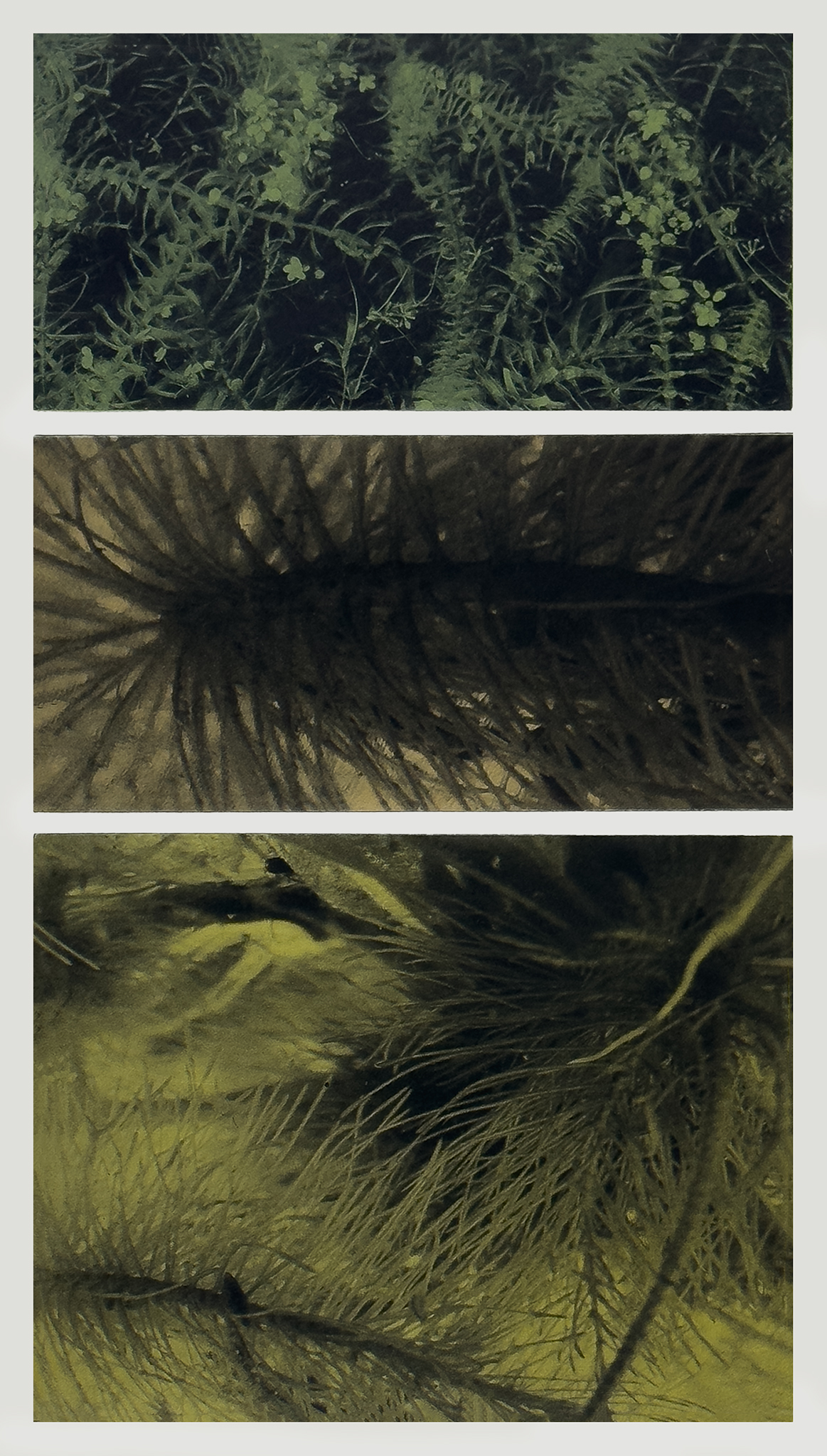
Water Lettuce Roots (Pistia stratiotes)
Photopolymer gravure and monotype
22” x 12”
2023
BS: LSU’s print facilities are impressive particularly when it comes to providing access to extremely large exposure units, presses, and papermaking equipment. I happen to know that they came from a prodigious run of grant writing success from the print faculty. Do you have any advice to share with our members who are looking to find grant opportunities, or looking to break through with a successful application?
LK: Yes, most of our specialized equipment has come from grant writing. It is increasingly difficult for the arts to remain competitive in garnering funding, since so much gets dedicated to STEM disciplines. My tip is to not give up. If you don’t receive funding for a project, try, try again. The other suggestion is to partner up whenever possible to show greater impact across disciplines. And to also look for opportunities by creating them!

Asiatic Jasmine (Trachelospermum asiaticum)
Softground etching and aquatint
14” x 10”
2025
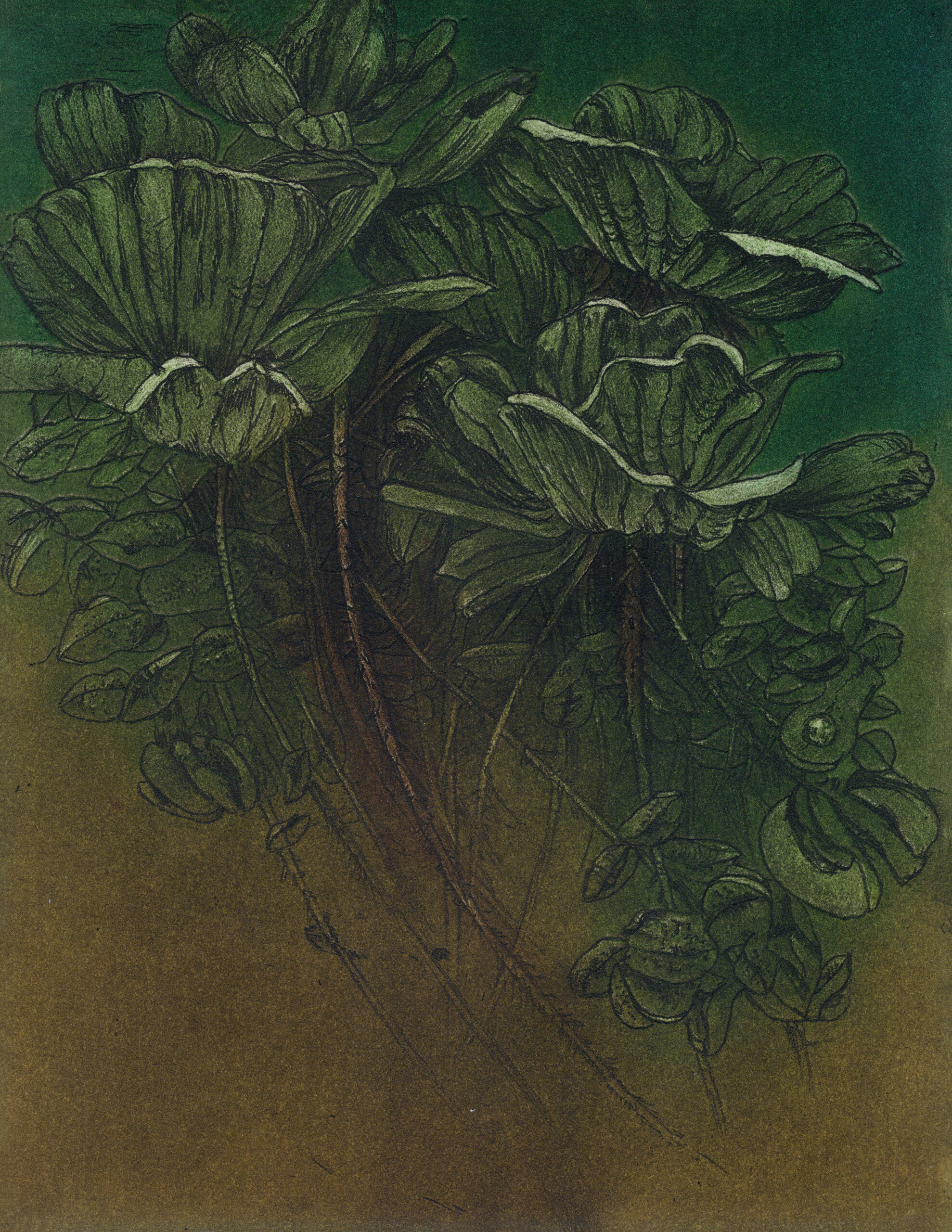
Buoyancy
Softground etching and aquatint
9” x 7”
2026
BS: Your work is based in observations of nature and biological specimens. How does your approach address the ubiquity of the Louisiana ecosystem and its persistent creep toward entropy?
LK: Working with Louisiana plants that have been designated as “invasive” I am struck by both the ecological threat they impose, and at the same time inspired by their beauty and resilience. One could suggest that their negative impacts invite a certain chaos to the native landscape. My current project, Botanica Collectanea, reimagines the botanical print tradition through a contemporary lens, pairing curiosity with environmental urgency. I harvest these plants to create distinctive papers – transforming ecological disruptors into alternative substrates for storytelling. I haven’t had to look farther than my own backyard to find them. And each plant truly has a different story to tell.

Mulberry I
Softground etching and aquatint
14” x 10”

Japanese Climbing Fern (Lygodium japonicum)
Soft-ground etching and aquatint
14” x 10”
2025
BS: At times your work has been subtly autobiographical. How do you choose how much to share with an audience? Have you become comfortable with them turning the microscope on you as you do with your specimens?
LK: This is a great question. I haven’t used a microscope for a while, opting to draw more than relying on photographs, but I would like to get back to it.
I think all my work looks inward, despite being inspired by what is overtly seen. I reveal layers of what the work means to me, with different audiences. For example, I may not go into depth on a personal level in a professional artist statement to a group of strangers, but I will have honest conversations with my students or with those who sincerely inquire. For example, I’ve always been interested in the skin as a boundary between inner and outer worlds. However, my own skin is often my nemesis, as it can reflect everything I am feeling, even when I don’t want to share that feeling with others. I try to balance honestly sharing what drives the work, with leaving room for mystery.

A Selection of Hand-formed Papers made from Invasive Plant Fibers
2024 – 2026
BS: You and Brian Kelly are both long-term members of the Baton Rouge Gallery, a cooperative gallery with active exhibiting members who help run the space. How does the gallery nurture your practice? How has its model influenced students’ experience at LSU?
LK: The Baton Rouge Gallery, Center for Contemporary Art is one of the longest running successful cooperative galleries in the country. Under the leadership of president/CEO Jason Andreasen and Kelsey Livingston, Director of Exhibitions, the gallery is thriving. I feel honored to be a part of this vital Baton Rouge arts center, and especially in its era of expansion and success. The gallery promotes and cares about the community and each artist it serves. It’s a place that students and the public can come out to see contemporary work and hear artists talk about it. Not to mention all the other educational events they sponsor year-round.
In the Studio with Leslie Koptcho
BS: This is being published just a couple of weeks after the wrap of Printelligence, the 2026 MAPC conference in Baton Rouge. This marks the third national/international print conference you’ve been integral to organizing, and you’ve had many iterations of Louisiana symposia. Why do you keep coming back to this sort of service? Do you have any advice for print folk who want to get involved in organizing a conference? Any wisdom for the Steering Committee currently working on Confluence in Pittsburgh?
LK: It was exciting and rewarding to co-host the Printelligence conference. Previously, I served on the site committee for the “Navigating Currents” SGCI Conference that was in New Orleans and have served as Member-at-Large on the Board for SGCI and the American Print Alliance. (I can’t recall the years?) While these service opportunities prepared me with some framework for what’s entailed, nothing can quite prepare you for hosting a big conference. I mean that in the best of ways. I was thrilled to see so many alums come back to LSU for the conference. And all our energies were worth the time and effort involved in bringing the print community together.
BS: What’s coming up next? Where can our members see your work next out in the wild?
LK: I expect to continue spending a lot of time in our labs here at LSU because they are comprehensive, and conducive to my multidisciplinary practice across paper and print processes. I expect to be getting out of doors more now that the weather is cooler for more plant adventures. Prints from the Botanica Collectanea series are ready to travel, now that the exhibit has just concluded at the BRG.
To learn more about Leslie’s work here are video links:
- Interview: In the Studio with Leslie Koptcho
https://youtu.be/9HJW6nI7R9s?si=5iIUcYJVLvxybacp
- Video Collage: Leslie Koptcho in residence at Art Print Residence, Arenys de Munt, Spain
https://youtu.be/wt8nZhLOd30?si=buqvWQrI-5pjDvcQ
- Meet Leslie Koptcho of LSU: Faculty-Led Programs at SRISA
https://youtu.be/Reb6Gkz8Vrw?si=Nl-IPQw11mmpj8Am
- Meet the Artist: Leslie Koptcho | Botanica Collectanea | Pt. 2
https://www.facebook.com/reel/976284701889243