Exhibitions
Jurors: Phil Gresham, Jacq Garcia, and Haley Kean
In selecting participants for Inclusions, the jurors selected proposals that exhibit diverse interpretations of inclusion from the literal to metaphorical. Particular emphasis was put on new approaches to printmaking, and participants were encouraged to experiment with new methods combined with traditional matrices. The resulting portfolio is an exemplary collection of contemporary printmaking from artists across diverse backgrounds and stages in their careers. While many chose to depict inclusion through visual elements or combinations of matrices, some have taken this a step further, creating dimensional elements to their prints or physically adding non-print elements to the page. These literal inclusions can add interest and strength to the project, just as inclusivity adds strength and variety to society. Together these prints form a narrative of what it is to feel included or be inclusive, bringing together multifarious methods of making through a shared common ground, that of the multiple. Taken as a celebration of technical exploration and a philosophical proclamation of tolerance and camaraderie, Inclusions serves as inspiration for what printmaking can be, the inclusivity it can inspire, and the communities it can build and empower.
Inclusions Colophon

Yuqi Liu

Beyond the Eye (2)
Pure etch on handmade mulberry paper with shiitake mushroom inclusions
This print comes from Beyond the Eyes, an artist book that began with foraging mushrooms in the woods of New England and looking closely at them through the microscope. The image is based on a microphotograph of mushroom surfaces—forms so small they cannot be seen by the human eye alone. Under magnification, gills, spores, and tiny fibers begin to resemble landscapes, webs, or hidden worlds.
In translating this image into pure etching, I was interested not in making an exact copy of the photograph, but in creating another kind of seeing. The etched plate reduces the image to black line, tone, and texture, allowing the lighter areas to emerge through the natural beige of the handmade paper itself. Printed on mulberry paper with shiitake mushroom inclusions, the work brings the material of the mushroom back into the image, so that the subject and the surface become inseparable.
This print reflects my interest in what exists beyond ordinary perception, and in how printmaking can make visible the fragile, intricate structures that usually remain unseen.
Catherine Prose

Scorned Women: Mary II
Screenprint
This print is based on a smaller screenprint I did in 2024 depicting Mary wrapped in a Keffiyeh. Scorned Women is a series of artworks I have been working on which focuses on women found historically in mythical folklore and religious stories. Both mythical views are clues to the social positioning and treatment of women in societies around the world. The idea is that women can either be the ‘mother caregiver’ or the ‘mother of harlots’ but not both. You are either useful and fertile or used and spoiled. The landscape is usually depicted in chaos and juxtaposed with present day concerns. Together the landscape and iconography are representative of my own looming feelings of uncertainty addressing gendered inequalities in the era of climate disaster and colonial patriarchy. Both of which that can lead to violence against women and women identifying.
Catherine Prose has her studio in Wichita Falls, Texas where she teaches printmaking and drawing at Midwestern State University.
Red Sagalow
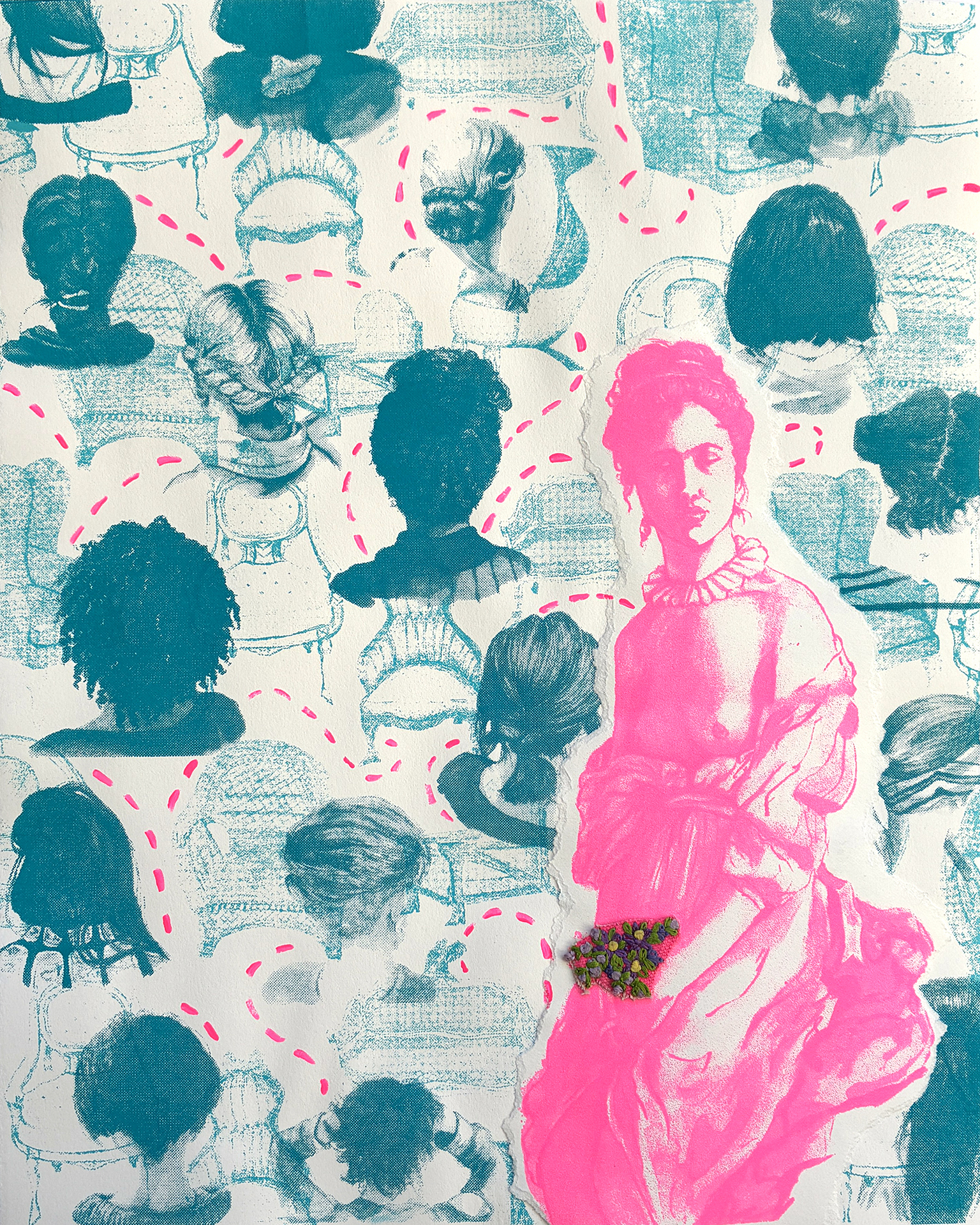
Including My Rage
Screenprint and embroidery
Including my Rage is a layered print that began as a formal exploration and became something far more charged. Drawing from three distinct bodies of my past artwork, studies of furniture, backs of heads, and art history portraits, each image originates as a hand-rendered drawing transformed into a halftone, collapsing the personal and the historical into a single surface.
The silkscreen process builds the composition in stages: furniture and the back of heads are printed directly on top of one another, their forms merging into an ambiguous domestic and human landscape. A vivid pink art history image is then affixed on top, demanding attention, disrupting the layers beneath. An embroidered bouquet is affixed to the print creating a tactile moment that I couldn’t create with print alone.
But the process was not quiet. As the piece accumulated layers, so did my anger at a world where people’s rights are steadily, deliberately erased. The rage did not interrupt the work. It became the work. Every layer added is an act of inclusion: of history, of the body, of fury.
Despite its pretty look and colors, this print does not ask to be looked at calmly.
Becci Spruill

All Together Now
Screenprint and relief with shaped element and velum slip cover
Artist statement text from the slip sleeve:
“This is the original soudtrack to my childhood, created from my memories and conversations with my family. Thank you to my sisters, my mom, and my grandparents for filling my life with song. We had our struggles, but I hope this record reminds you of good times, as rare as they were. Our harmonies are my happiest memories.”
Track list:
Side A:
We Are Family–Sister Sledge
Controversy–Prince
Brick House–Commodores
Brandy (You’re A Fine Girl)–Looking Glass
Sara Smile–Daryl Hall & John Oates
Side B:
Te Quiero Igual Que Ayer–Moncy & Alexandra
So Sick–Ne-Yo
Leaving, On A Jet Plane–John Denver
You Are My Sunshine–Jimmie Davis
Landslide–Fleetwood Mac
Polly Law
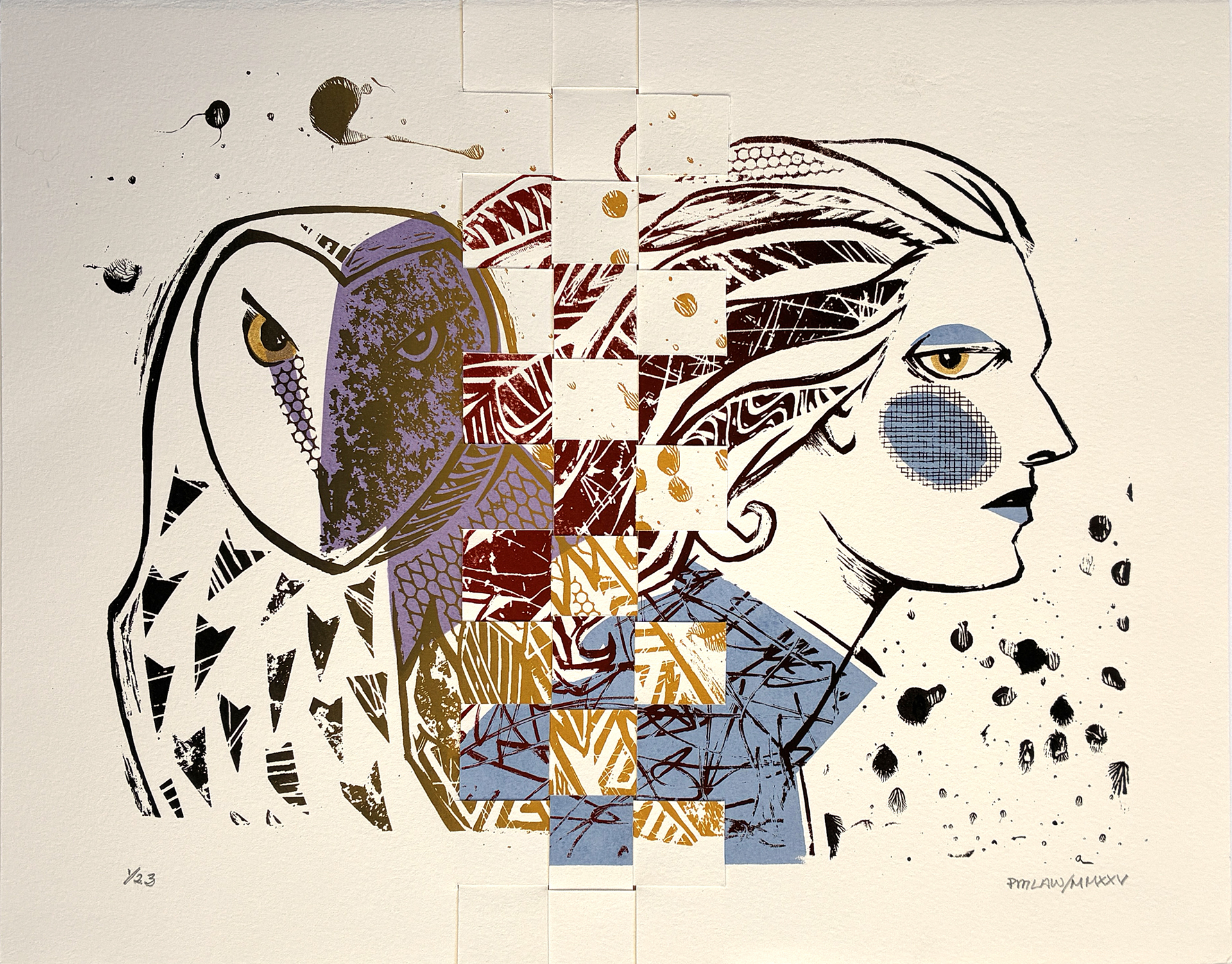
Athena
Screenprint and plaiting
When I first considered the theme of Inclusion, I imagined interweaving as the method of inclusion. I had been thinking about interweaving for a while and this project’s timing was opportune. Then the question was how would the interweaving work best within my visual/stylistic canon of images? I started with “woman” and “bird,” evolving into “woman’s profile” and “owl.” Incorporating my usual grab-bag of visual patterns and textures- lots of small bits of patterned acetate taped to an acetate backing- to create some raucousness rounded out the image.
The technical issues, such as paper- weight, size of cuts, etc eventually, after some testing, sorted themselves out -allowing the assembled print to be relatively flat and uniform.
Mariceliz Pagán Gómez

dichotomous
Etching, lithography, screenprint, velvet fabric, silk thread, seashells
My print reimagines Puerto Rican plant specimens collected in El Jardín Botánico de Río Piedras and El Yunque National Forest, presented through the visual language of herbarium storage. The print uses layering of lithography and screenprint for the imagery of background and translucent gampi for chine colle layers as well as for a protective enclosure. The “specimen” itself is a laser-cut and engraved sheet of kozo paper, slightly folded to evoke the
dimensionality of a pressed plant.
This print explores the concept of inclusion through acts of collecting and preservation: what is gathered and remembered as part of a larger personal archive. The work positions inclusion not only as a physical gesture, placing a handmade specimen within an envelope but also as a cultural one, becoming both an archive and an imaginative space where the presence of Puerto Rican nature and culture is highlighted within a shared portfolio.
Jenni Freidman
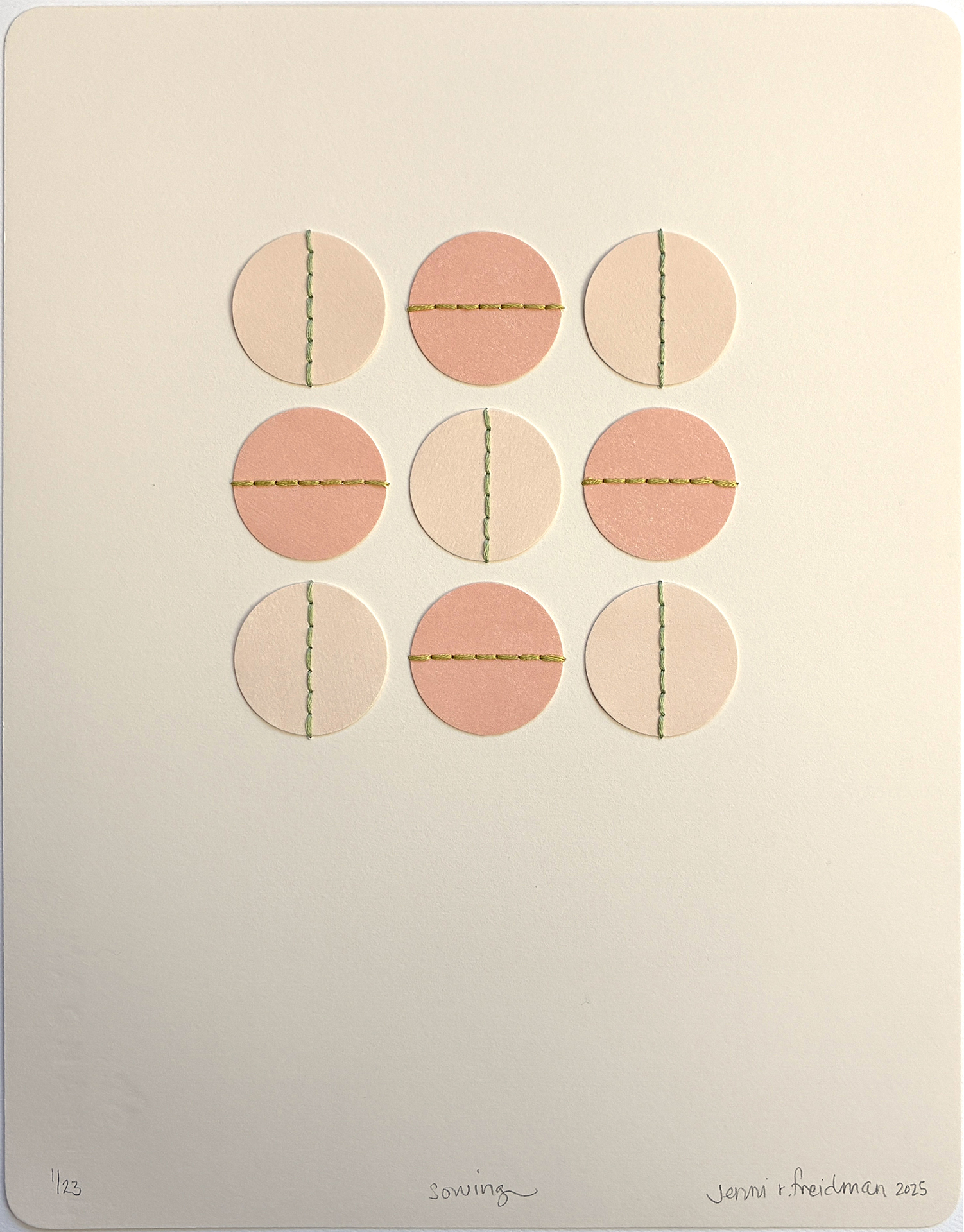
Sowing
Monotype and Embroidery
When I first began making art seriously, I dug around in my memory and used my work to build an understanding of my experiences. The resulting imagery was often melancholy and subdued. Eventually, I shifted my gaze outward, looking to light, shadow and natural forms as inspiration. The making of this work was a contemplative and somber act for me. Following the birth of my child, the mood and rhythm of my work shifted from a quiet mediation to a playful bounce. Inviting in joy was paramount and the work became more celebratory.
A change in career paths created a pause in my work. Little by little, I am finding my way back to the studio and to a new way of seeing. With these new pieces, I am returning to a more meditative practice. I think about my older prints as seeds that were planted years ago and now are being harvested so that this new series can grow.
As it does, life and art come full circle, initial intentions reappear with new clarity. I offer the viewer something lovely to look at and hope they find comfort in knowing that both joy and melancholy will pass with time and both should be celebrated at every moment.
Lancelot Yates

Mollies on the Run
Screenprint and relief
I think a lot about constructed narratives of Queer identity through found graphic ephemera, and those narratives’ relationships to actual Queer history and culture.
The word “molly” emerged in the 18th century as slang for an effeminate and/or homosexual man, and “molly houses” were meeting places where these men would commune with one another, often in secret. While Queer history in general doesn’t have nearly as much scholarship written about these places as it should, there’s even less written about how that history unfolded in the United States up until the Gay Rights Movement in the 20th century.
With this research rabbit hole in mind, I dove back into my treasure trove of Cattleman Magazine issues from the 1970s, allowing its romantic aesthetics of the “Old West” illustrations, movie stills and graphics to spark an imaginative tale based on real history. Suddenly, the grasp of one bandit’s hand on another bandit’s leg as they escaped through a window had new context; the smoldering gaze from a pen-and-ink cowboy, looking at the viewer with a hand on his belt, took on new meaning. The text saying “They Went That-A-Way” had me asking, have I gone “That-A-Way” too?
Dusty Herbig

In Transit
Relief and screenprint
Cynthia Brinich-Langlois
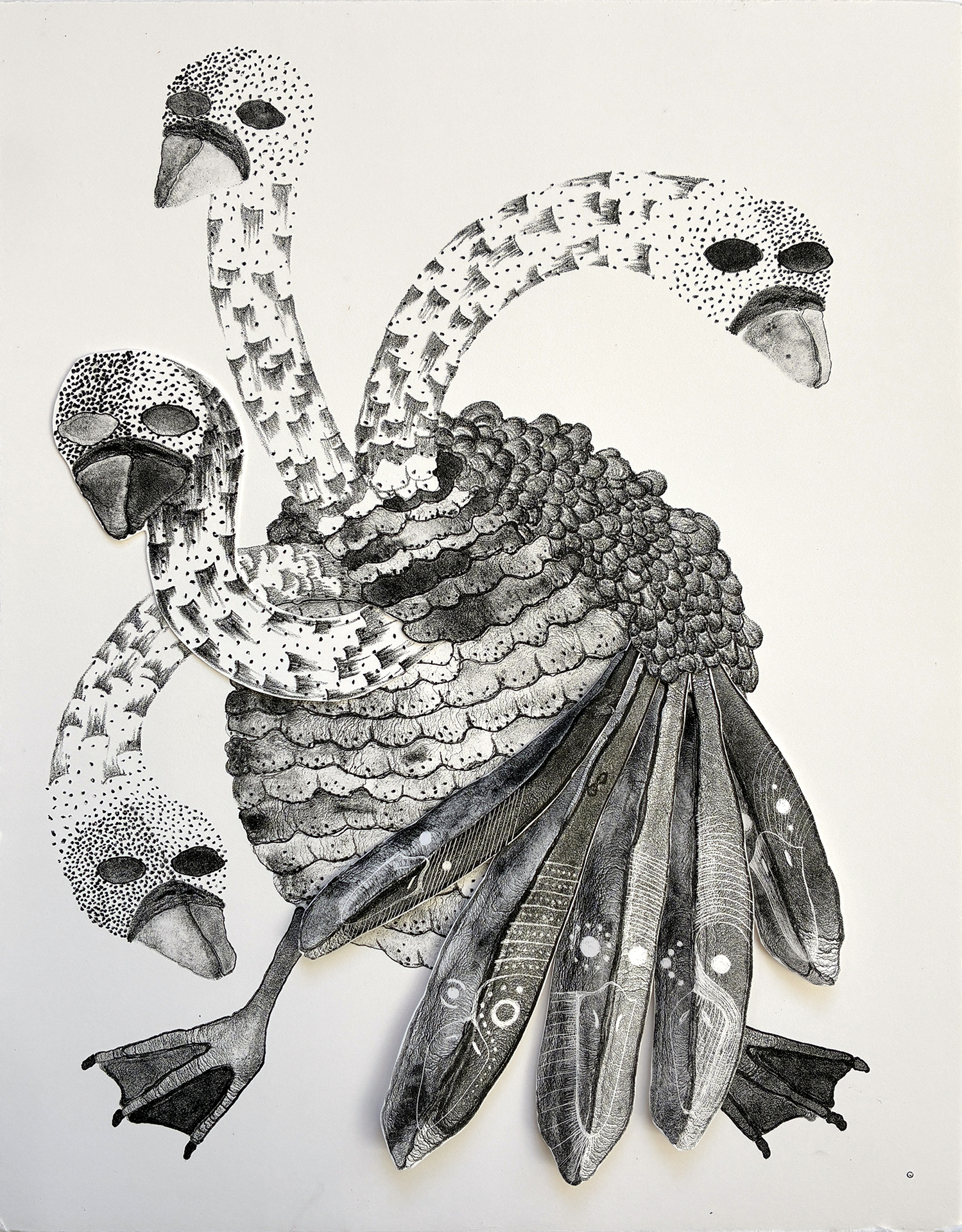
Common Four-Headed Goose
Lithograph with dimensional paper elements
Animals watch us.
Even when we think we’re being subtle and unobtrusive, animals are aware and regard us with caution. They adjust, they step aside, they recede and give us space. But they still watch us.
So in these works, animals stare back at us the same way we stare at them. Their gaze meets ours.
Similar to the snake print above that contains a face scratched into every scale, I will produce a creature composed of many faces, representing the multitude of perspectives and sensory awarenesses that animals possess. The creature will be goose-like, possessing more than one head (either because it actually has multiple heads or because it’s a time-lapse). Many of its face bearing-feathers will be cut from another print and adhered to the paper. I will use= stone lithography, both additive and subtractive processes, to produce a range of marks before cutting and collaging the elements together.
Celeste De Luna

Unsaid
Color reduction linocut
Among my favorite works of Pre-Columbian art are Lintels 24 and 25 from Yaxchilán, which depict Lady Xoc performing a bloodletting ritual by drawing a thorned rope through her tongue as an act of sacred sacrifice. In Lintel 25, that offering conjures a Vision Serpent whose open mouth speaks with the voices of her ancestors. Across cultures and centuries, people have sought ways to reach those who came before them, to make the dead speak.
My work lives inside that same longing, though the rupture I’m navigating is more intimate. Speech, communication, and the failures between them are at the center of what I make. Hearing loss and PTSD have moved through my family, leaving behind gaps in what gets said, what gets heard, and what gets lost entirely. I carry a persistent uncertainty about whether I’m truly reaching anyone — whether my words, like blood offered through a wound, are actually conjuring something.
This image is an attempt to sit with that question.
Lily Jarrell

Curiosity of a Sandpiper
Etching, cocquina clam, handmade paper, handmade dye
My work uses personal memories related to moral development from my childhood, specifically focusing on memories of guilt. My thought is that guilt and shame are some of the strongest memories linked to our personal and moral development. And I have been highlighting three main ways we collect moral growth: innate, taught, and applied morality. For this piece I used the motif of a coquina clam to represent innate morality. Growing up close to the coast of North Carolina any time I would see these creatures I had the desire to rip them open and study their anatomy. But I didn’t because I understood that that would hurt them if not kill them, so I never did. Though I wasn’t taught not to open them and I didn’t perform the action, regret it, and learn from it I understood that I shouldn’t, this understanding of life and harm outside of my own selfish desires was something I was born with.
Candace Garlock
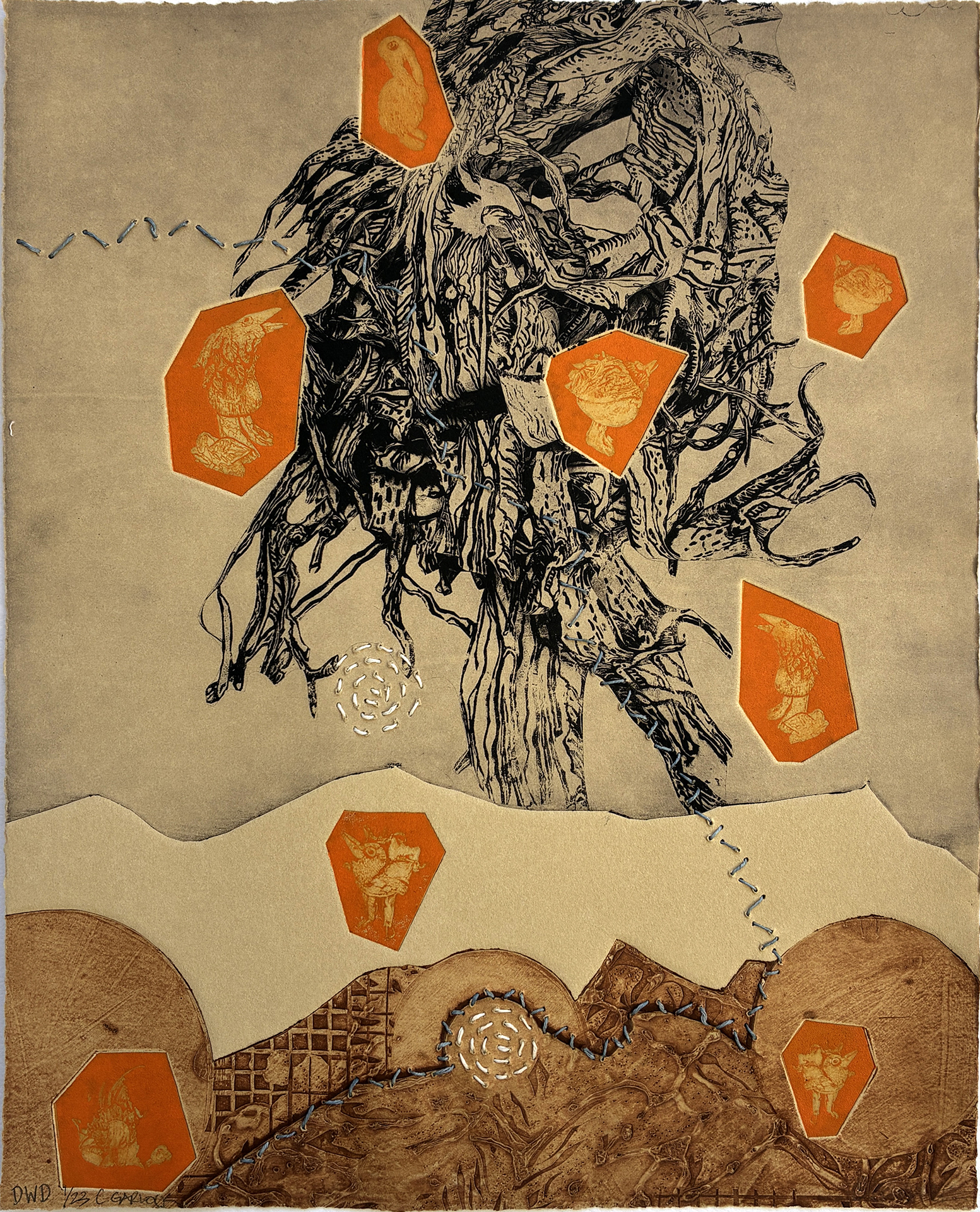
DWD: The day water and dirt divided
Collagraph, photopolymer, thread on Rives BFK Cream
As the story continues on the Road to Terminus…the day water and dirt divided.
There is a legend that the world of fashionistas and bright orange lights broke up into fragments of floating plastic after the water and dirt divided. The water itself, mutated into a tornado-like structure that roamed the earth, sucking up all the trees in its path, decided to deny the dirt of its life source.
As the saga unfolds on the Road to Terminus, we find ourselves in a distant future where civilization has succumbed to the cataclysmic effects of environmental degradation. The once-thriving landscapes that teemed with life have transformed into a stark, desolate panorama, characterized by parched earth and the haunting remnants of a bygone era—scattered shards of plastic, twisted steel, and crumbling concrete.
In this unforgiving wasteland, a unique and eerie society has emerged: the mutated raven people, known as the Corvidae. With their dark, iridescent feathers and keen, intelligent eyes, they navigate this barren world in search of the vestiges of lost humanity—seeking not only the remnants of physical existence but also the echoes of a once-vibrant spirit that thrived in connection and creativity.
Among the tales whispered on the winds of this forsaken land is a legend that speaks of a time when the world was alive with fashionistas and dazzling orange lights, a world that has since shattered into fragments of floating plastic. According to the lore, the vibrant cities of the past were torn apart when water and soil were violently divided. In this cataclysm, the water itself, mutated into a tornado-like structure that roamed the earth, sucking up all the trees in its path, denying the dirt of its life source.
More info: https://
Matthew J. Egan

Immigration
Lithograph
Inclusions in a piece of paper can be seen as an imperfection or celebrated as an attribute. Perhaps elements, marks, and colors in a composition can parallel these sorts of inclusions by happenstance. In my prints, I typically find myself with a collection of images that are inclusions, which compete or become married together by drawing in a single composition to arrive at an unlikely conclusion reflecting on present moments. Presently, it seems we find ourselves in a moment that can be equally contemplated and quite easily seen as either inclusive, or divisive. Through the drawing process, my print for the Inclusions portfolio became a collection of images that developed into a campfire scene – a place that seems inclusive, basic, primal, vulnerable, and ephemeral. This composition borrows the depiction of plastic chairs from Home Depot and a bus used for transportation. It is a collection of images that began with the idea of inclusions and became an image conceding to exclusions.
Doug Eberhardt

Print Gnomes
Risograph
My work explores the intersection of the natural world and the human experience through vibrant, illustrative printmaking. Using the language of color, texture, and visual density, I create spaces that invite viewers to explore, like wandering through a two-dimensional narrative.
Rooted in printmaking, my practice thrives on the balance between process and play. The medium allows me to build layered, colorful environments that range from quiet and contemplative to loud, maximalist, and sometimes humorous. These active scenes that evoke curiosity and reward close attention.
Ultimately, I want my work to take viewers on a visual journey. Not just to observe a scene, but to travel through it, to get lost in the details, to linger in its atmosphere, and to emerge with something new each time.
Delaney Dumm

Soft Spoken
Etching and chine collé
This piece combines intaglio matrices such as copperplate and tetrapak to embrace the variety of intaglio techniques. The doe motif in my work reflects my voice as a queer artist. The composition juxtaposes urban landscapes with organic forms to celebrate the personal journey of seeking kinship and escaping communities that do not fit one’s identity. Living in the south for most of my life and moving intentionally to predominantly queer communities has rapidly changed the course of my artist practice. Photographic elements are etched into the copperplate to evoke feelings of memory. My intention is that each intaglio technique represents a step of this journey that meshes into a celebration of queer artistry and the bravery it takes to share personal identity.
Daniel Dawson

Cloth Cutter
Screenprint on clear and reflective films, relief & lithography on thin, translucent papers, assembled with chine collé and sewn features
As the world becomes more divided a remedy resides within us. We must come together with openness and create a world free of the “othering” that drives some to hatred and violence. However, to realize this equitable existence we must first recognize the ineffable thing which connects us.
Utilizing reflective and transparent materials alongside layered imagery I offer the viewer a moment for literal reflection and integration into a scene that exists outside of themselves but which contains fragments of themselves. The imagery will focus on portraiture with an emphasis on the range of that can look like person-to-person. This play of self and other as the viewer sees their face reflected back, altered by the images of others, should instill a sense of connection with humankind.
I utilize multiple printmaking techniques to achieve these images and to further the idea of inclusion.
Ruben Castillo

Annotations (Schaffer, Jarman, List)
Screenprint
In my work, I investigate, recontextualize, remix, reposition, restate, and replay images of intimacy, archival history, and the body to find traces of queer contact. Print media is at the core of my practice. I construct images using a variety of traditional and digitally manipulated methods to portray scenes or objects that evoke physical, emotional, or psychological responses. Starting with drawing or photography, I’m curious about how pictures metaphorically transform and mediate narratives around queer subjectivity. I am drawn to the slow pull of the quiet and mundane world of domesticity, particularly a world built through a relationship with someone (or something) else.
My recent work highlights material qualities that can be perceived as tactile or felt, creating moments of sensual tenderness and fantasy. I’m interested in both human and non-human traces left in everyday ephemera. Documenting these minor moments and objects builds an archive of feelings, quietness, and suggestive closeness. Pillows, plants, wallpaper patterns, handwritten notes, clothing, and corners occupy these images like figures in a scene. Allowing these elements to collide implies a sense of archival discovery and emergent possibilities while reconsidering historical narratives associated with queer life.
Ariadna Abadal Llobet

Held in Suspension
Laser Woodcut
My piece reflects on the theme of Inclusions by exploring the tension between individuality and belonging. We are all different, yet we share a desire to feel accepted and included. In a diverse society, why do some elements find their place while others remain suspended or set aside?
This work questions the pressures of uniformity while emphasizing the richness of difference. The suspended forms suggest a state of in-betweenness—neither fully integrated nor entirely separate—inviting reflection on the fragile conditions of belonging.
The print was created from a laser-engraved woodblock during my time as a visiting artist at Alfred University. It is printed full bleed on Japanese paper using an offset press, in an edition of 23, produced specifically for this portfolio.
Through vertical lines and floating shapes, I aim to evoke both gravity and resistance, connection and isolation. The composition becomes a space where elements coexist in tension, held together yet distinct. Ultimately, the work affirms that inclusions—whether material or human—bring depth and vitality to what might otherwise remain flat or homogeneous.
Graphic Impressions is published by SGC International. SGC International is an educational non-profit organization committed to informing our membership about issues and processes concerning original prints, drawings, book arts, and handmade paper.
Graphic Impressions Updates
Submissions
We encourage your submissions to Graphic Impressions. Submission types include:
- Feature articles
- Reviews
- Interviews
- Studio visits
- Exhibitions
- Demonstrations or process-based content