
Interview
Exchange: A Conversation with Rajesh Pullarwar
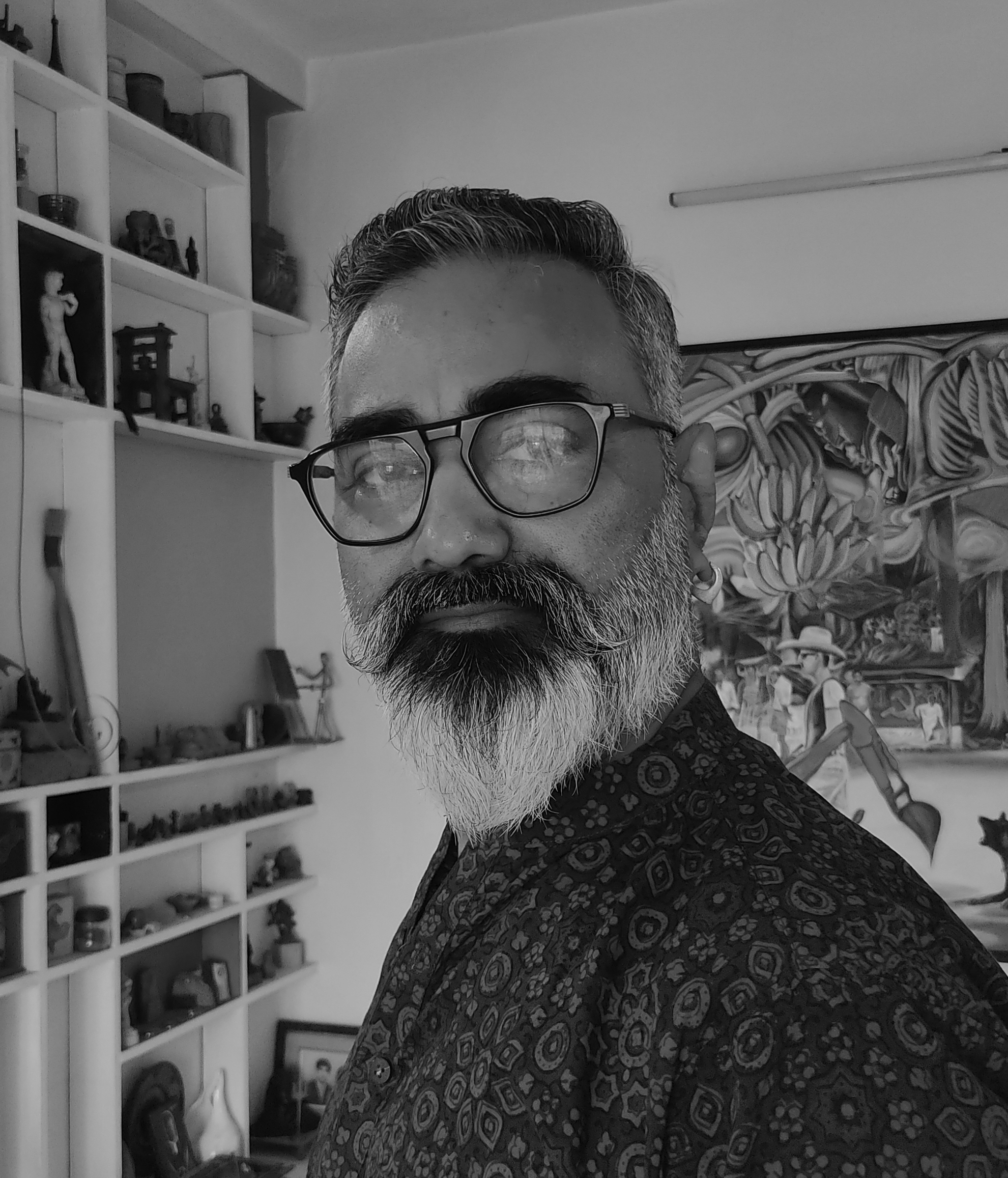
As a founder and director of IPEP India, Rajesh Pullarwar attempts to bring together artists in various stages of their careers on an equal aesthetic footing, irrespective of their works’ commercial value. His idea of artist’s exhibiting their own portfolios, a highlight of IPEP India, was a result of his drive to keep prints out of closets.
As an artist he uses print, paint and mixed-media installations in his work. Rajesh completed MFA from Sir J. J. School of Art in 2002 and was awarded the ‘Most Promising Artist’ of 2005 by the National Gallery of Modern Art, Mumbai. He has several exhibitions, awards and commissions under his belt.
Coordinator’s Note: In early April I took a day trip to Iowa City to visit Rajesh during his residency at the University of Iowa. This was just one of many stops in a loaded tour of schools and print shops around the country and I was pleased that we could arrange the meeting. Little did I know this was his first trip to the States, a shock given the global nature of IPEP India, International Print Exchange Programme, India.
During our chat he shared a lecture he presented that evening. I am including captions from my notes on the lecture to provide context for the artworks below.
To be clear, Rajesh speaks Marathi as his first language, English is somewhere down the list. As we spoke, I was pleased he borrowed a couple English phrases for his lecture. The following interview is pulled from our conversation. It has been lightly edited for clarity, though I attempted to retain the cadence and spirit of the chat out of respect for Rajesh.
The Interview
Blake Sanders: Do you recall when you first became aware of printmaking as a means of production when you thought it could be, and when maybe you decided it was something that could be for you and your practice?
Rajesh Pullarwar: I wanted to be a doctor, but the situation was not in my favor because I was brilliant, top student in secondary school, but didn’t have the opportunity. But I used to draw. I love to draw. In India, if you are drawing, you’re a painter, or you are an artist it doesn’t have any value as such. If you’re a doctor, engineer or something like that and you are getting a lot of money, then it has value. I didn’t get money to get admission into medical school, so I stopped going to the school.
Then I came to know one fine day that there education, there’s an education in Art as well. So I ran away from home to Mumbai. I did my undergraduate and advanced degrees in Mumbai. Still, there was a lot of illiteracy about art in India. Printmaking is another thing. When I came in the college, only then did I come to know the names of the colors. Before that, I only knew about gouache and watercolor. Then I entered college and everything was surprising because nobody had been there to teach me about art before. Art school gave me a lot of opportunities to learn as I studying, I came to know about printmaking and was drawn to it because print requires a lot of technical mathematics. Mechanical knowledge. My father was a retired mechanic, and I used to work with him. So I had that ability with technical things in my blood.
I started to use print tools and machines so well that my results were stronger than in painting. With print it was fun to be in suspense about how the result will be. So that made me curious and made me work a lot. Since I was from a science background I used to do more research and some experiments in skills like screenprinting and other other things. I did not follow only the traditional methods of printmaking. Now I think it was a good move. I leave everything to nature. If they allow me to flow like this, I’ll do it. I only knew I had to flow. Otherwise, I’m not deciding who, what will be the next thing. [this allowance for chance and fate is a theme throughout the interview]
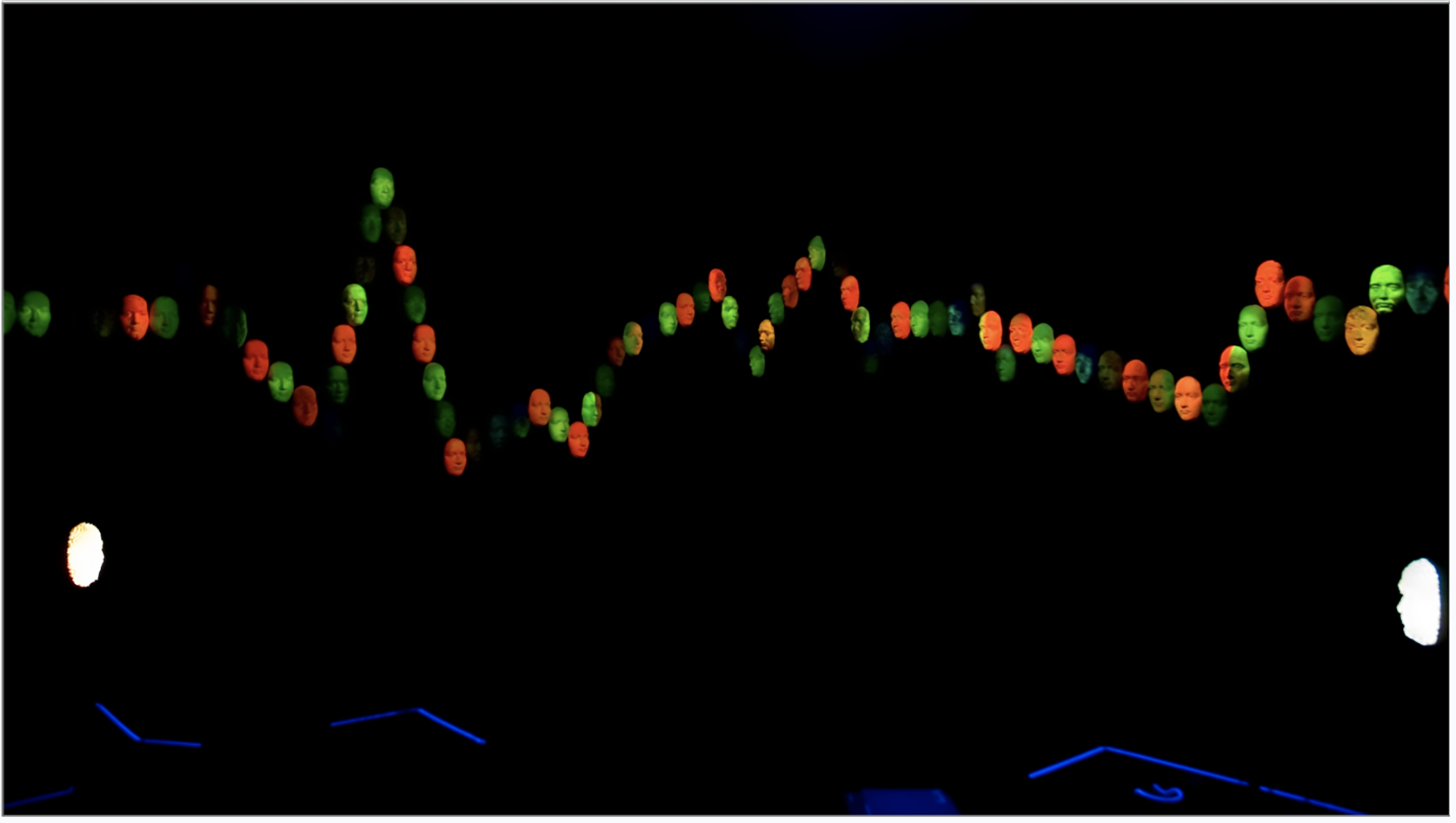
Racing Pulse
Site-specific installation at Art India Magazine space. Curated by Mortimer Chatterjee
2006
This relatively early installatin is filled with dozens of faces composed of cut plastic, arranged to look like a EKG reading. Work during this period revolved around the release of emotion, particularly anger, to lead to greater harmony.
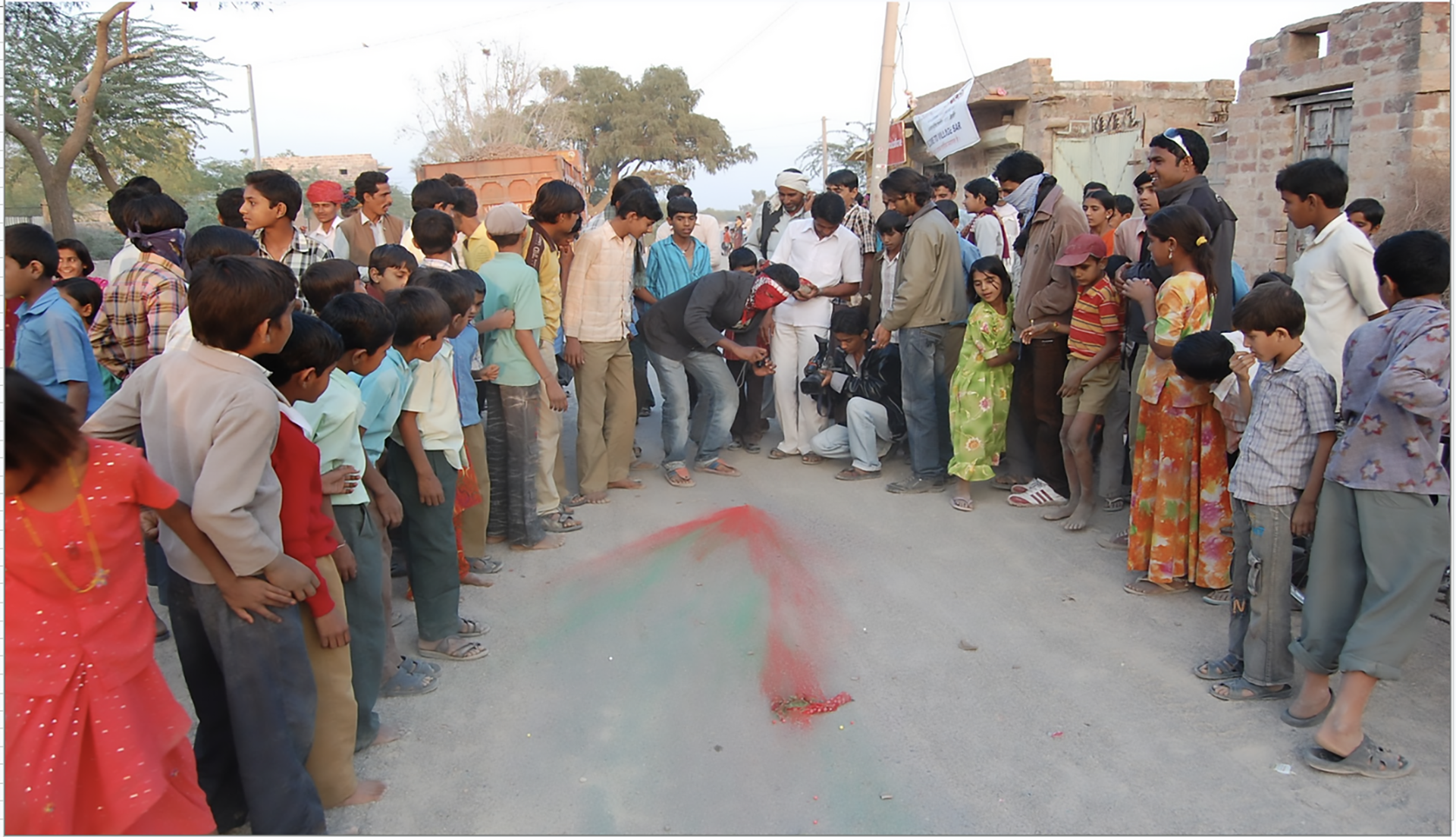
Don’t Worry Be Happy
Interactive performance at Sowing Seeds Art Residency
This piece is a reimagining of a ritual where mourners spread the ashes of their loved ones. In this case, jars are filled with pigment and participants are asked to shatter them on the ground, scattering the pigment, and their negative feelings with the wind. The performance provides catharsis while creating beautiful atifacts of the release.
BS: I wanted to ask this question about visiting the US and how your global travels have nurtured your practice. I didn’t realize this was your first time in the States. So maybe this is a question that’s more of a prediction. How do you feel this trip plays into your interest as an artist/activist? How are you tailoring this trip to assist and inspire your work?
RP: Okay, great. This is the most important question, because this is what I realized. First thing, we have limited resources in India. In printmaking, in painting, in libraries and many more things. Here, when I arrived on this first trip, when I saw everything, I thought we are nothing compared to this institution because we have not promoted art in the manner that government should have. Even technologically. When you see the value of something, you start investing in that. If you don’t value that thing, then you, and even the government, don’t try to promote it. And it’s vice versa. If it isn’t promoted, it can’t be valued. This is a catch 22, I think it’s called. So government is not also working to promote the arts and so artists are not showing their potential as well. Okay, the resources and technology in printmaking in the US education system is far and away better. We are far behind. So, I learned a lot of things about how the materials, instruments, machines are important to produce good art. I like learning, machine learning, and the discipline. I have been recipient of learning from everywhere. Everything was new for me when I touched down at the airport. Everything was new. I become a kid trying to learn everything. That was fun. Being a kid and learning new things and revising everything. Again, unlearning the things. First, you need to understand and then you can access it, uh, accept a new thing. Otherwise, it will be missed. So this happened here. I learned so many things, I’m so motivated that I’m taking things back to revamp my studio. If it is possible. There’s big motivation.
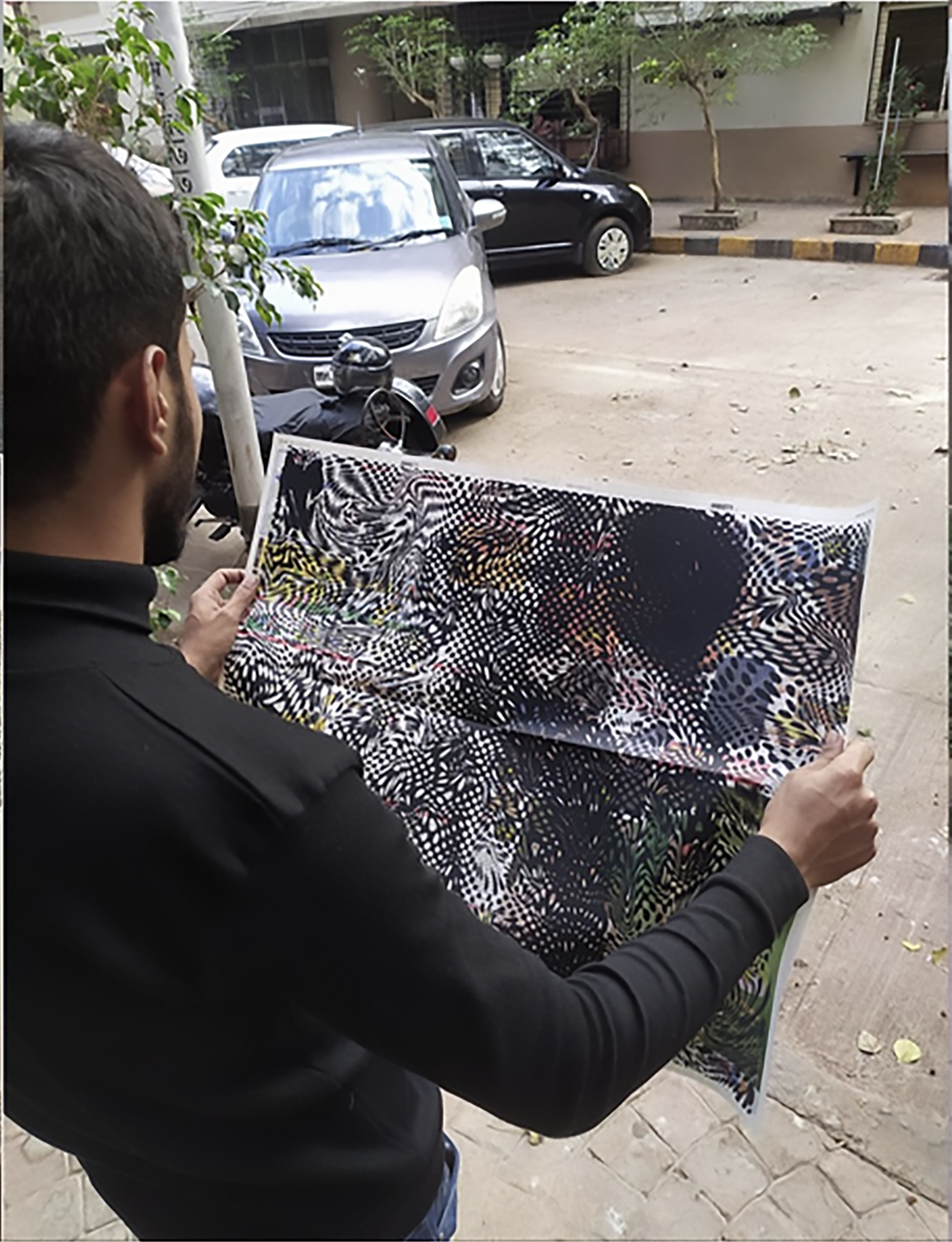
Mute Spectator
Public interactive Installation
Screenprint on newspaper
This project is representative of a body of work highlighting media censorship and enforced governmental media purity. Found newspapers were screenprinted with imagery reminiscent of envelope security patterns. Hidden among the pattern is an image of a bathing nude woman. The result is a commentary on the resilience of media dissemination.
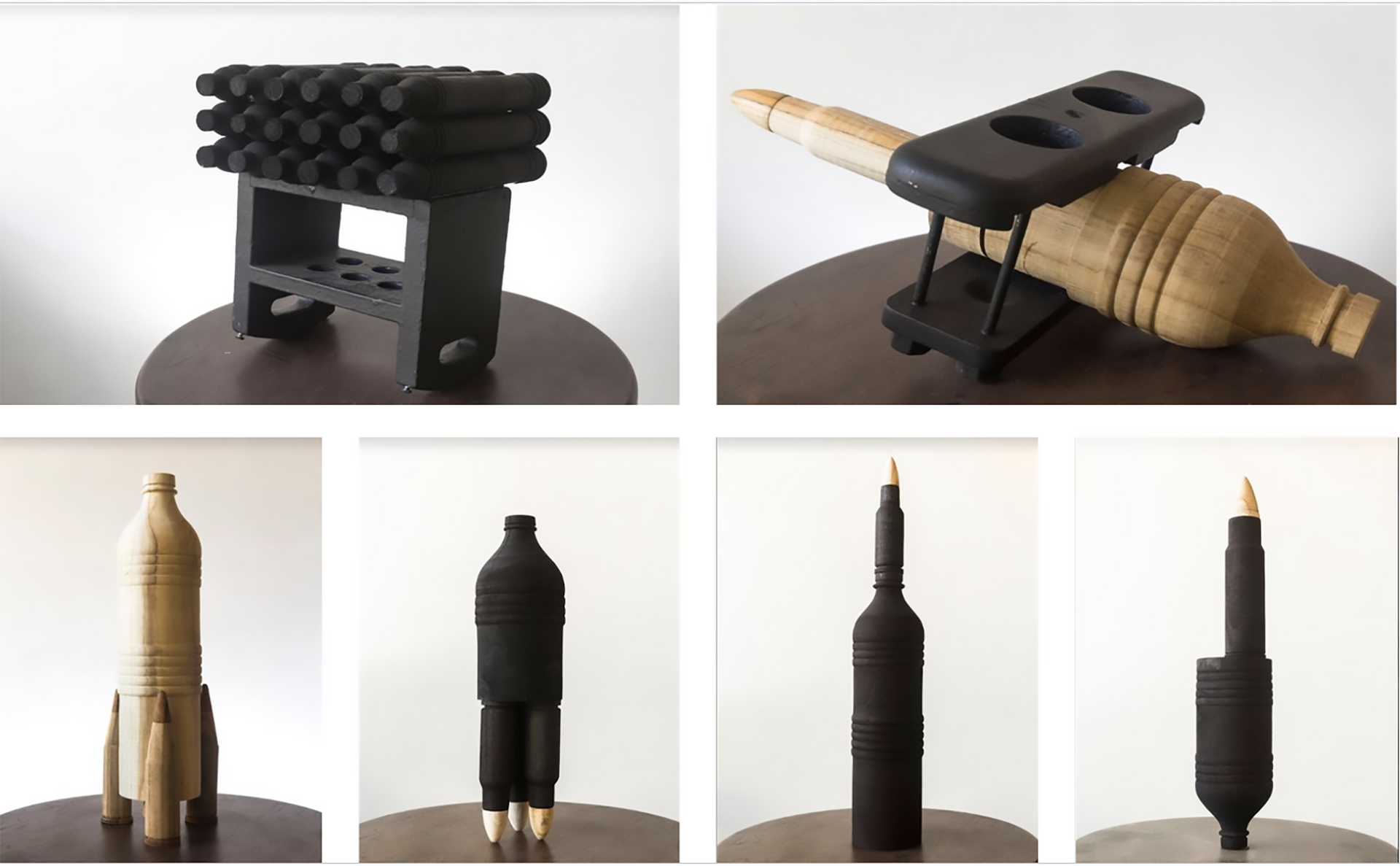
#WarToys
Wood
This project was inspired by a recent conflict between India and Pakistan, where India effectively cut off a primary water source to exert influence and have a bargaining chip over their regional enemy. These weapons of war are based on plastic water bottles, referencing the inevitability of future wars around water rights, and how contemporary waste has led humanity to this conflict.
BS: I’m really glad that you walked me through your talk for this evening, so I could see the diversity of your work, the number of techniques, and mediums, and the experimentation in practice. You work in all sorts of manners. In painting, in printmaking, in mixed media, in sculpture. How do you integrate those processes, those mediums, into a cohesive whole? That could be literally, physically, or conceptually/metaphorically.
RP: I can sing if it requires. I can dance if physicality is required. This is a medium of expressions. Which medium does the most justice to the thought? If this thought can pass through speaking, I think we should speak. Through performance, we should perform. By the video, by the painting, by the print. Accordingly, I work. I am an artist. So all mediums are for me. I’m not bound to one thing. I like a big definition of an artist. In the pandemic I used social media as a platform. When I think we need a platform for global printmakers, I initiated IPEP. Many more things happen in that way.

During the pandemic, with typical art venues out of reach in India, Rajesh moved his practice to social media to exchange with his audience. The lockdown in India was particularly stringent, but the country chose to help fly foreign nationals back to their home countries to wait out the pandemic. However, they were less generous with the Indian migrant laborers who were stranded without resources in the major cities they helped build and maintain. Thousands attempted to travel the hundreds of miles back home on foot, only to be thwarted regularly by authorities.
To aid those migrants Rajesh pulled funds set aside to remodel his home and instead began an improvised soup kitchen, feeding thousands over 28 days before the local government shut him down. The experiences with these forgotten laborers continues to fuel much of his work.
This digital college imagines how those contrasting government responses could have coexisted.

Rajesh printed these masks and distributed them during the pandemic. The zipper is an allusion to government censorship generally, and the suppression of the voices of laborers and migrants specifically. As the zipper opens the teeth become lines of anonymous laborers.
BS: That actually plays into my next subject about IPEP. It rose out of a desire to serve and draw together the print community, right? So, let’s talk about IPEP. You found it in 2013. It’s this expansive portfolio exchange. And one of the reasons I was pleased to be able to participate is because it asks the participants to exhibit the portfolio in their home area. Which I think is really smart. It’s great for, say, the academics who want another line on their CV, but it’s a great way to do what print is meant to do. It’s not supposed to just live in a box once you get the exchange. It’s supposed to be seen by the people.
RP: I said earlier that artists should come out and speak loud. And printmaking has that sharing capacity. Why did I initiate IPEP in 2013? In 2000, I went to a big studio in Singapore. I had asked them for the recipe for a material, because it was well equipped studio, which was not available in India. So I wanted to learn something. But after so much discussion, they refused. I was sad. When I was denied, from that day, I never demanded anything of anyone.
I’m fortunate that I did my work so much. And I’m so fortunate that Iowa University invited me. Thanks to all of them. That they saw the potential in me. Simultaneously I am aware of the exploitation of an artist and want to help. Especially printmakers. All over the world, many institutions create portfolios. They ask for the fees. The artist has to pay the fees and their studio, for the electricity, for the rental and the paper and the ink and the machine, and then they curate it for the courier. The institution gets that edition and send it back as a portfolio. There will be maybe one exhibition. So it will go in the dustbin directly. Artists are paying for everything. And if it gets sold, then there is perhaps a commission from the institution. If it doesn’t, then artist is only made for exploitation. I thought it’s a bad deal, if the institution is working. So I thought, why not to do something by the artist, for the the artist? It’s very democratic. IPEP doesn’t ask for fees. Sometimes we ask for extra prints, that is very limited, which goes for the curator and the people who are who are giving their service. We are giving them a print. We prefer to barter, when participants share their portfolio, they barter. Even the exhibition exchange is bartering. Right. If I am putting on an exhibition, I am putting it on for the 39 people in the exchange. And somebody is doing another, the 39 other artists. So this works on trust. How many people desert, and don’t produce a show? That’s a different story, but many of them do follow through and they did something for their art and for the others.
This is such a great idea. IPEP was very small in the beginning. I started from my home, the 1st exhibition was in my home, and then it turned so big that we had 10 years of celebration. And we had big, massive exhibitions in the Bihar Museum, Patna, and the Chandigarh Museum. Something happens when you, uh, thinks and you do from the heart. We are not asking for the money and we are not asking everyone to spend the money on their exhibitions. If they have money, or they can get sponsorship great. Even if that’s not possible, they can take their portfolio–we design the portfolio in such a way that it can be taken on your back–and take it along with you and hang it with thread to do your exhibition. The only thing we ask is that you should celebrate printmaking with 15 or 20 people at least. You should celebrate. Otherwise, it’s useless. We should have a dialogue. This is a way to stop the exploitation and give the platform to the international artist. It is not necessary that all artists are financially well equipped.
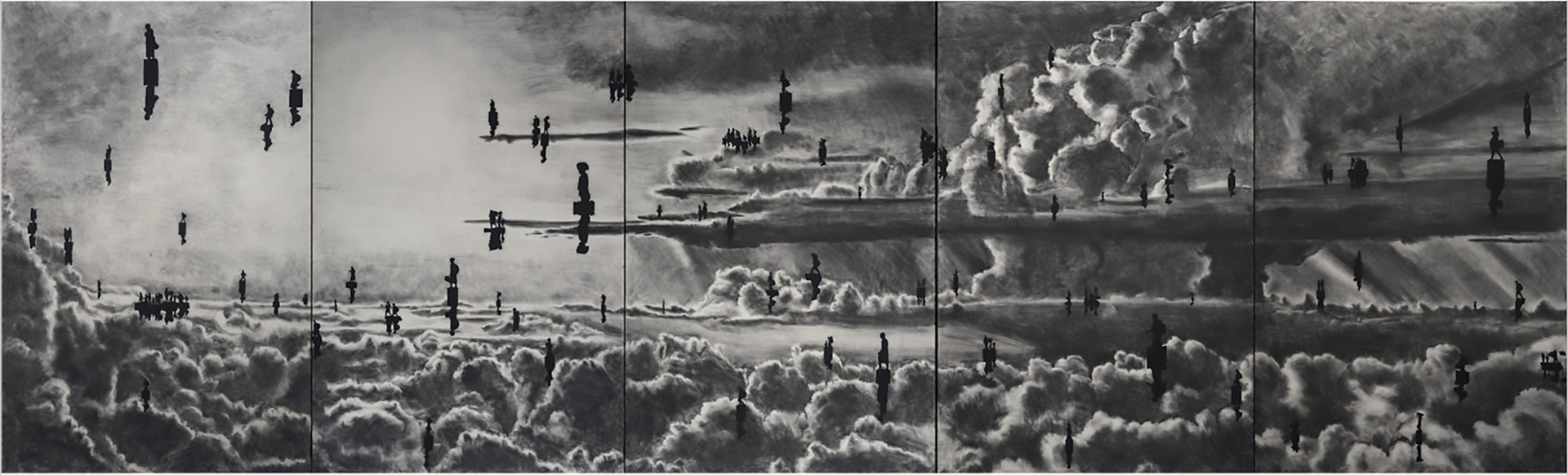
Apne Hisse Mein Suraj (The Sun in Our Share)
Charcoal on Canvas
5’10″x19’2″
2025
Hindi Poem by the late Vinod Kumar Shukla
(Translation)
People look at the sky that belongs to them, and they see the whole sky.
The sky that belongs to each is the entire sky.
They look at the moon that is theirs, and they see the whole moon.
The moon that belongs to everyone is that same full moon.
Each one breathes, somehow, their share of air—
the one sitting in a garden at home, reading a newspaper,
and the one surviving amidst stench and filth.
Yet, the air that belongs to all is not the same air.
With their share of hunger, not everyone receives their full share of rice.
The bread you see being baked in the market’s oven—
it is not bread for everyone.
The time that ticks on every clock
is not the same time for all.
This time.

Modus Operandi II
Encaustic
The repetition of the cast shadows of the migrant laborers locks the figures in place, referencing their lack of upward mobility. Rajesh pointed out that this composition evokes a spinal column, indicating how integral this unrecognized population is to an outwardly thriving India.
BS: What’s coming up on this U.S. tour? You’re here in Iowa City for a handful of more days. What’s the next stop?
RP:I was in Chicago first, and in Knoxville, at University of Tennessee, for the talk on IPEP. And here in residency I have a good residency. I did some prints in screen printing, then mezzotint, and intaglio in etching. I’m doing some monoprints as well. I’ll do 2 presentations. One on IPEP and one on my own work. After that, I will go to New York City for IFPDA and Brooklyn Prints. They invited me for the opening and other things. Then I will have a workshop at Robert Blackburn. Then I will go to Baltimore. Then Washington Print Group. They are also having some workshops and talks. So in Baltimore I will meet a few artists who participated in IPEP and I will stay with them. Same in Washington. Then I’ll go back with a lot of memories and a lot more work to do with the inspiration.
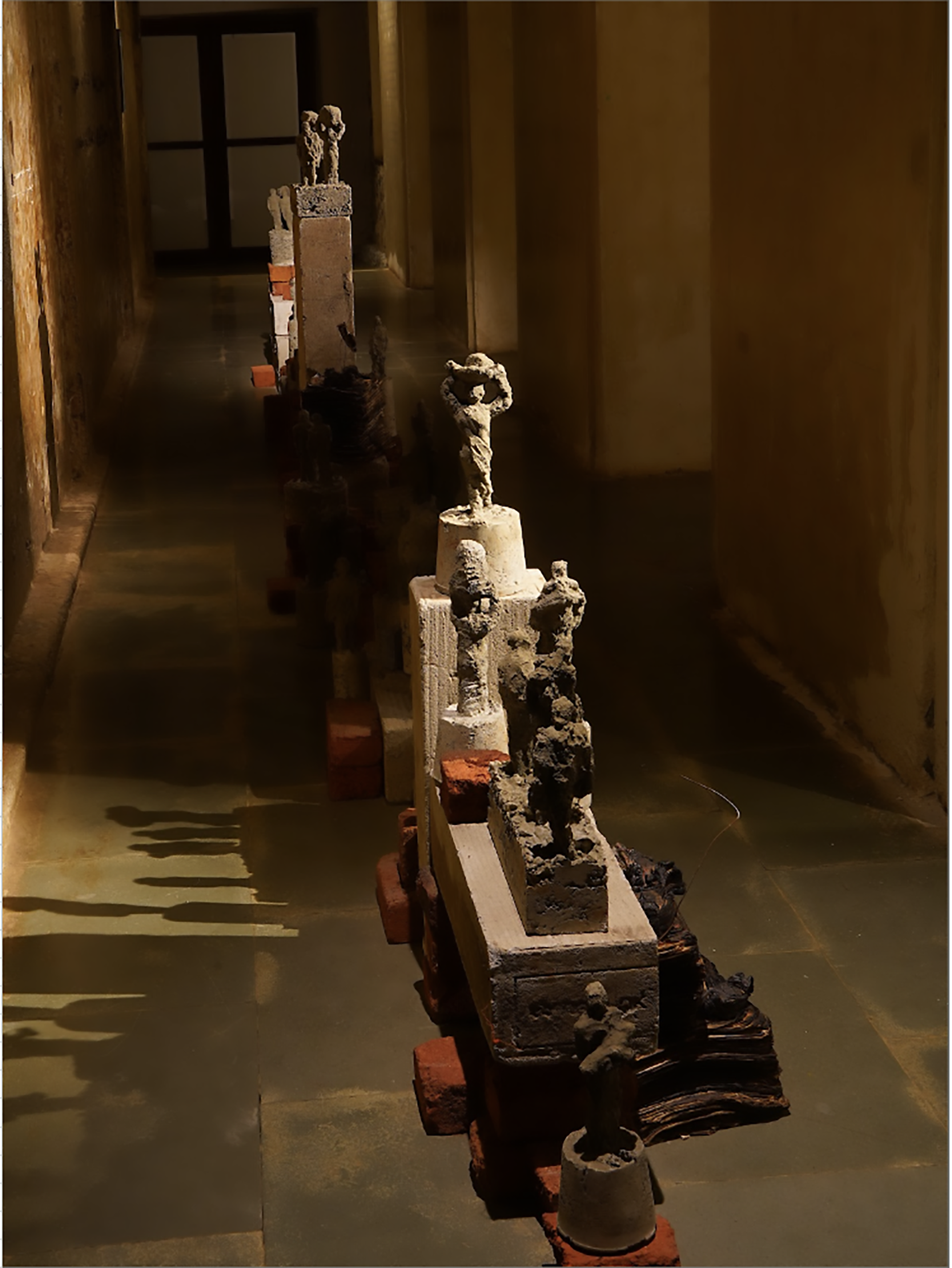
This installation depicts anonymous laborers, cast in concrete to reinforce their stuck place in society. They are surrounded by building materials to show despite their limited access they are responsible for building and maintaining the cities they inhabit. Among these figures are books burnt by candles, encased in their wax, showing the destruction & censorship of information and the way it entombs the culture.
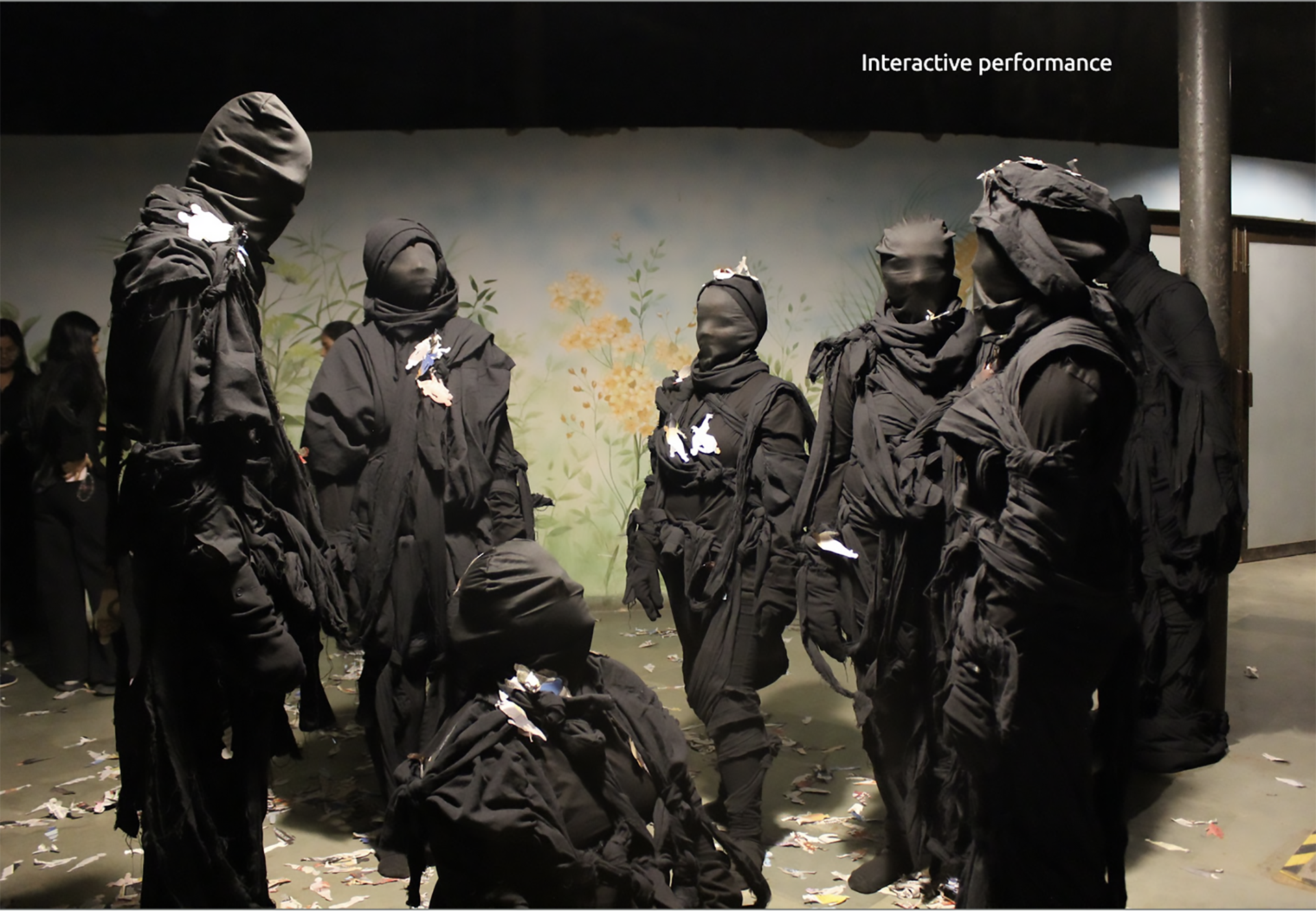
This still from an interactive performance, peopled with Rajesh’s sculptures and prints, highlights the anonymity of class, and the media censorship prevalent in modern India.
BS: Through IPEP, through your sort of connections, you’ve created a strong matrix of international printmakers. How would you like to use that matrix, those connections and experience to further global print partnerships?
RP:With IPEP it’s true that I initiated it, and for two, three years, I did it on my own. Now I have a great team with me. I have made a few friends and well wishers who believe in contributing something to the world. I never planned my life. I just keep working. I believe that working leads to moments, but if I plan something, then what will be next? Expectations can lead to frustration actually. If you do not choose, then sometimes you get the opportunities. Life is like that. I do work hard. I am just working and the things are coming up, so I just collect them. IPEP came from working.
Another good thing, we didn’t think would happen happened. In IPEP’s ninth year, I said in a meeting that we should have a 10 year celebration. My team said how it is possible? I said, let’s see. There’s no planning, nothing. I said, let’s see what happens. If it happens or not we will accept it. Suddenly, one fine day, the director of this museum came to the studio and he said, Rajesh, would you like to exhibit your portfolios in our museum? I said, okay. This is the example I’ve given. Okay. Then I just fly flew for a picnic in Simla. I went to the Chandigarh Museum and they offered me a show. I didn’t say anything.
If the work is there, there’s this energy, this law of attraction, and things happen for you. When we are open for everything. Especially when what you do, you do for the people, for the artists. We have collaborated with so many people in between. Like, for the book [For the Love of Printmaking, published in conjunction with the 10 year anniversary of IPEP] we collaborated with so many artists, institutions, designers. All of this happened when we didn’t ask.

A new screenprint made at the University of Iowa
BS: Are plans in the works for the next iteration of IPEP?
RP: Yes. After the 10th year, we have decided to do alternate year portfolios. In this format, we are thinking to organize and curate the portfolios in the first year, then we will work on the philosophy, on the text, and the study and research of printmaking for a symposium. So we can work on the symposium, we can work on educational kind of things. Both are education, but here, here will purposefully focus on the text. The symposium will have speakers, there will be interactive session, there will be workshops, there will be something which can educate and boost the mind.
So this year we have invited Professor Anita Jung as the IPEP 2026 curator. Just now, I created the message, which I am going to blast on the social media. She is, you know about her, she’s well learned, a good teacher, and she has good relations. She has very good knowledge.
Since I was here, so we had a lot of discussion and these things. Before I came here, we asked her, and she happily accepted. So this year, uh, the theme will be related to AI and machine learning. How AI and machine learning is impacting humankind. How it is good and bad or whatever. How artists are taking it. How humanity’s systems will go down, or will be raised by AI, or will be controlled? Okay. So it is related to sovereignty, science, ecology, social concerns. Many more. It seems today you need a device without a device, you can’t do anything. If the AI controls writing controls you, then the device becomes one with your body. It’s another limb. And perhaps the system will fail one day. I don’t know what will happen, but this is our subject. People will start connecting with this.
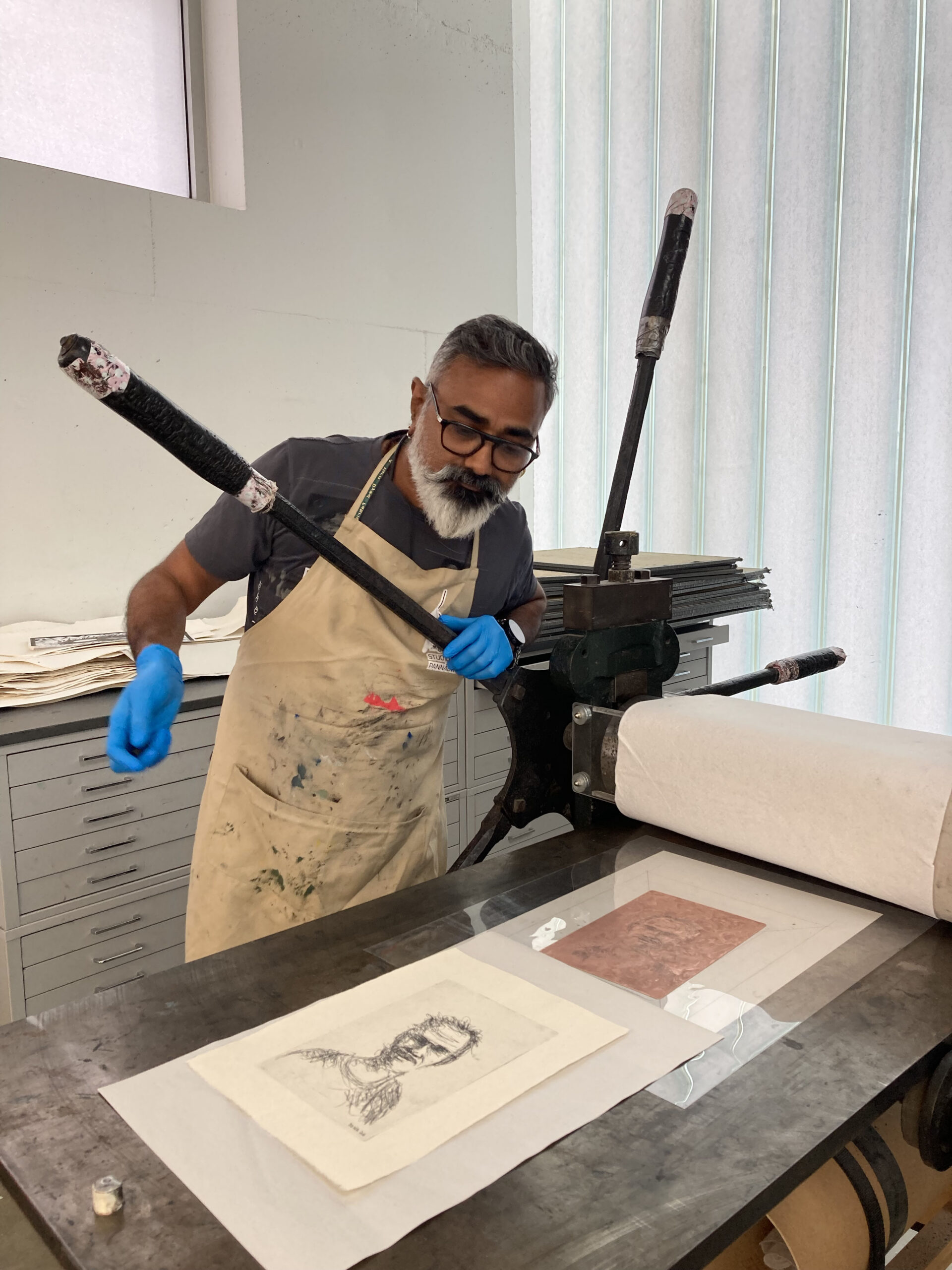
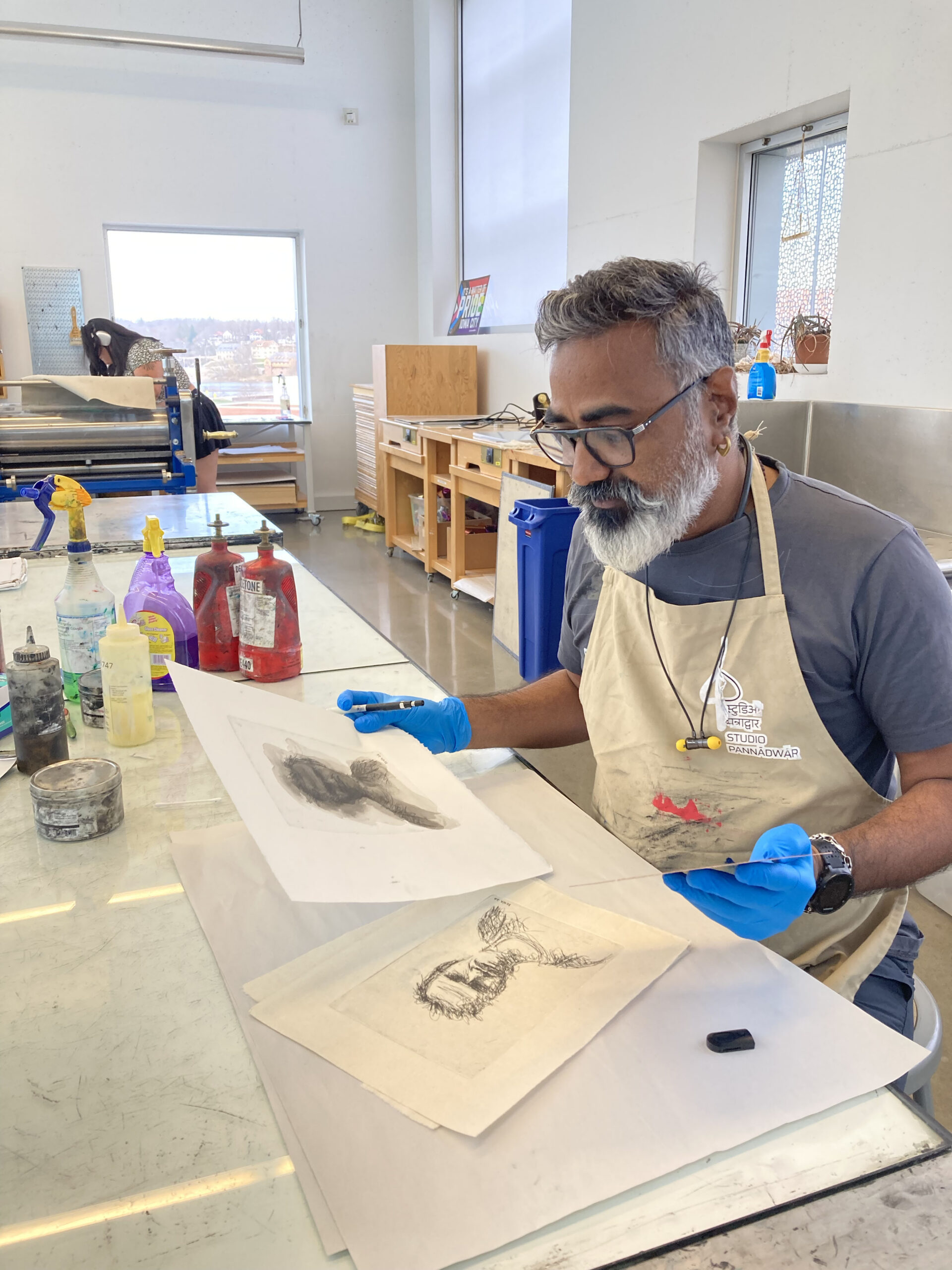
Rajesh pulling an etching at the University of Iowa