
Interview
Animated: A Conversation with Nathan Meltz

Nathan Meltz uses printmaking, animation, sculpture, and performance to comment on the infiltration of technology into every facet of life, from politics and food, to family and war.
His solo exhibitions include the gallery at Atelier Presse Papier, Trois-Rivières, Canada, the Shircliff Gallery at Vincennes University, Indiana, Southern Illinois University’s Vergette Gallery, GRIDSPACE (NYC), the University of Florida – Jacksonville’s Andrew Brest Gallery, and more. His international exhibitions include the 2024 Taiwan International Print Biennial, the 16th International Printmaking Triennial Graphica Creativa Triennial, Jyväskylä Art Museum, Finland, and the 8th edition of the Graphic Art Biennial of Szeklerland, Romania. His art has been featured in publications including Art in Print, Printeresting, and the Mid America Print Council Journal. His series “Strangling the Fascist Viper” has received juror awards from the Louisiana International Printmaking Exhibition and the Political Impressions exhibition at the Rochester Institute of Technology, the Printworks Award from Artists Image Resource, Pittsburgh PA, and the Prix de Print award from Art in Print Magazine. His recent printmaking/animation hybrid work “The Golem Trilogy” has screened internationally at film festivals, earning the Special Jury Mention award at the Electric Dreams Film Festival in Milan, Italy.
Meltz is a Senior Lecturer in the Department of the Arts at the Rensselaer Polytechnic Institute in Troy, New York, and is the founder and curator of the Screenprint Biennial, a project highlighting the medium for over a decade.
Artist Statement
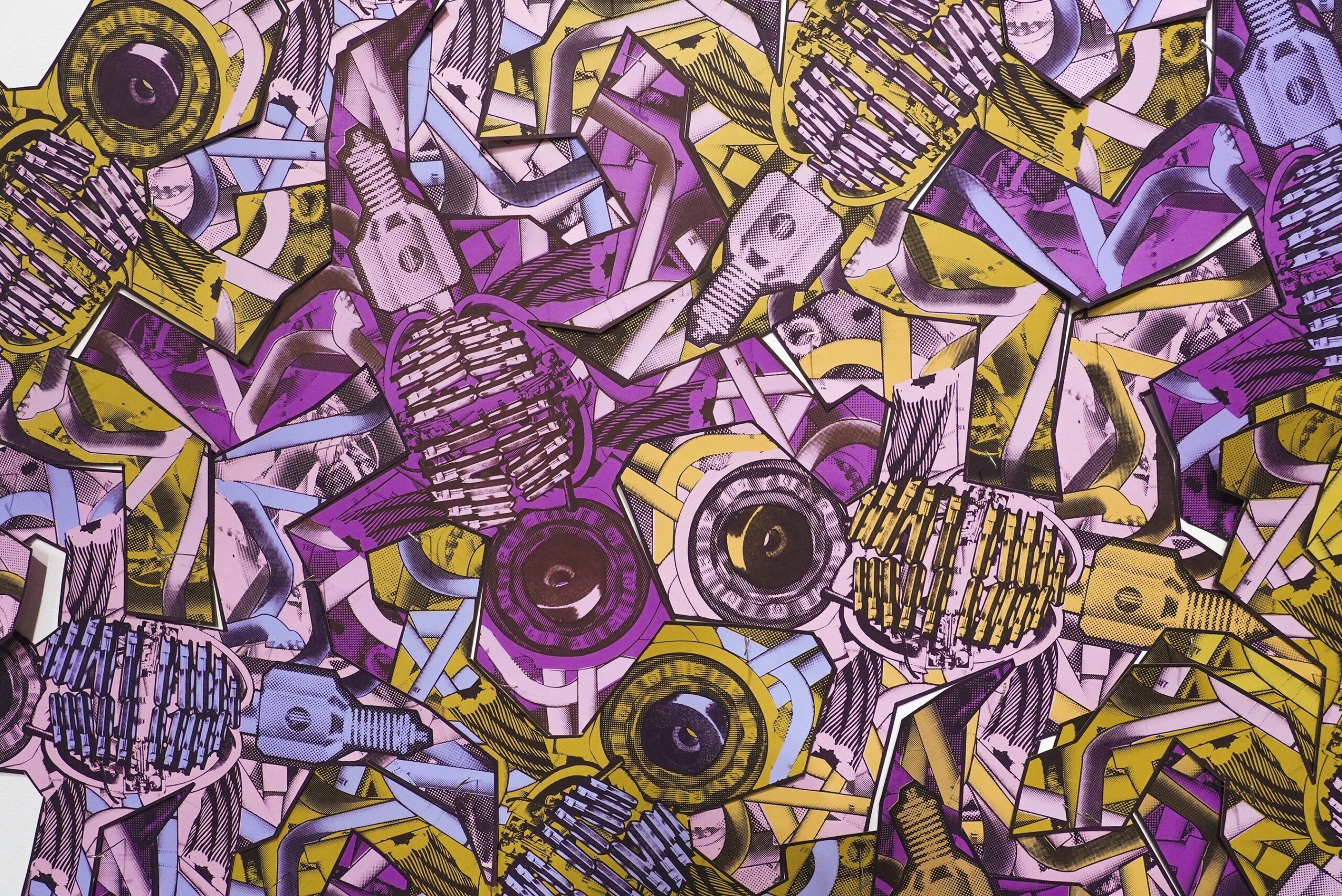
Part critique, part fascination, the art I create examines the infiltration of technology into every facet of our lives, from family and food to politics and war. Nightmarish industrial creations are set against images of grand mechanical constructions, an off-kilter vision of technology. In my visual vocabulary, the contemporary world of nanotechnology and genetic modification is retrofitted with collaged analog machine parts. Collages of mechanical humanoids and animals turn into printmaking, animation, and sculpture, as I create visual narratives telling the story of a doomed robotic populace in a techno-dystopia.
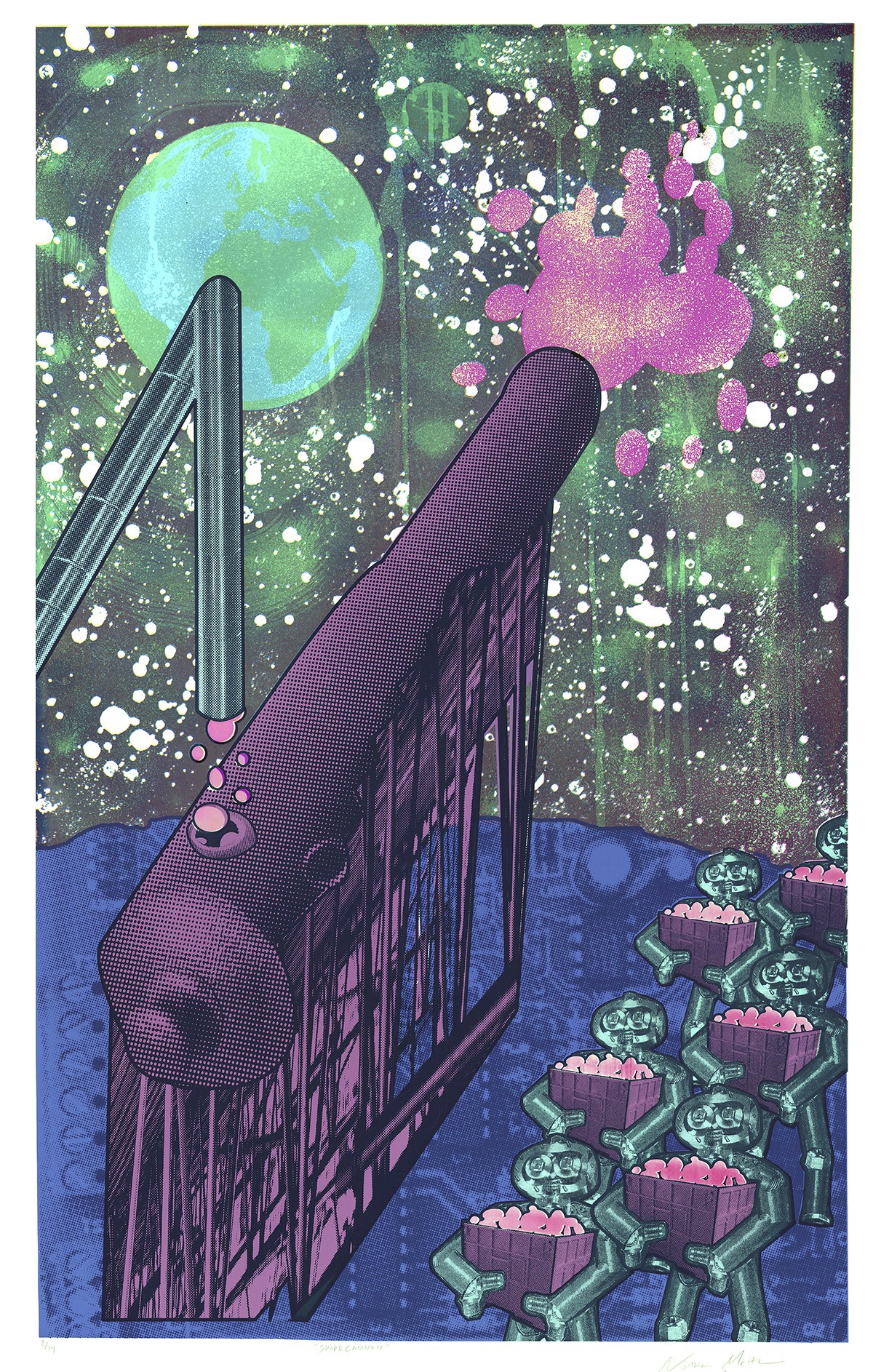
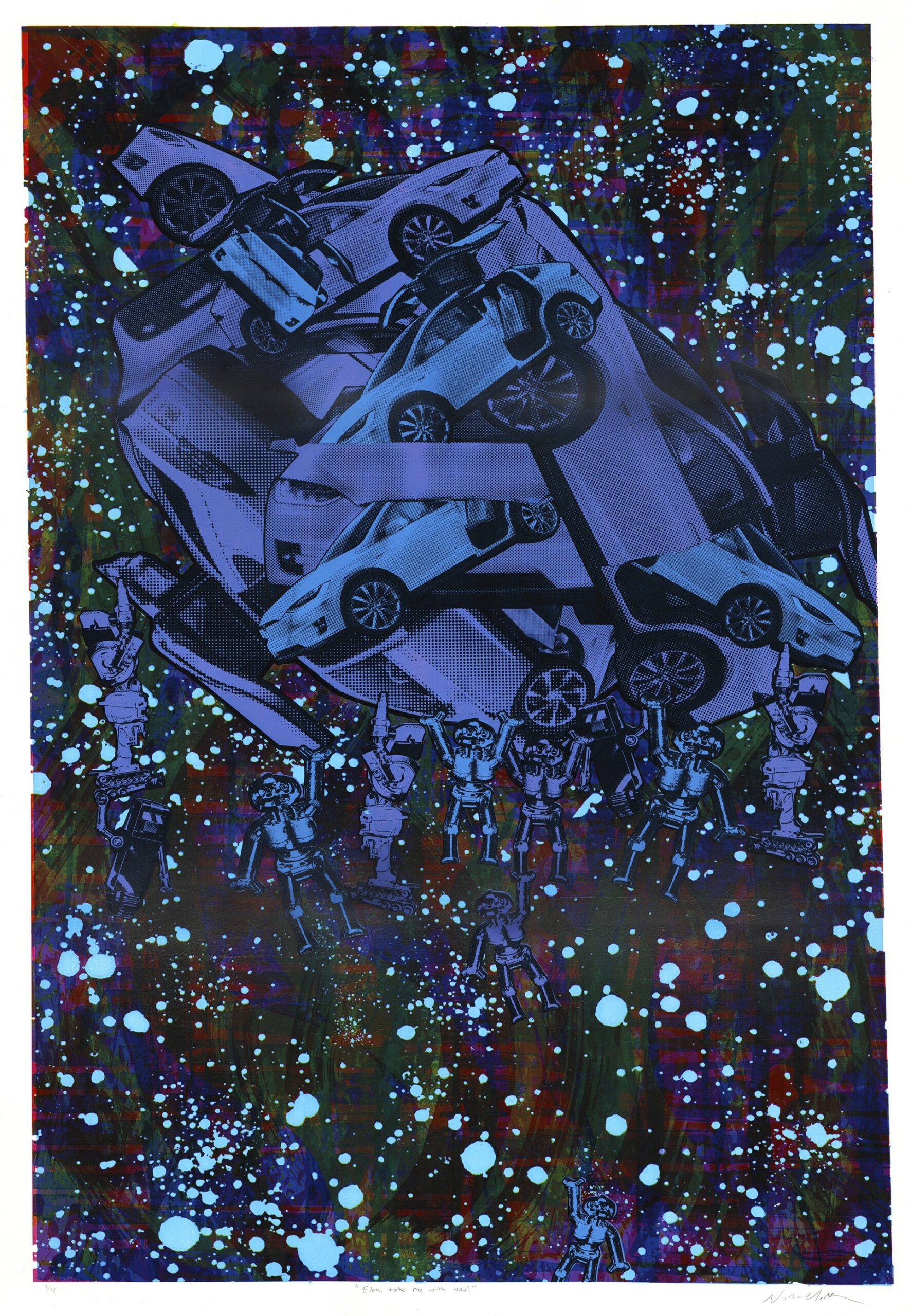
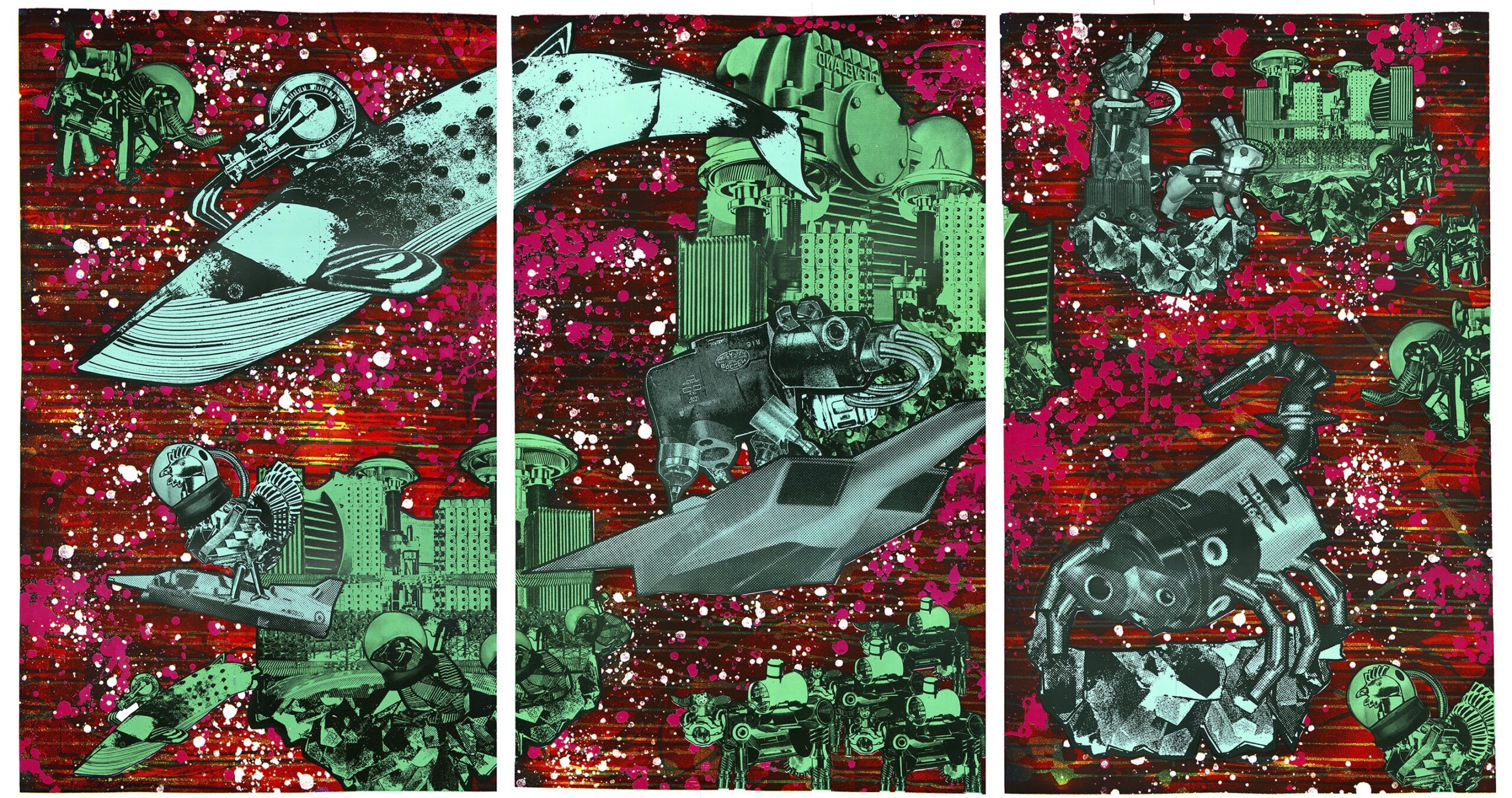
My current body of work investigates technology’s role in utopian movements. One branch of research involves fantastical narratives of animals, plants, and fungi seeking to escape earth for a more sustainable climate. The other involves representations of the mythical Jew Golem, the original automaton summoned by magic to protect against oppression. Both branches seek to answer the question as to whether our technologies have made for better worlds, or worse.
The Interview
This interview is composed of a recorded in person conversation edited lightly for clarity and flow.
ADDENDUM: Nathan Meltz would like to add that he was very caffeinated when giving this interview.
Blake Sanders: When did printmaking become your chosen medium?
Nathan Meltz: As an undergrad I was just making mini comics, publishing, using, not to date myself, Quark Express in my comics. And I was playing in bands the whole time. I spent just as much time playing in bands with, like, late 20 year old guys in Madison. And one of the guys I played with had played in this really good band called Low. Then we got a record deal right out of undergrad. All this time, somebody had to make merch, T-shirts, posters, especially when we went on the road. So sometimes I would be designing and printing, sometimes I’d be printing other works by the people in the band because they were artists, too. So that was the gateway.
Bill Weege was at the University of Wisconsin and, like, we’re using Photoshop 1 to do like 4-color separations, which you could never do before Photoshop. So that was a gateway drug. I continued making a lot of posters. Honestly, I didn’t take a lot of the visual arts super seriously for a while, I was a musician. I was a touring musician. Then, like with a lot of bands, that next record deal doesn’t come, or people get sick of sleeping on floors with a cat on your face and not having health insurance.
I was always a substitute teacher between tours because I had an Art Ed degree. I’d be at my elementary school classroom printing gig posters after school and not still not taking it very seriously. Then I remember the Little Friends of Printmaking were also in Madison at the same time. At some point, Melissa Buchanan was like, “why don’t you come over and we’ll take some photos of these? We can put them online on this website called gigposters.com.” I cannot overemphasize the importance of that as a gateway drug for printers, because you could go on there and the forums would be Little Friends, Jay Ryan would be on there. Luther Davis would be on there, giving, like, printing tips. Frank Kozik would be on there as a kind of right-wing printer. This guy named Clay, and I don’t know his last name, would be running it, and the competition would be to get picked as Poster of the Week. One time, finally, because James and Melissa helped me photo some work, I got work on there. I thought. “Huh, this is like a serious artform.” People were taking this seriously.
At the same time, Aesthetic Apparatus were kind of overlapping there within the Madison scene. Dan Abarra from Aesthetic Apparatus. And, like, they were printing out of the old graphic studio on Williamson Street in Madison that was set up as a feminist printmaking studio called Survival Graphics. They showed me all sorts of tips and tricks that they were learning. I just realized that I was better communicating and expressing myself at that time through print than anything else I was doing, kind of like mediated through printmaking, which, obviously, happens with lots of folks.

Golem
Screenprinted installation
12’x9’x2’
2022
Golem (detail)
Screenprinted installation
12’x9’x2’
2022
BS: You started with a BS in art education from Wisconsin. How’d your focus shift toward your own making in grad school and beyond?
NM: There was, like, 6 years I was in Madison, Wisconsin, public schools as a K12 art teacher, but teaching mostly K through 5. I had my room and there’d be class, and after class I’d be printing, Pedro the Lion posters or posters for Ian Svenonius’s bands. Mostly local bands, and we created this little art/music/craft collective called the Wisconsin Pop Explosion, which had some good bands. Nobody really went anywhere.
At some point, I had to keep taking credits to renew my teaching license. So I would take art credits at the University of Wisconsin, work with Phil Hamilton learning lettering. And there was always this professor there, who unfortunately passed away, Richard Long, not to be confused with the kind of hot shot painter, Richard Long. He was a great instructor, kind of controversial because he was like a hardcore Catholic. He would make these beautiful altars to popes that he loved that’d be combinations of Dutch Renaissance painting, high-end wood sculpture and AbEx gold leaf. He was a beloved professor. At some point he was like, “Meltz, you know what? You could do this professor thing, you can talk and you can think, you’re making good work.” When I grew up my mom didn’t go to college. My dad was the first person in his family to go to college. So my parents didn’t know about school, and the idea of being a professor and being an artist didn’t match with my class upbringing.
So I ignored Richard Long until I was taking classes and then met this sociology grad student at the University of Wisconsin, and she was really cute, super smart, and we started dating. She became my wife. She, at some point, said “Yeah, you could do this art thing. You could totally do this academic art thing and be good at it”. And I give her all, like, seriously, I’m going to get emotional because I give her all the credit. You need that person who believes in you and she did. Then I took grad school seriously.
So I got into the Wisconsin program and did a couple years, got my MA, and then my wife got a job out east. And Wisconsin at the time, I wasn’t totally happy with how my work was progressing. I loved John Hitchcock and Derek Buish, who was there. Then we moved out east and I found a program that was a little more interdisciplinary at the University of Albany. I went there and I mentioned how at that point printmaking wasn’t doing it all for me. They said, “Well don’t do prints. You like these comics? What about comics or animation? Do you do animation?” I had the tech skills, but I hadn’t really tried it. So I did, and kind of went down this whole new rabbit hole. I also focused on making sculptural print-based sculpture.
It took me four years of grad school to figure out how to be an artist. So I recommend it to anyone reading this. It’s okay to quit grad school to change programs. They might not be the right thing at the time. I found that I was an artist and it took a combination of printmaking, animations, sculpture, and eventually bringing in the performance to find how I wanted to express myself. Change advisors, change programs. I loved Wisconsin, and I love all the people there. Sometimes certain places aren’t right at that time. Find the program that serves your development.

Vessel
Screenprint over three sheets of yupo paper
37″x66″
2022
Spore Cannon
Screenprint
37”x23″
2022
BS: You describe yourself as having a lifelong passion for screenprint. How has that dedication honed your technique over the years? Where do you see yourself pushing the medium?
NM: First, I make a joke that I haven’t learned anything. It’s affirming to be able to teach a class at Frogman’s or I get asked to demo at SGCI or IMPACT. You know, I’m old and I’ve learned a lot of tricks, whether it’s from Aesthetic Apparatus or Little Friends or John Hitchcock. Talking to Mark Hosford is like a masterclass in screenprint. Looking at the work of Seripop, or at the work of Stella Abner, I feel like I’ve accumulated all sorts of tips and tricks.
I had a conversation with Carl Heywood, who I believe has unfortunately passed away, but was a legendary Kingston, Ontario printmaker at Queen’s College, and he had this quote, and I’m paraphrasing, but something like he was “always trying to subvert the inherent flatness of screenprint”. So, you know, you look at every stencil as a gradient pull. I like gradient pulls, but that’s not really my thing. I started doing reductions and I tried to have deep space, an illusionistic space. Sometimes a confounding space, through screenprint, which is hard because it’s a flat media. If anything, I’ve gotten good at adding some painterly effects.
Recently, I’ve been doing a lot of demos, showing how to use a ceramic atomizer to make kind of speckled, airbrushed sort of effects directly into the screen. So that, sculptural prints, print in hybrid forms. I’ve been definitely super influenced by Sheila Golobortko, and she’s been so helpful curating great hybrid shows. The people I met were influential: Hitchcock, Sheila, Midwest Pressed, definitely, and Seripop’s later, printed work. My inclinations are towards non-static forms, hybridity, which has definitely filtered into the way I curate the Screenprint Biennial as well.

SpacePods
Cyanotype and screenprint on 3 sheets Sekishu paper
38″x75″
2021
Elon, Take Me With You!
Screenprint
37”x23″
2021
BS: The graphic nature of your screen print complements your works, the focus on technology, and its effects on humans and society. It often includes loud colors and aggressive compositions. So how does that visual vocabulary help communicate the content, and how has your aesthetic and attitude regarding technology evolved?
NM: I like things that are loud, political, expressive. With technology, I have a balance of critique and fascination. I love technology. I am a technologist. I teach at a tech school. The more you learn and use technology, the more critical you are.
My wife is in this field that’s all about being critical of science and technology. We study and we ask questions. I print on Yupo paper because it’s this machine cut paper. The mechanized element of screenprint that’s fast. You become a printing sort of machine. Cory Doctorow has been talking about the reverse centaur where the centaur is a machine, the horse is the machine. It should be that a human is in charge of machines instead of the other way around, which is why he’s critical of as a technologist. The images I’m using, half tones, which are an artifact of technology. All of my machine language is used as a metaphor for technology. In my artist talk, I talk about Fritz Kahn, who makes his “man is an Industrial Palace”, all of his lithographs show biological systems transformed into little humanoids in analog machinery.
I’m definitely using the half tone and the printed artifact as a metaphor for technology. Whether or not it works or you buy it, that’s up to the viewer, but that’s what my motivation is. I’m passionate about it. Technology, whether it’s the printing press or mustard gas or the machine gun, the atom bomb, these are the history making and breaking elements of the human record, at least in the 20th century. It’s important, and I care about it, so I try to make it loud, and I don’t care about subtlety. I’ll be didactic and heavy handed and it’s okay if you don’t like it. That’s how I made things. There’s lots of layers. You know, Krazy Kat? What does Ignatz the mouse say every time he throws the brick? Trangression! But I do love subtlety as well. I love it from other people. Ann Apsinwall has the most subtle, lyrical work, and I love that stuff.
Noah’s Ark
Screenprint on three Yupo Paper Sheets
40″x78″
2021
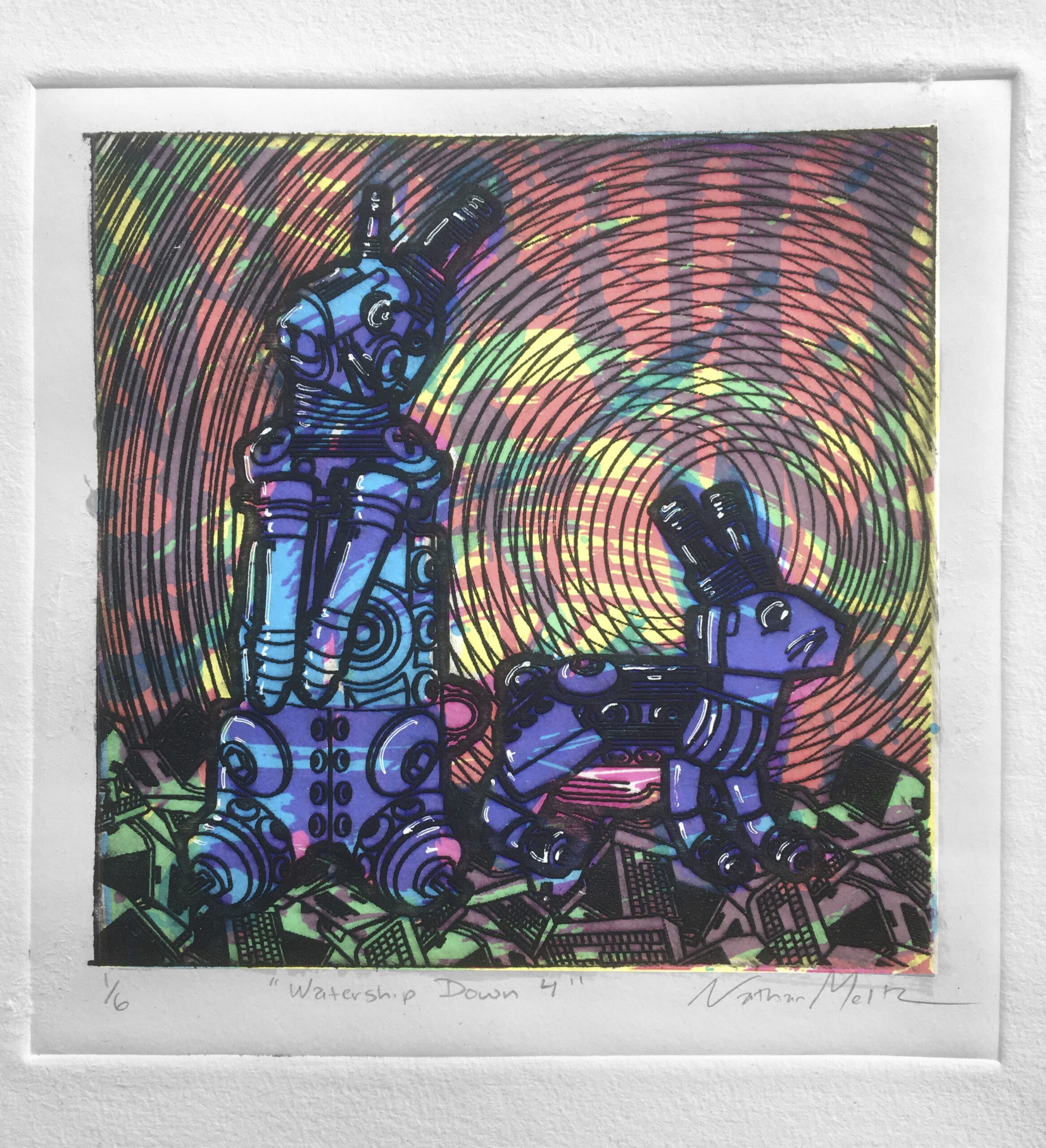
Watership Down 4
Laser-etched intaglio and screenprint
6”x6”
2022
BS: You’ve employed technology to reimagine your print work as print-based animations, including the long-running Golem series. While devices and contemporary software were part of the work in the creation since the beginning, their stop motion aesthetic harkens back to the age of practical effects. How does that balance reflect your ambivalence about tech and our tech reliant age?
NM: I view technology, as we’re talking about tools. I don’t differentiate between 15th century technology or 21st century technology. I have done projects where I’ll use a laser into plexi and then print it intaglio style. It’s all just a craft. It’s all tools, all technology. The piano is a level of high technology still.
For the animation, it’s basically like a cut out animation using screenprint positives. And using a parallax element of a DSLR, but then going into, you know, a laptop to use Dragon Frame, and I’m using ink, squirting, ink around. It’s all a mix of processes. I think it’s when you start mixing processes that the art tends to happen. If I’m doing all just one thing the mystery’s gone. I’m an old man now. I get bored easily. I want to see something I haven’t done before. I want to put all these things together, all these different tools. I feel like my midlife crisis was learning a little intaglio. At 40 he’s going to learn intaglio. I thought, this is fascinating and fun, and I’m not particularly good at it, but it’s almost more interesting now to fail a little bit than just to have rote things succeed. I started learning to sew this year. Like I made a tote bag and I was like this is fun.

Heartbreaker
Laser-Etched 25-layer screenprint
7”x7”
2021
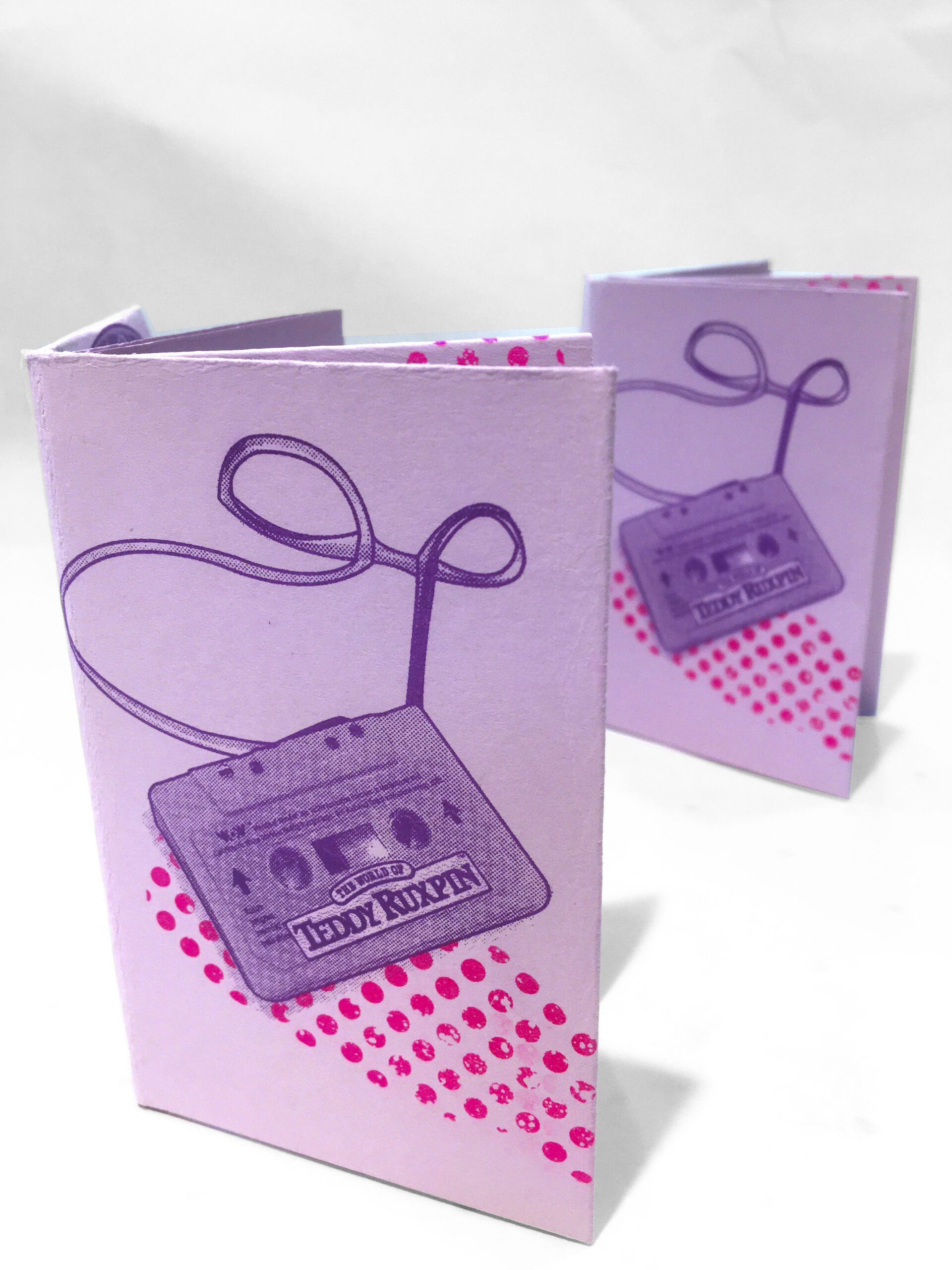
The World of Teddy Ruxpin
Risograph zine
2”x3” letter size folded
2021
BS: Your love of screenprint inspired you to found the Screenprint Biennial in 2014. What was your original vision for the exhibition? How has it grown over the years?
NM:
The inspiration came from Richard Noyce, the English print historian. I saw him give a talk at the IMPACT conference in Scotland. He mentioned some obscure Eastern European biennial, some etching biennial, that doesn’t exist anymore. This is the time, 2013, there’s a lot of biennials going around. So I thought, where’s the screenprint biennial? There’s a Mesh Tech biennial thing in Japan, but no screenprinting. This is like my thing. When I was doing music for money, we would talk about how we made the record we wanted to hear. Not the record that we thought would be successful. So I wanted to make the show that I wanted to see. I just invited every cool screenprinter or people who made screenprints. I asked them if they would send me work. I couldn’t pay them. There’s no money. And lots of people said, yes–a couple of people said no and that was okay, because I don’t blame people who don’t want to work for free–and it came together. The first was like this little scrappy invitational at this art center in upstate New York. And then I did two galleries in upstate New York. And then it traveled to the Center for Contemporary Printmaking. Then it was at this endowed gallery, at this little liberal art school in upstate New York. We did a couple there. Then Nick Satinover and I put a ton of work in to bring it to Middle Tennessee, and then that was 2020. And I felt really bad. It was fun, really. I really enjoyed working with Nick for a failed show during the pandemic.
We started bringing in other guest jurors. We have a panel of jurors, Miranda Metcalf, and Luther Davis, and Althea Murphy-Price, Taryn McMahon, Christina Weyl, and Travis Jensen, and probably leaving people out. You can look on the website and they’re there. Then we have a 10 year anniversary and every year, ever since the first one, I sent cold emails to Print Center New York, Print Center Philly, and the Turner. Ann Coffin at Print Center was really nice and she was the one who got me into the Center for Contemporary Printmaking in Norwalk. It’s never worked out in Philly. Then finally the Turner, they got a new curator. Rachel Skokowski, she’s a great collaborator. And she was interested to bring something like an exciting package show, and she invited me to bring the show there, and so we had our 10 year anniversary at Turner, which was great, because they have a great screenprint collection there. Janet Turner focused on screenprint. Because it was the 10 year anniversary, I decided to have another invitational, drawn from people who had shown in one iteration of the Biennial prior. It wasn’t a greatest hits, but it was about choosing people that make another blockbuster show.

Collapse
Screenprint on 36 feet of 1980s dot-matrix paper
10’x6’x2’
2020
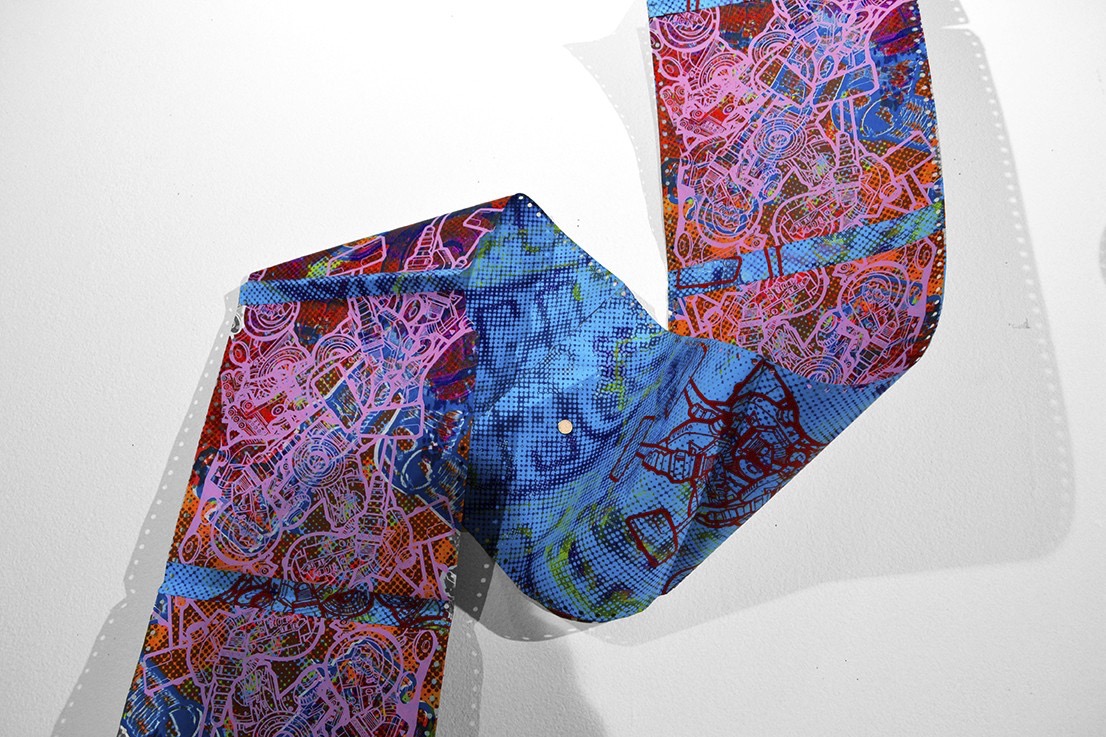
Collapse (detail)
Screenprint on 36 feet of 1980s dot-matrix paper
10’x6’x2’
2020
BS: Well, the next iteration is currently in development for Confluence, the Pittsburgh conference October 2027. We’re really happy about this. What are you looking forward to for this next exhibition? How does the conference theme relating to a convergence of people and ideas complement the Biennial’s philosophy?
NM: First on the theme, it’s a merging of SGCI and the Screenprint Biennial, instead of bringing two things that have been very distinctly separate. After having six iterations, I wanted to do something different. I wanted to get some new energy. I looked at how Printeresting sunsetted their web presence, but then still had a couple special projects afterwards. They did a published element, and I thought, if I want to keep doing the Screenprint Biennial–obviously now the whole thing’s a misnomer–it is not a biennial. I wanted to do a different version of it. So it makes sense. I love SGCI and love the energy, and I thought can we somehow branch this element? So for Pittsburgh there will be a sort of open call through SGCI, so you’ll have to be a member of SGCI to apply. The venue is TBA. So nothing is confirmed. These are all plans and hopes and aspirations, but the aspiration is to have a Screenprint Biennial special edition at SGCI, and it will be sort of like if you’re a member of SGCI, you can throw your hat in the ring. It will not be invitational. It’ll be another open call. And I hope that will be an interesting way to bring people who hadn’t thought about applying to our prior open calls. Maybe people who have applied again will want to reapply. So it’s going to be something different. I can’t predict how it’s going to turn out, but I think bringing the SGCI energy with the Screenprint Biennial energy will be like that for some, you know, Duchamp’s frisson of getting two things together that are different. There’s maybe a little conflict, and the friction causes a new third thing that’s interesting art.

Watership Down 2
Screenprint
37”x23″
2019
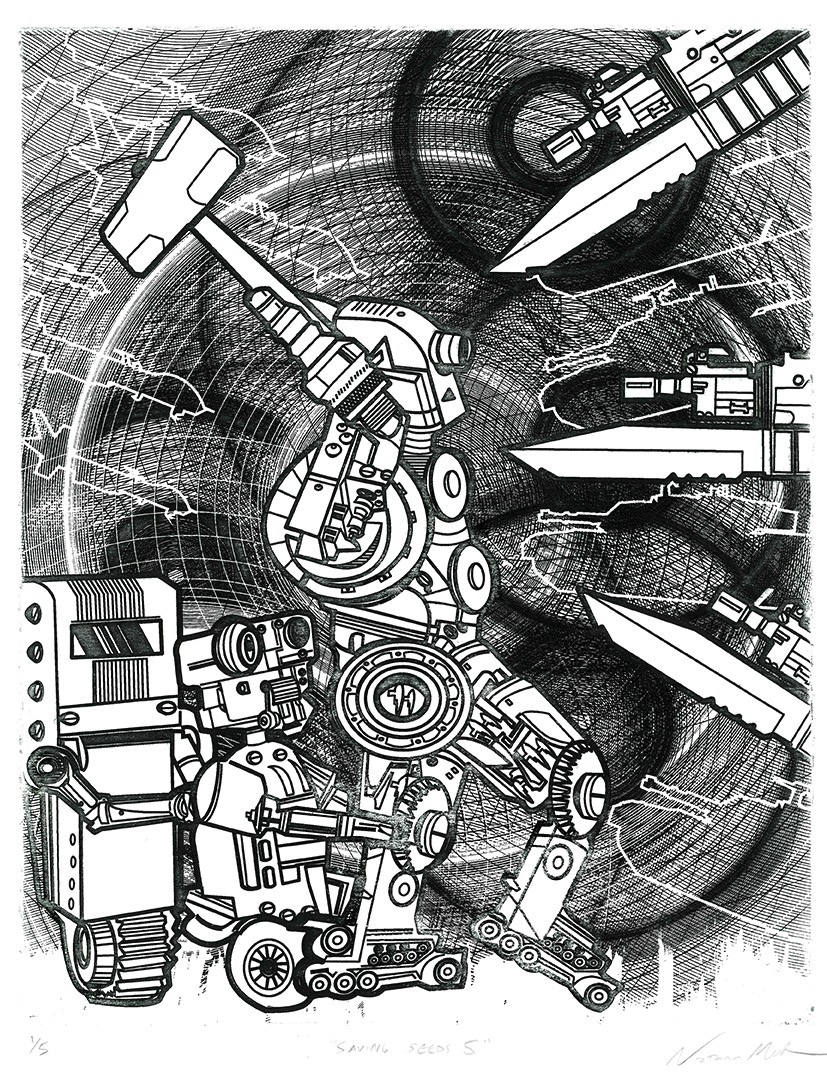
Saving Seeds 5
Laser etched intaglio
14”x11”
2019
BS: Again, we appreciate it because we just had the Member’s Survey go out and one of the big things that we heard back from people is they want more opportunities for exhibitions, more energy, more ways to sort of enmesh as a community. I think often–and this is confirmed by our very young board right now–a lot of our youngest members are somewhat intimidated to apply for things at the conference. Certainly to run a panel or to do a demonstration. They just don’t know that they can get their foot in the door. So to have more opportunities, more open calls, beyond just the juried members exhibition–and especially something that already has a really great reputation like the Biennial–is another prestigious exhibition that is now going to be open to everybody. That’s going to be a really nice way to welcome in so many more of the attendees that don’t feel like they’re really part of the machinery of SGCI.
NM: I hope it’s a way to welcome more people to be involved. I have to give credit to Miranda Metcalf has been heavily involved for years, doing design. Katie Garth has been doing design. Travis Jensen’s been like an informal advisor. Tonja Torgerson’s definitely been like an informal advisor. There’s been people that have contributed in different ways. Hopefully with it being a part of SGC it can both get people in at the bottom floor for some mentoring, and they can see that all curating–at least the way I do it–is DIY. When I do get my artist talk and I have a slide about curating, it shows me doing 3 things. It shows me installing, driving art in a U-Haul, and moving boxes. And that is something we can all do, or hopefully anyway. So I’m hoping more people want to be involved to combine committees on the ground with Screenprint Biennial and make it a larger tent. I’ve always dreamt of sharing the ownership of the Screenprint Biennial with more people and making it more of a democratic process. I think that being part of SGCI is part of that.
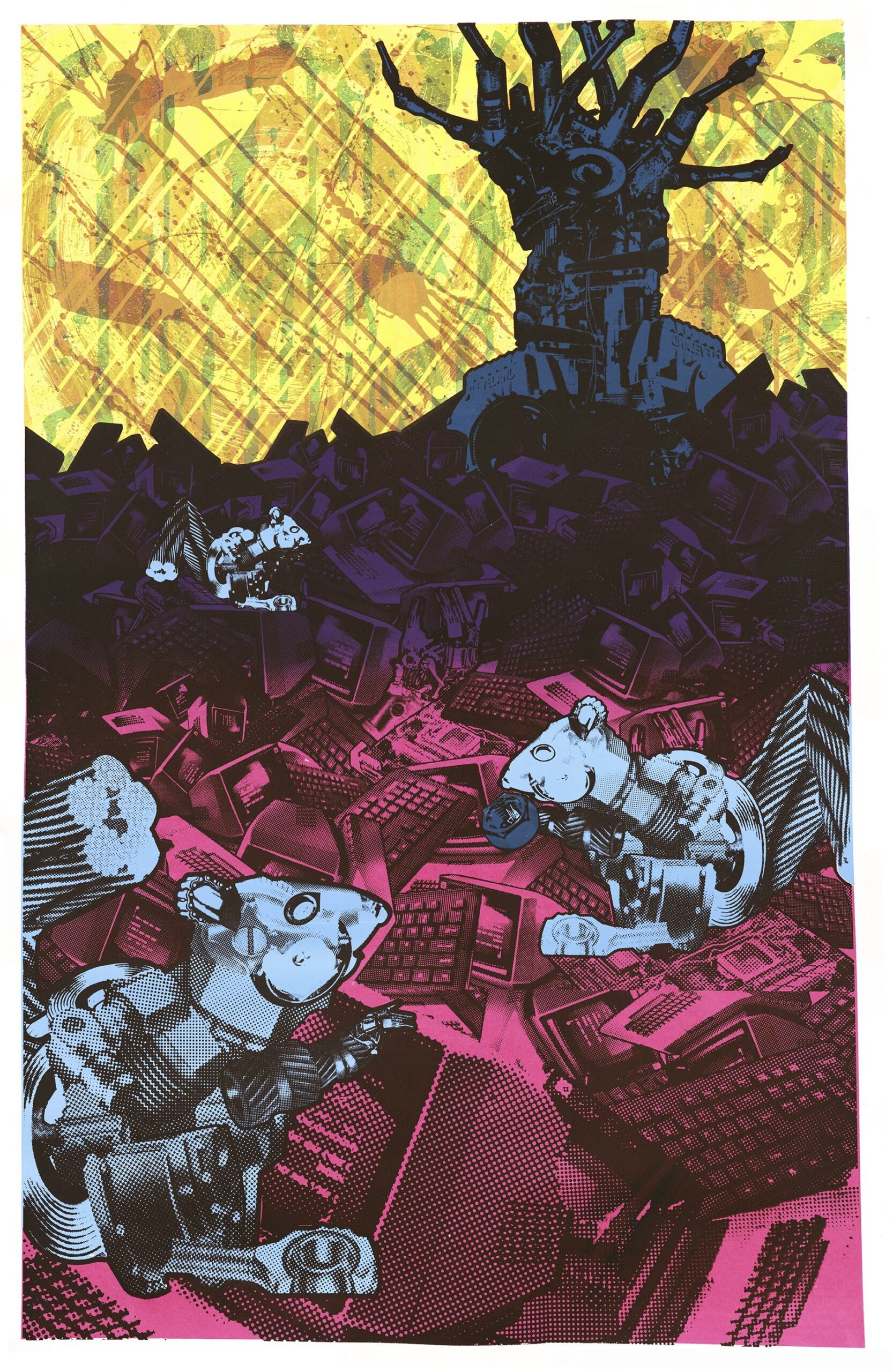
Ecologies 1
Screenprint
37”x23″
2020

Thanks a Fucking Lot, Charlie Lindbergh! (After Gropper)
Screenprint
37”x23″
2017
BS: You have a significant international exhibition record, including the show at Atelier de Presse Papier at Trois Rivieres. Do you have any advice for printmakers looking to expand their global reach? What are some good accessible international show options?
NM: First of all, if the international biennials seem out of reach, a ton of them have no entry fees. So you should throw your hat in the ring. They might do a weird thing where they’ll be like, you’re in through the first step. Now send the art for the final round of judging. It sounds like, oh, am I going to pay for international shipping and not get in? I think, and I don’t know for sure, but I always get in after that. I think they’re just confirming that it’s actually a lithograph or a screenprint they want to make sure it’s not like a digital print. Don’t hold me to it, but that’s my impression. You should apply, send the work in. How do you find out about the work? This is complicated because we’re in this time of social media. So, honestly, there’s some really good people who are good about posting on the social media that I find shows through. So look for people whose art that you like. If your work is in some of the same realm as someone like Erica Adams, for example, and she’s super successful, look at her CV. Where is she showing? Then start applying to those shows. Justin Diggle is legit great about doing this. Look where is he showing? There are similarities there because we both do some collage, etching, screenprint work. Where’s he showing? Look at his social media. He’s actually really great about posting open calls. Amanda Maciuba is great about doing this with MAPC. Find out the people who are really good about doing that, posting open calls, follow them on social media, or just look at the people whose work you admire and maybe has some similar threads, either in terms of media or concepts. Look at their CVs, where they apply then apply to those shows.
Entry fees suck. With the Biennial we never had entry fees, because I think it limits access. If you’re gonna pay an entry fee, make it worthwhile. Pay for shows in which they’re going to be paying your return shipping, um, or maybe they’re going to treat you like an artist, the Trois Rivieres Biennale, totally worth the entry feed, because if you get in, you get paid fees, just for showing, you don’t have to sell work, and they treat you like an artist and they have great communication. Maybe there’s the juror, curator, somebody who you really want to have your work in front of. Maybe that’s worth it. Be very judicious about what you apply for. Look if the show is the right fit. Look for the shows that don’t have an entry fee. I wish someone would put together a good database of no entry fee printmaking shows. There was a great animation database for a while that was all no entry fee film festivals that focused on animation. I wish people could start differentiating between the entry fees and no entry fee databases. Start your own shows. Curate. Put together this show that you want to see. It can be at a coffee house. It could be at a bar, it could be at the empty storefront. Put together your own shows, because people will remember that, and curating karma, I think, goes around. Put together an exchange portfolio, and show it at your public library, because then somebody else in the portfolio will show it at their library, their institution. All the stuff that comes around goes around. So don’t just try to show for yourself, but try to bring up the community as a whole because even if it doesn’t come back to you, you’re gonna be doing something for your community. And for the print community and for the discipline, it’s all worthwhile. That’s punk as fuck.
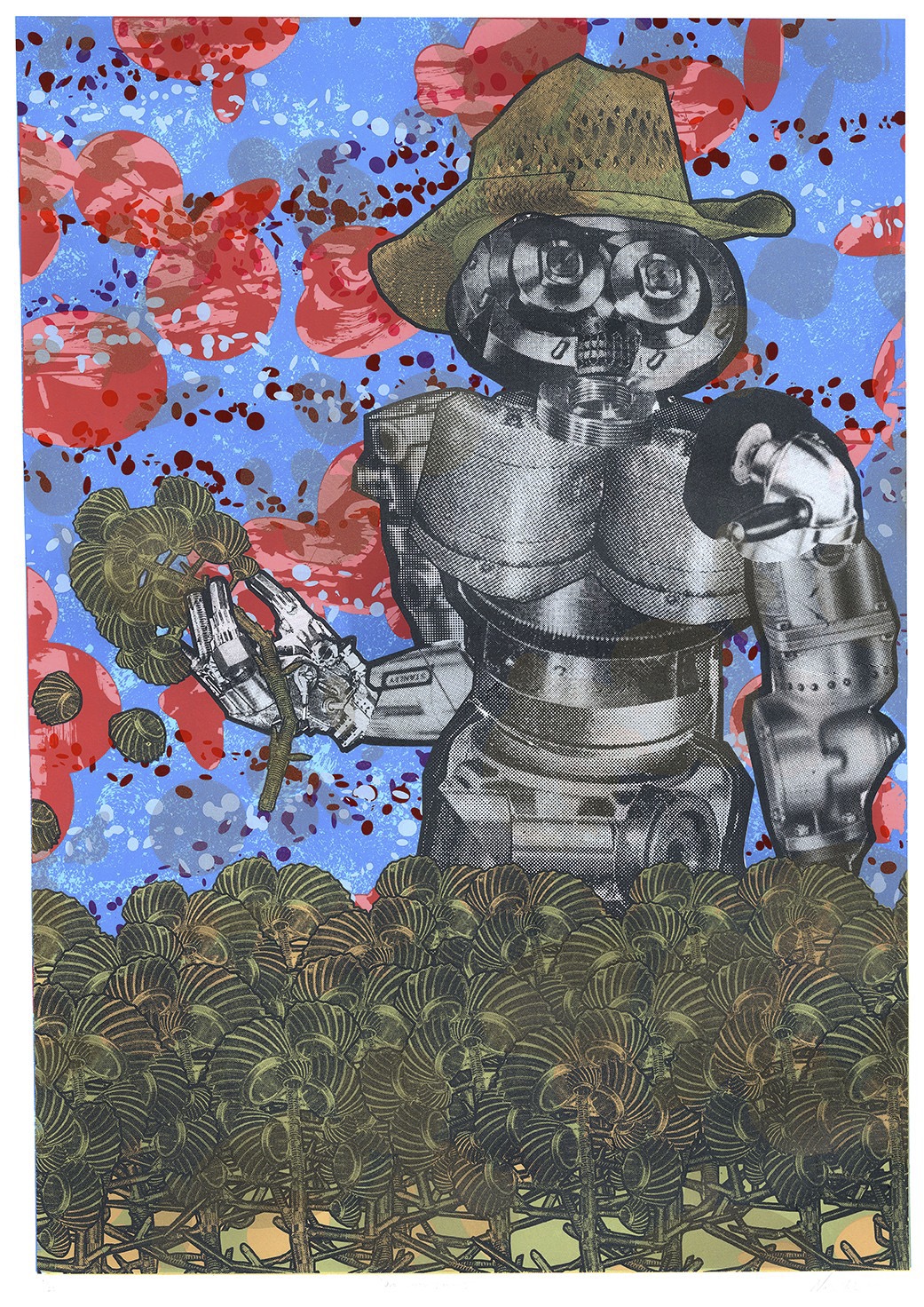
Our Good Earth?
Screenprint
41”x27″
2017
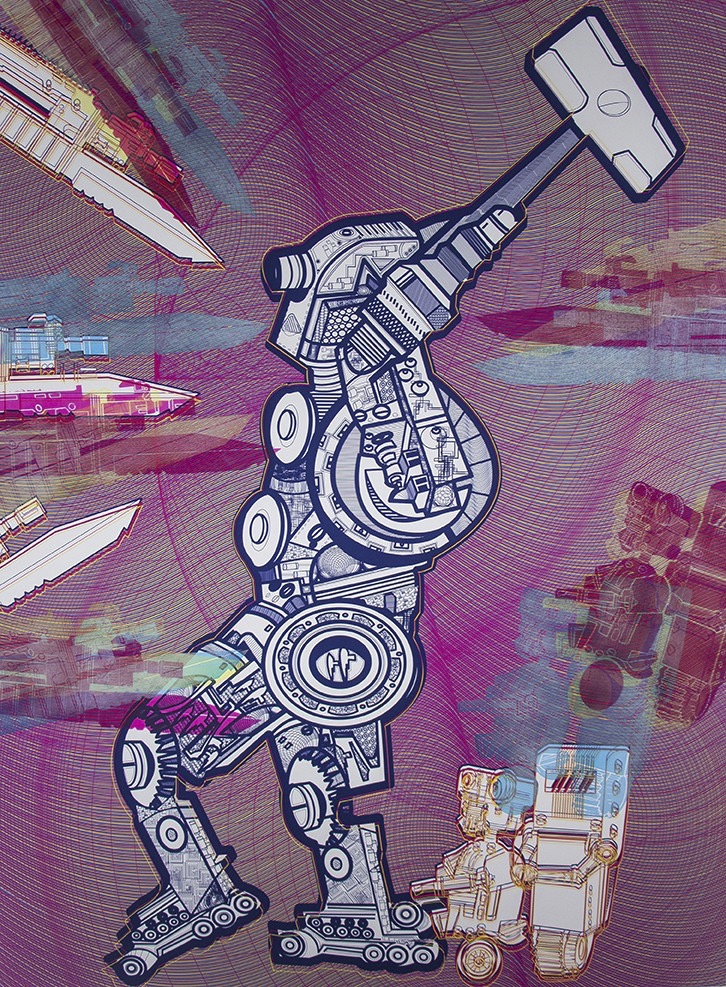
Saving Seeds 2
Screenprint, screenprinted puff-binder, digital
50″x38″
2019
BS: That was my whole thing when I started organizing shows. I don’t care that much about my work. I’m glad other people like it, but I make it for other people, right? I was so much more interested in promoting the people that I’ve met, through Frogman’s, through SGCI, and getting their work out there and just being among them on a wall. It made a big difference.
NM: It’s also important to remember you can make good art and other people don’t have to like it. I’ve made so many different bodies of work and I think it is good. And a lot of it, I know it’s good. Sometimes it gets awards, sometimes it doesn’t. Sometimes I’ve got multiple awards and nothing sells. It can still be good work. Can I tell this little validation story?
So, I’ve been mostly focusing on animation with screenprint positives and with a live scoring band. I’m playing drums, I have this great lap pedal steel player, guitar player, bass player. We’ve been doing all these shows around the northeast. We got a grant to do a community show, so we did it at this community center, and it was probably for a dozen and a half kids, little kids in the show. And it’s this narrative animation about robots get persecuted, they raise a golem, except eventually the golem gets violent, and these two factions have to make peace to battle the golem. These two different robots, basically these robot kids, band together to defeat the golem. And in this narrative, they do, and when that happens, all the kids in the audience start clapping. It doesn’t get better than that. That’s the affirmation I need. It’s better than an award. It’s better than a sale. I seriously don’t know how to top that.
You should just make the work and if it doesn’t show, it doesn’t mean it’s not good work. One great thing about curating is you realize when you don’t get in that show, it’s not because your work’s bad, it’s ’cause you weren’t a good fit for the show. Maybe you weren’t doing the sculptural printmaking work that you needed to fill up the space. Not getting a show can be so arbitrary, because curators are putting together a show and honestly, it’s not about you. Keep applying until you apply to that right show. That’s the right fit for your work. What does the juror make? The juror is an artist. Look at what they make. Also, honestly, there’s been years when I start getting the most acceptances because I’m making the same work and maybe that’s a sign to make a giant change because it kind of got boring. This concept was done, and then you’re not going to get in some shows for a while maybe, but nothing comes without taking that sort of risk.
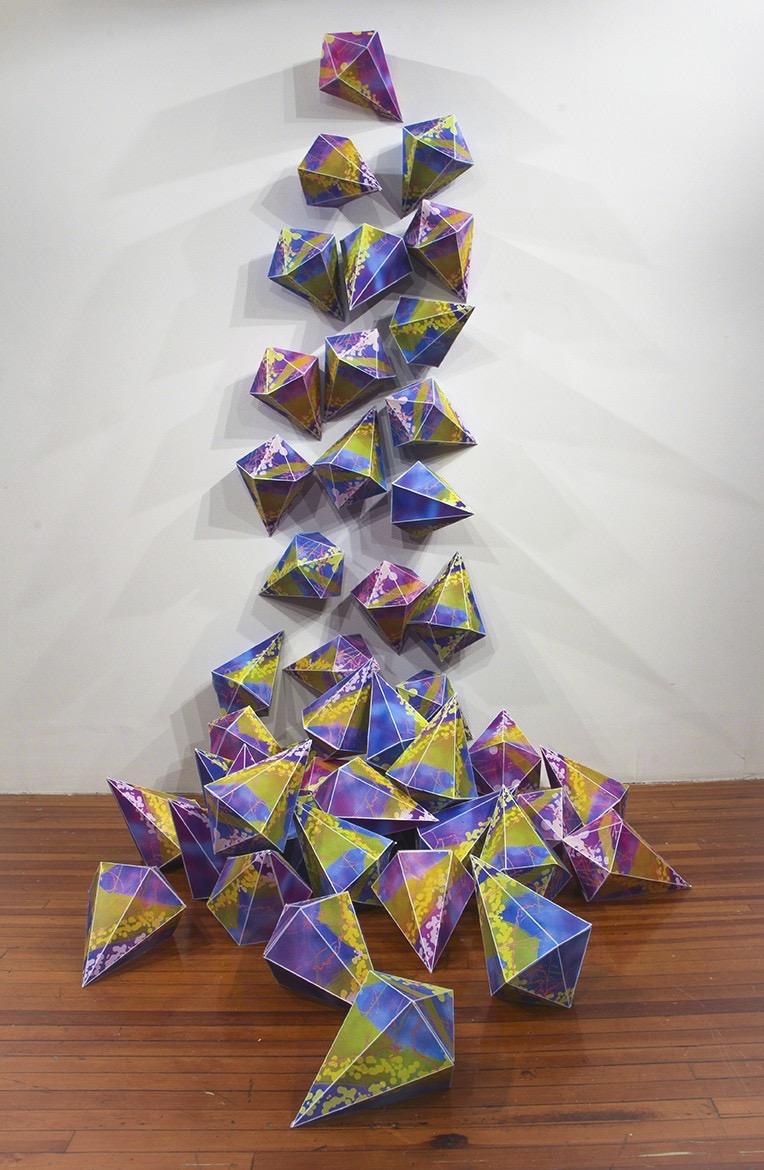
Crystal City Installation
Screenprinted sculpture
9’x4’x5′
2017
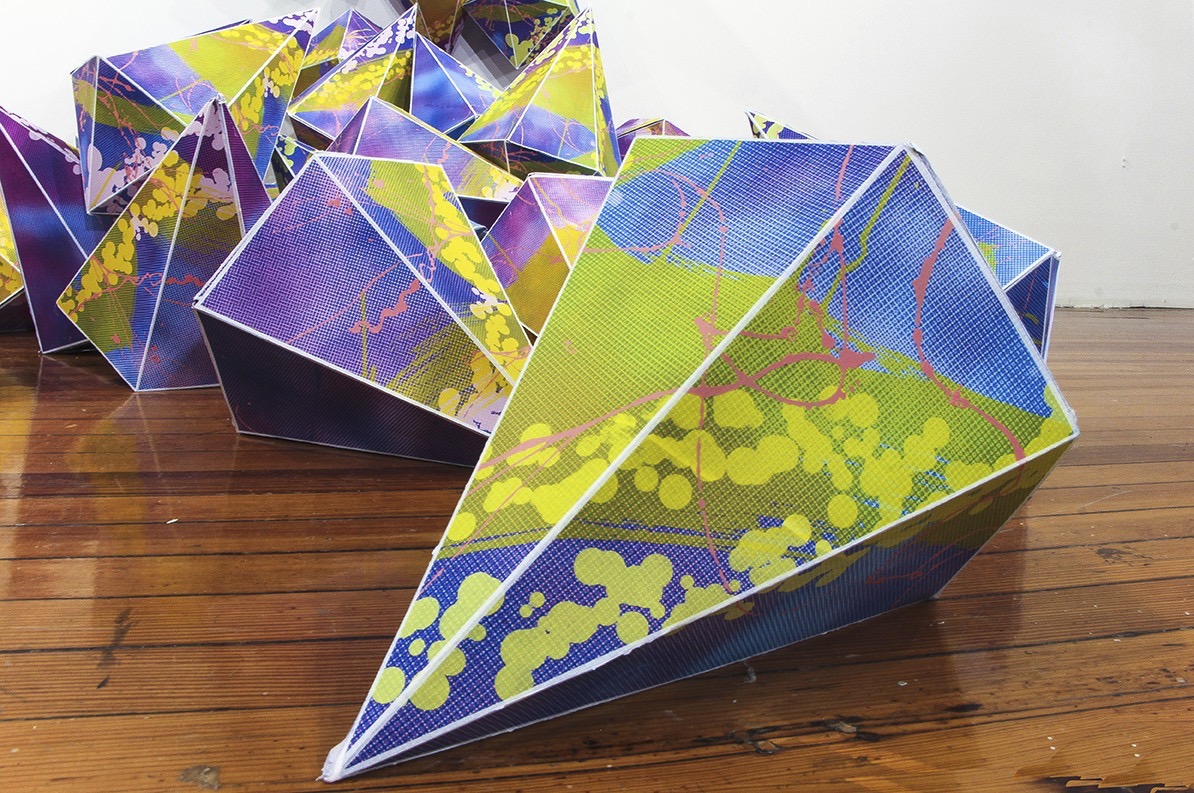
Crystal City Installation (detail)
Screenprinted sculpture
9’x4’x5′
2017
BS: What do you have coming up next?
NM: I’m still really pushing this live scoring project that’s 30 minutes of a stop motion narrative with animated ink and clay and screenprint positives with a live scoring band. I will bring that to your institution if you can pay my musicians, because this is the hilarious thing of collaboration with pros. Folks gotta get paid. That is something if you ask people to do stuff, pay people if you can, if there’s a budget. We need to pay living wages.
So, people like this live show. I’m really excited. This is the most popular thing I’ve done in a while. I’m happy we’ve been playing around the northeast. and want to do more. I’m trying to get some things in Philly and different parts of New York. The Golem Trilogy, with a live score, with some very talented musicians, bring me to your town. As long as we can afford to get there. A lot of people are doing the live scoring now, but they’re doing like Nosferatu and things like that. This thing, I made this, and then it’s original music. But I’m too old to sleep on a floor now. So it’s a little more complicated.
Can I tell this story? I was in an unnamed film festival in the animation reel, and the winner of the animation reel was an AI animation. And I’m not going to say the outcome of all this, I raised a little kerfuffle, but just to say that now I’m all about a live experience. If I’m gonna do video work, it’s gotta be this live experience. So it’s something that cannot be just absorbed through a screen. I’m getting into a post-screen part of my career, whether it’s print or video performance. I think we need to become more post-screened as a society and that’s why I want to do what I do.
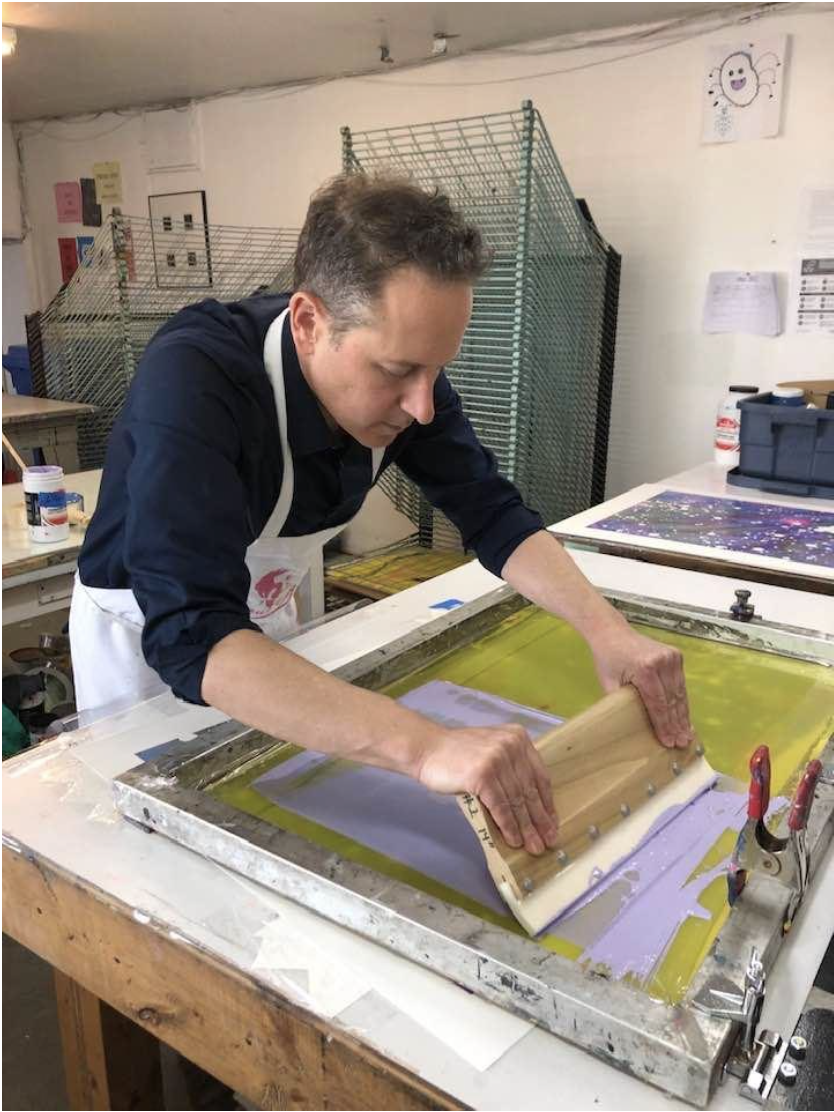
In the studio of Atelier Presse Papier, Trois-Rivières, Quebec, Canada
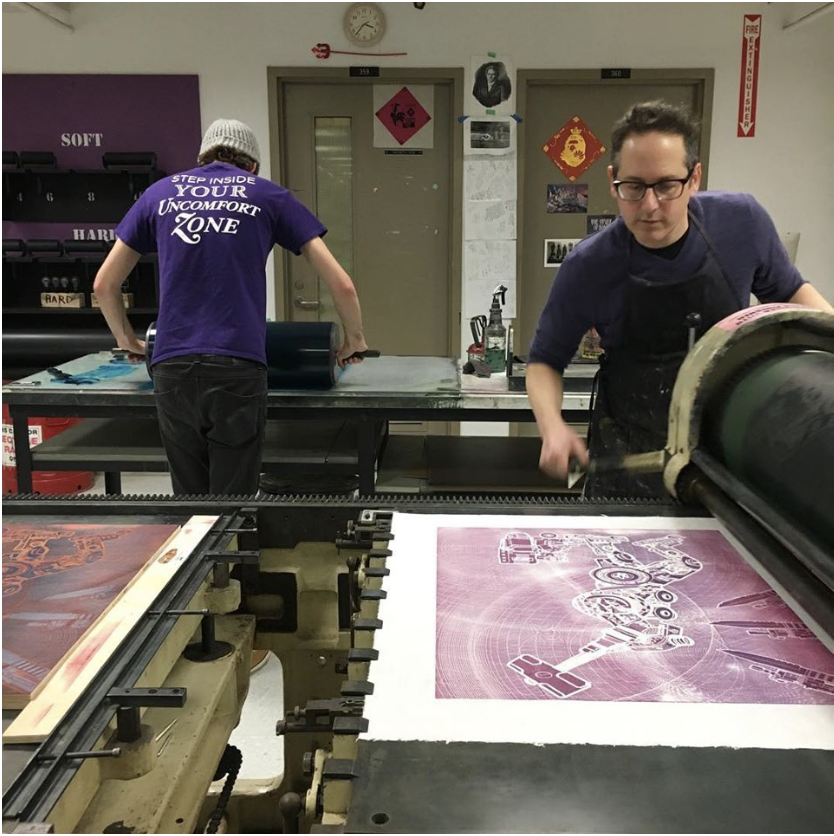
At the institute for electronic arts, Alfred University, Alfred, NY
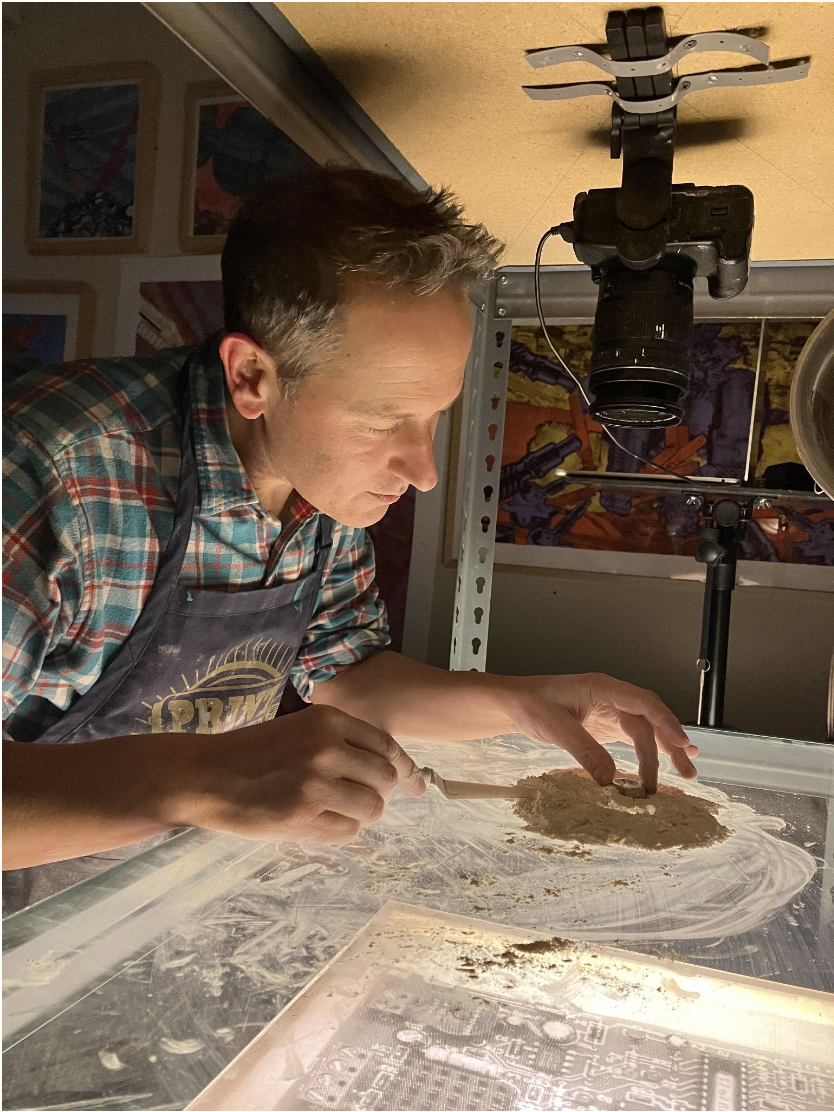
Animating at his studio at the Rensselaer Polytechnic Institute, Troy, NY