Interview
Exposed: An Interview with Andrew Kozlowski
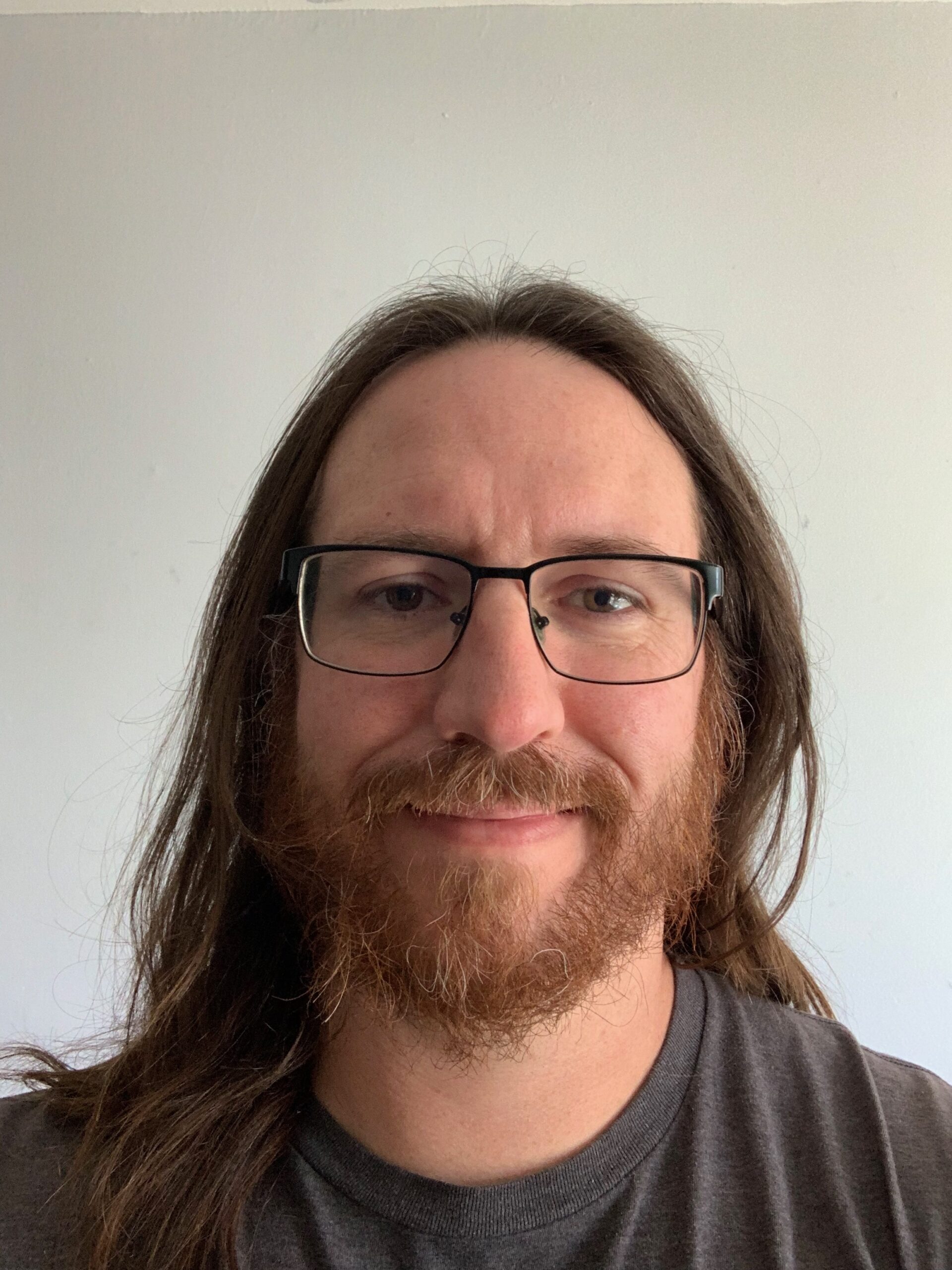
Andrew Kozlowski
Instagram:
@andrew.kozlowski
www.papercitypublishing.com
Andrew Kozlowski is an artist and educator based in Jacksonville FL. While he’s been making art for some time, he found a big shift in 2020 and found his way back to making comics and zines. Since 2021 he’s published a weekly comic via Instagram- these comics cover his experiences as a father, husband, teacher, artist, and explore topics related to creativity, mental health, and relationships. His prints and works on paper have been featured in numerous solo and group exhibitions in the US and abroad, including solo exhibitions at 1708 Gallery in Richmond VA, ArtSpace in Raleigh NC, The University of West Georgia, and the Valdosta Art Center in Valdosta GA. His comics have been published as part of MoMA’s Drawn to MoMA series, KUŠ Comics #51, and will be included in the Shenandoah Literary Magazine in 2026. In 2023 he opened Paper City Publishing- an imprint to self publish his work, and the work of other cartoonists, artists, writers, poets, and zinesters. You can see more of his work at www.papercitypublishing.com
Artist Statement
I used to make large murals using wheatpasted screenprints of objects to think about how we collect and share stories. I loved these pieces, but became exhausted by the intense preparation and travel required to realize them. Quarantined throughout 2020 my sketchbook became my studio, which led me gently back to comics. In 2021 I started making and posting a weekly comic guided by two simple rules: make at least four panels and share it each Sunday.
The comics I write come from my attempt to make sense of how I fit into our increasingly fragile world. The main character, an avatar of myself, is supported by a cast of symbols- birds, skulls, bones, pencils, snakes, and backgrounds- my desk, my neighborhood, the woods where I walk, the pool where I swim. Most often presented through monologue, the stories mix poetry, humor and anxiety, working to reconcile my roles as a father, husband, teacher, artist, and community member.
Titled and dated, most entries are shared the week they are made. However, revisiting them as self published books, prints, or exhibitions of drawings allows unrealized connections to present themselves, offering readers new points of entry.
While my previous work spoke about the histories we share through our objects and collections, this project has extended my understanding of the impact of small work, accumulation, and time. Our human time scale makes untangling what we experience a slow business, but I’ve found meaning in working these threads. Bird by bird, over time each page becomes a node, a connection between my story and yours, hopefully helping us both see how we fit into this whole mess, together.
The Interview
Blake Sanders: When was your first encounter with printmaking? When did you know it was for you, was it love at first sight? How did it change your understanding of what art could do?
Andrew Kozlowski:
The moment that opened printmaking for me was when I went to Frogman’s in 2002- I won a scholarship to attend 2 workshops. I had a workshop with John Timothy Pizzuto which introduced me to ideas about green printmaking, and a screenprinting workshop with Lynwood Kreneck which was amazing. Seeing John Hitchcock share his work- installations that combined prints, give-aways, and video all together made an impact on what I thought print could do. This was reinforced again through my time at VCU- I had really great teachers Holly Morrison, Barbara Tisserat, and Pete Baldes who helped me consider printmaking as an ethos or idea as much as a set of techniques.
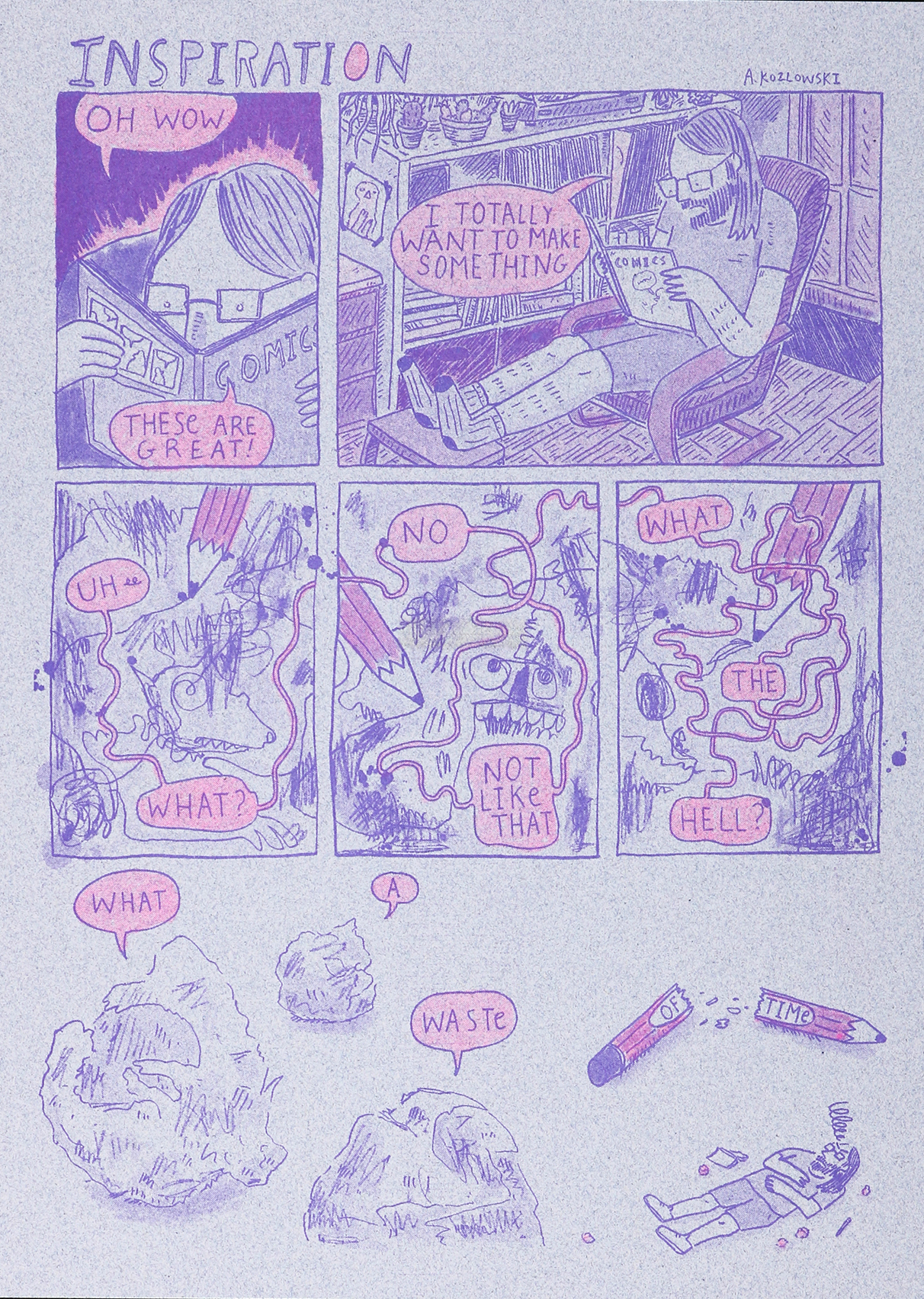
Inspiration
Risograph (fluorescent pink and violet)
8” x 6”
2025
BS: You got your BFA from the Tyler School of Art in Philadelphia, and your MFA at VCU. How did those programs shape you as an artist? How did that pedigree prepare you for art as a profession?
AK: My faculty were awesome, thoughtful, and I learned all the usual techniques- but both programs were really open to what prints could be.
This shows up in my teaching and the work I make- When I see students get wrapped up in the technical side of things (like “if I just get perfect registration this will be better”) I remind them that without asking the questions of why you’re making something you’re going to have a hard time coming up with ideas even if you ever figure out that perfect registration.
My experiences kept me open to seeing/looking for the medium that helps you tell the story- not just the medium that you think you’re supposed to work in.
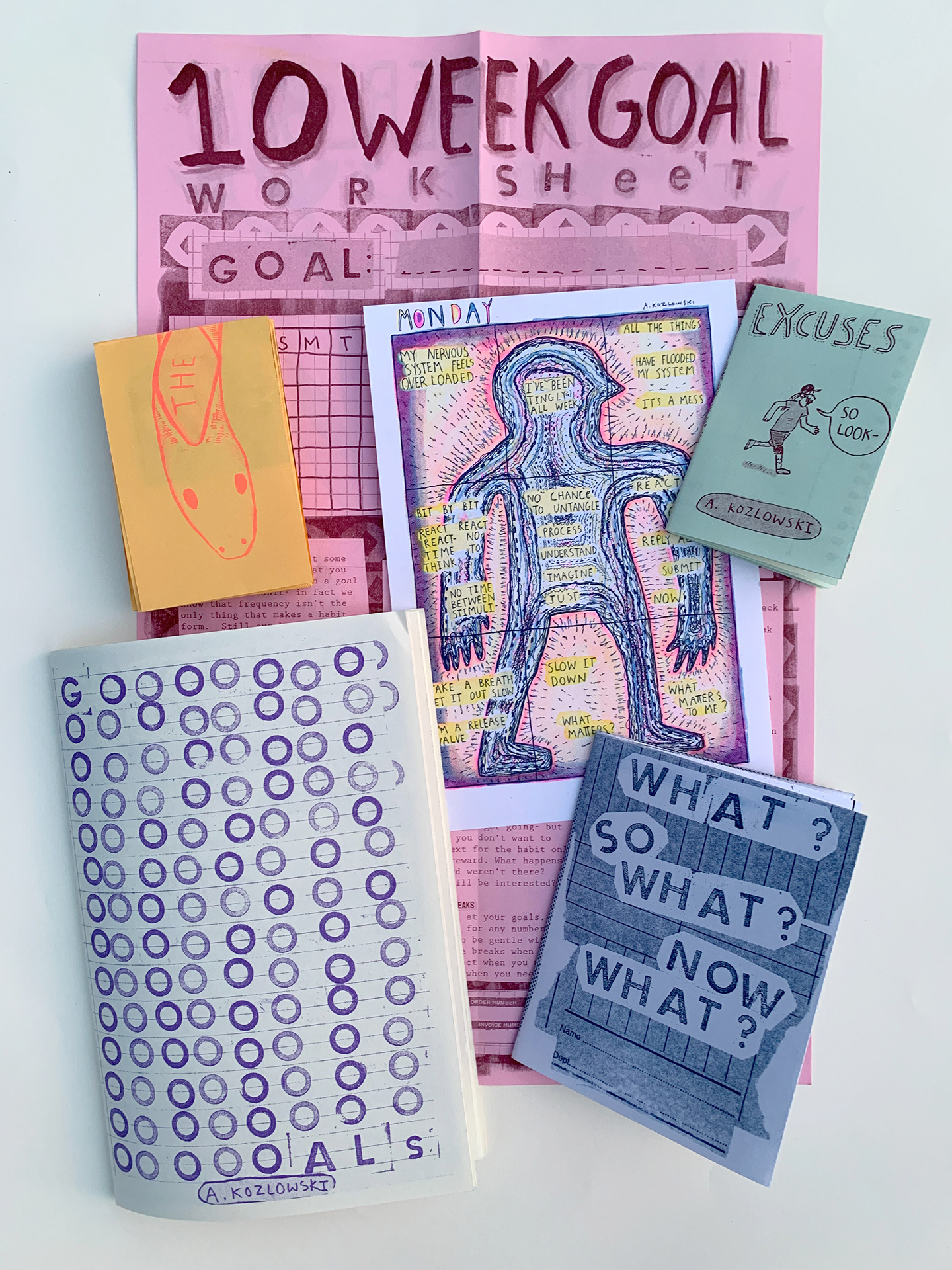
GOOOOOOOALS Tool Kit
Various books and posters Risograph (fluorescent pink, orange, yellow, sunflower, cornflower, light teal, federal blue, copper, burgundy, violet, kelly green)
Dimensions range from 17” x 11” to 4.25” x 2.75”
2024
BS: I first encountered your work when you were showing at 1708Gallery in Richmond. Back then you were creating large print & collage based installations. What was the impetus for the shift in your work?
AK: Quarantined at home during Covid I couldn’t travel to make those installations- but I was also feeling burned out at that point too. As a new professor/academic I was pushing to get shows, and those pieces required a lot of logistics and travel- I had a young family and it wasn’t always easy to do.
It can also be slow work to develop- not everybody is willing to give you that kind of space to wheat-paste a bunch of prints on their walls. Don’t get me wrong- I really loved those pieces, but they demanded time and energy that was wearing me out. So in 2020 I was just ready for a break. Without a studio or venues I used my sketchbook as my primary site for making- I’d been teaching how we use sketchbooks for years at that point- the circumstances presented it as a time to stop and reflect. Eventually this led me back to comics, the first thing I ever really wanted to make as an artist.
There is a part of me that still holds a space for the installation work- they pushed me into the community aspect of making with the installation and the deinstallation processes that became part of the work. It was really amazing to meet and work with so many people and I loved how each one came together. So a part of me still holds a space –like if anyone asked me to do another I’d do it- but then I also feel like I moved on- and it wouldn’t be the same.
In the last few years I’ve participated in shows and found ways to include installation and community based making as part of my work, using printed worksheets and developing spaces for community creativity- and that makes me think I’m on the right track. It’s a lesson in remembering that while the look of what you make might change, much of the time the core ideas are still there- you’re just finding new ways to share them.
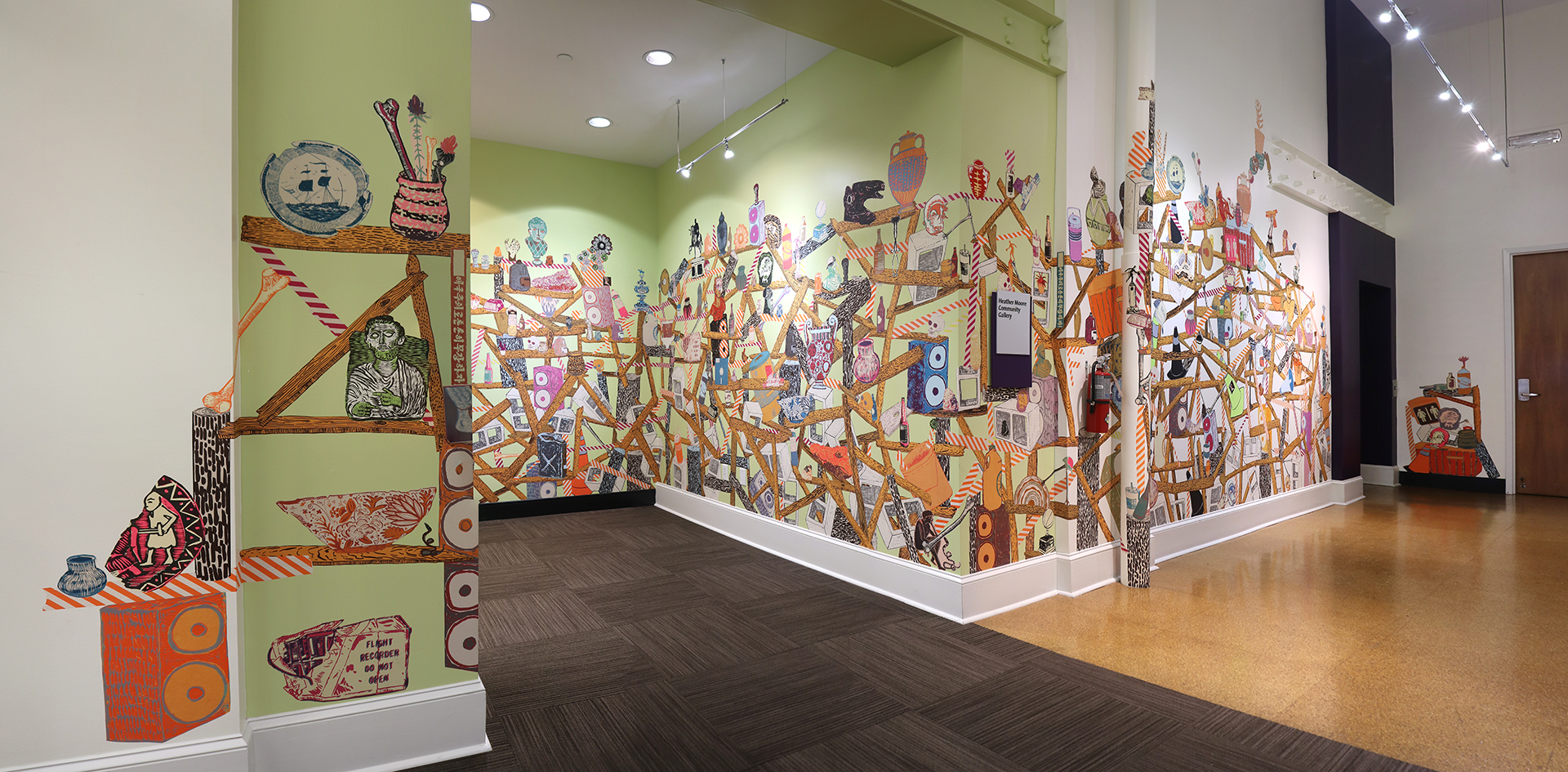
After the Deluge, Before the Flood
Wheat pasted screen-prints
Part of the exhibition 10,000 Years at Cathedral Arts, Jacksonville FL
This piece featured hundreds of screenprinted elements wheatpasted to the gallery walls by a group of volunteers who helped develop a scaffolded bookcase to hold our valuables above the encroaching sea level. Following the exhibition the prints were removed from the walls with the scraps collected and reformed into new sheets of paper by students at Chaffee Trail Elementary in Jacksonville FL as part of Cathedral Arts after school programming.
Approx. 9’ tall x 35’ linear feet
2018
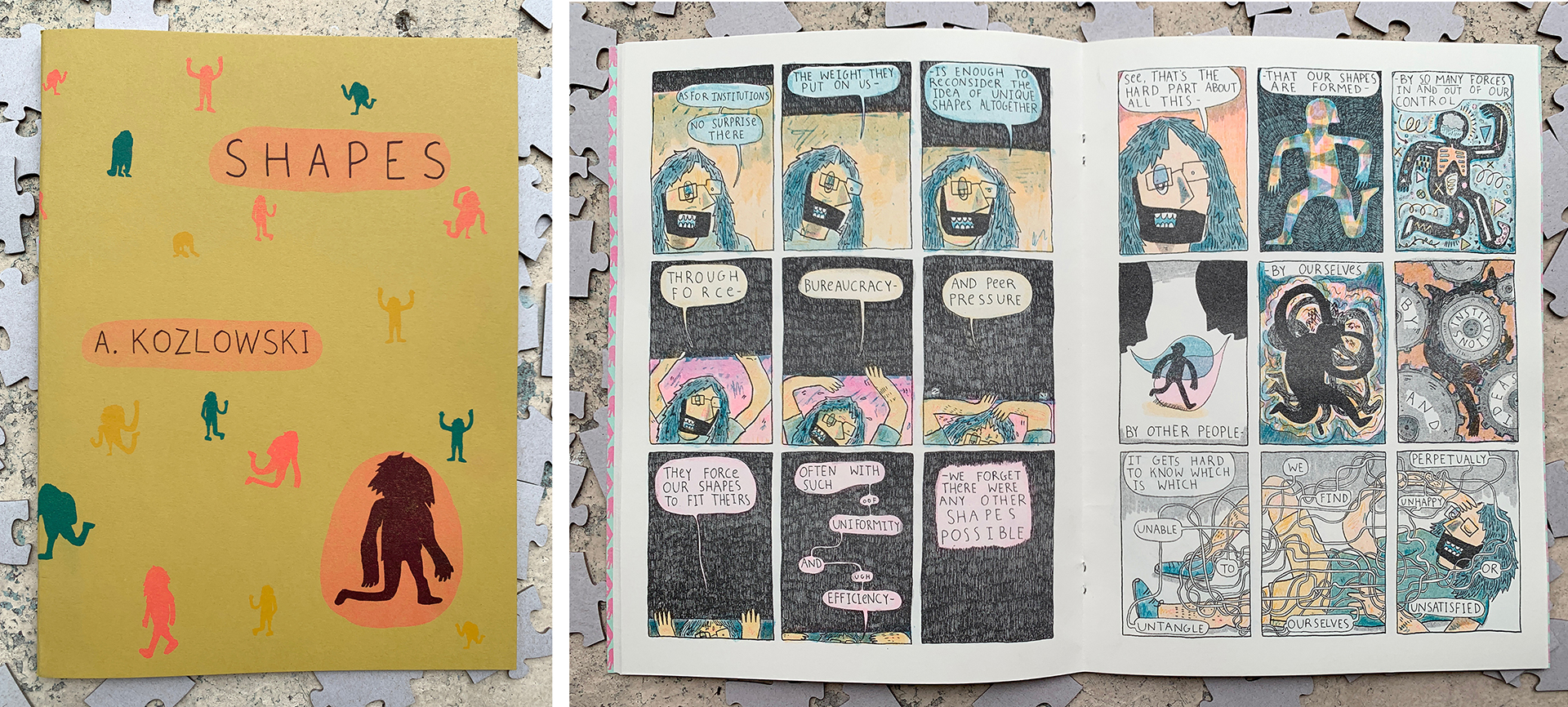
SHAPES
40 page risograph comic, staple bound, (fluorescent pink, sunflower, light teal, black)
9” x 7.5”
2024
BS: Risography and small press publishing are now integral components of your output with Paper City Publishing and beyond. How did Riso alter your approach to making? When does the collaboration possible with Paper City enter your process?
AK: The first time I made a riso print was with the machine that I had bought- I remember pushing the start button for the first time and thinking “I hope I like this!” For years folks were telling me “you’ve made so many screen prints- you gotta check out Riso- your work would be perfect”. So far those people were absolutely right.
My Risograph (an SF9450 named Barbara after one of my mentors) came from a research grant at The University of North Florida. Like any good grant proposal it has changed since that initial prompt and continues to grow into whatever it was meant to be.
As for how Riso changed my work: My installations had a feature that when they were taken down, they got destroyed- then we’d take those scraps and I’d host recycled papermaking workshops after the exhibitions. I loved that it pushed me into a place to be less precious with my work- that ephemerality was part of the story. I find that Riso has continued to encourage me to not be too precious about the work I make.
This has grown into things like my totally irregular (but free!) printed newsletter/process zine which is based on how much material I can send for the cost of a single stamp, community print workshops, and new classes like “Zines & Community” that I have developed.
Ultimately I think the Riso has extended the questioning my teachers modeled for me throughout school: What can print do? Not just as an image on paper, but as an ethos? What happens when you make printing and maybe more importantly sharing, a part of people’s lives? What happens when you can create the space that allows folks to access their creativity- especially when they might have given up on being creative?
Community based learning, workshops, mail art, long distance collaborations via pdfs and email, working with artists and non-artists, going beyond individual creativity to community expression… yes the Riso prints in all sorts of fun colors and has its funky idiosyncratic quirks- but ultimately for me it’s tilted the experience of ink and paper in favor of making space for the creativity we all need right now.
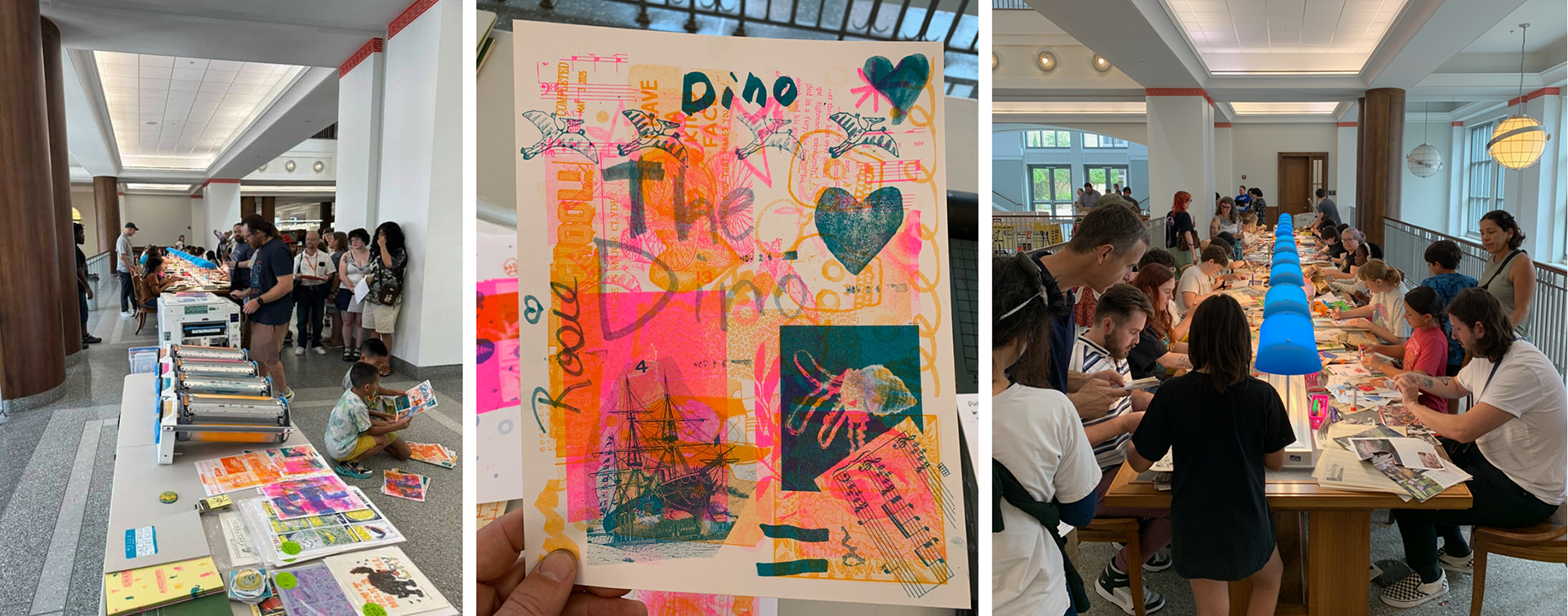
Community Printing Workshop at Duval Comics and Zines Fest
As part of the fest attendees were able to make collages and drawings that were scanned directly and printed via Risograph using a color they selected. They could take as many prints as they wanted, with the remaining prints run through with other attendees’ drawings. Some 800 prints were produced during the event which ran from 11am to 5pm.
2025
BS: You run the Zine Zone at the Jacksonville Public Library. How did this program develop? Why are zines a good way to get community to share? Have you found it a good way to expose potential printmakers to the medium? When do you integrate the Zine Zone and Paper City into your teaching?
AK: To clarify the Zine Zone- is part of the Jacksonville Public Library and was started many years ago before my time in Jacksonville. However the folks who started it moved on and in the past few years I’ve worked with the library closely to help promote the Zine Zone as an outstanding and unique resource for the community.
Just a little info: the Zine Zone houses the Zine collection at the Jacksonville Public Library Main Branch. It features over 2,000 donated titles and continues to accept new items weekly. Currently it is under the good stewardship of two amazing librarians James Greene (a UT alum in printmaking) and Al Cassada. Both James and Al possess a unique knowledge of the Zine collection and work tirelessly to promote it through education, programming, and outreach. One unique feature of the collection is that it circulates just like any other item in the library- if you have a library card you can check out a Zine! It isn’t part of “special collections” and isn’t found in an academic setting- it is a public library with a circulating collection. As far as we know the only other library system that has something similar is in San Francisco.
My involvement with the collection goes back to around 2022- I was invited to be part of a core group to help resurrect the idea of hosting the Duval Comics and Zines Fest (DCAZ) at the library. The first iteration was originally slated to happen in March of 2020. I am honored to be part of the team that helped see this event come to life. The first DCAZ took place in 2022 featuring some 50 tablers and over 1,500 attendees- we’ve held the fest each year since then and have been amazed at how fast it has taken off- in 2025 we had closer to 100 tablers and over 2,000 people coming through.
For me Zines are a perfect entry point to work with your community- and as a printmaker I’ve been thinking about the presence and power of print for many years. What I love about showing people the Zine collection is that it represents so many interests, view points, and ways of making- I find that a point of entry that really makes people feel invited to participate and contribute.
Often people ask us “what is a zine” and I love to quote my friend Al Cassada: “Zines are non-binary”- I think this helps us by defining a Zine not solely as what it is, but what it can be, and that speaks to what I’ve identified about prints as important: it isn’t always about a medium or technique, but about the choices you make to share your story.
Students are drawn to the collection because it is a public facing resource- it is something that they can immediately participate in. They can contribute their work, attend a workshop, or even host a workshop. I have my Zines & Community students plan and develop a public workshop as part of the class and it is always an amazing discussion about the art of gathering: how you make an event feel welcoming, important, and impactful to your community. For me that helps them to see their creativity as a value added to their community.
As much as I love printmaking there is still a bit of gatekeeping that happens- accessibility is a real issue that I saw become more pressurized as I tried to adapt teaching printmaking to students who were isolated in their homes or dorms during Covid. For me the ethos of Zines opened up everything that printmaking promised, but delivered it in a way that makes so many people feel they can integrate into whatever time, space, or creative power they have. You need a pencil and piece of paper to make a Zine. From there you might just head to your local library to make some copies (did you know many libraries offer some free copying or printing as part of your library card?) and you can then engage with your community by trading, sharing, or selling your work.
That is a really amazing feature of making Zines that I’ve seen play out time and again, they simply hold space that welcomes anyone- and to someone who hasn’t made something, or used to make things- just having that invitation can be life changing.
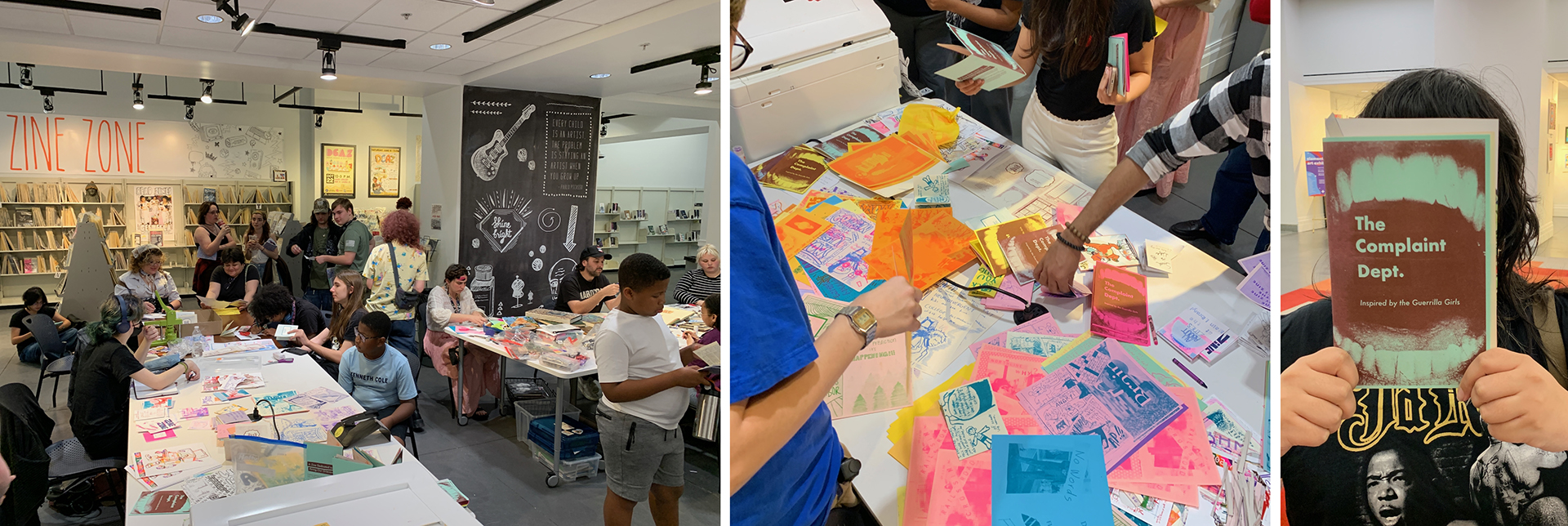
Zines & Community Zine Night
Students in the Zines & Community class were tasked with creating a community based zine making workshop at the Jacksonville Public Library during the first Wednesday Art Walk. Students developed a project called the “Complaint Department” inspired by the Guerrilla Girls. Attendees could create an 8.5”x5.5” drawing to register a complaint- which were collected and printed live via Risograph. Visitors could then collate a unique zine of complaints from the community.
2025
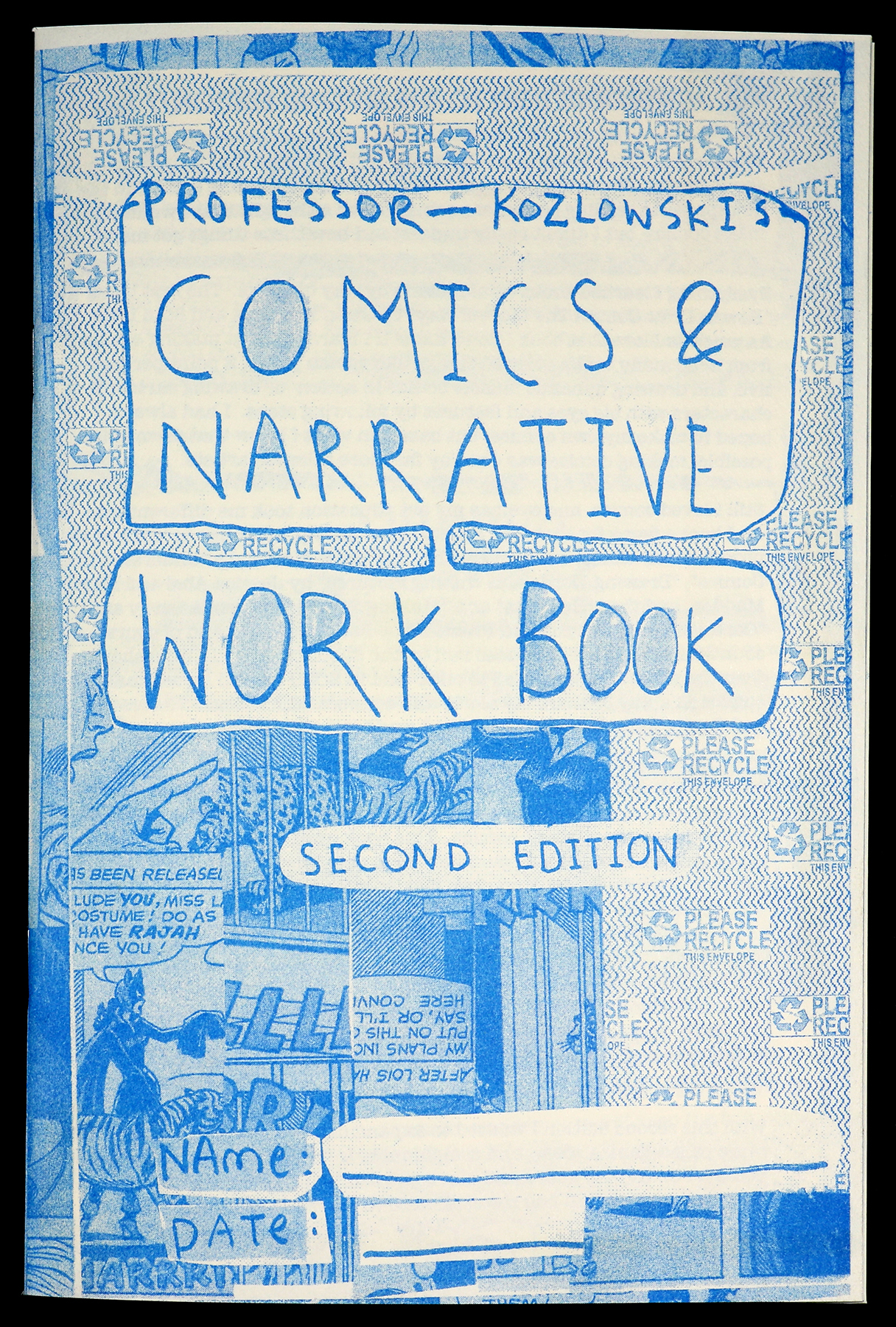
Comics and Narrative Workbook 2nd edition
40 page workbook/zine risograph printed in cornflower
9” x 6”
2024
BS: Whether it’s the symbolic significance of the collected objects in your relief work, or the poetic vulnerability of your comics, personal narrative has seemed a major force in your work for some time. What drove you to share yourself? How did you get comfortable sharing more of yourself in your more recent work?
AK: Early on I wanted to talk about what was going on outside my studio- but I didn’t have the confidence to work with figures, so I gravitated towards objects as stand-ins (this likely also has to do with my time working in museums). The installation work was all built around this “collection” that I had built up from my observations, a mixture of things from high art to disposable culture, all mashed together to upend the provenance we usually rely on to share our history.
Even before Covid shut everything down I was starting to work inwards- I had been teaching and working with my sketchbooks for years and I read Lynda Barry’s book Syllabus and was using her journal exercises. During quarantine I had a desk to work at, not a studio, so I worked in my sketchbook and I went inward. It was just the timing I suppose but all of a sudden I just felt more comfortable using myself as a character as a way to monologue through these ideas I had about teaching, creativity, family- these ideas were around the edges of my work before, but they became more critical at this point in my life.
I think what drove me to share myself was that I was tired of just not saying things. Like actually being honest about how I felt and saying that with what I was making. That directness was a path that wasn’t open before, but now it was.
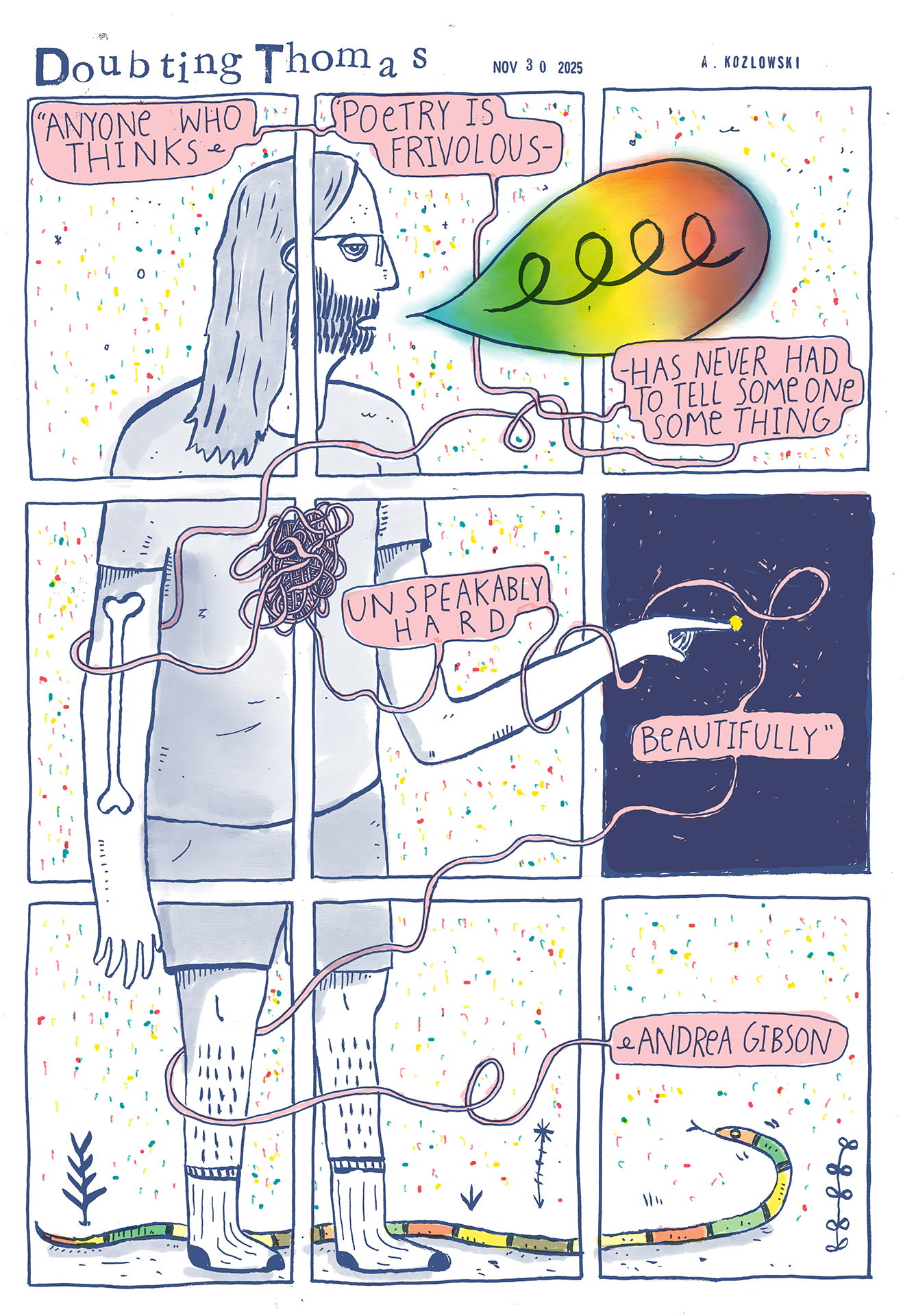
Doubting Thomas
Ink on paper with digital color
17” x 11”
2025
BS: How do you access vulnerability in your work employing a medium like printmaking whose processes can foster rigidity and performative toughness?
AK: This is a tricky question because I don’t want to dismiss how anyone finds their creative path. There are a lot of different ways including answers that include rigidness and toughness (performative or otherwise) that suit folks.
How do I access vulnerability in the work? I guess I really don’t think of it as being vulnerable- I just think of it as saying what I’m working through, just trying to be honest with myself. That said it makes it easier to say those things knowing that other people deal with the same things- though it takes a leap to figure that out.
There are a lot of reasons that people shy away from being vulnerable or honest or whatever you’d call it- it isn’t the right time, they don’t feel like they are safe, they feel isolated or misunderstood, maybe they have a history of just not being heard. In some ways I think this can lead to the kind of rigidness or performative toughness you bring up- those can be shields to protect against critique or feeling like you don’t have authority. They present some sort of control.
The other worry is that we mistake the ability to say what you feel as an obligation that others will listen to or care about it. We’re not guaranteed an audience for any of the things we make. It is messy business sharing work, and sharing before you’re really ready can set you back – or lead to those places of rigidness or performance.
The best compliment I ever received was from someone who said “your vulnerability allows me to be vulnerable”. To me that meant that I had used the peace and comfort I was afforded and somehow offered that to someone else- for whatever it was worth, it allowed them to see a place where they could be themselves.
I’ve been thinking that I can be way too sentimental in the stories I write, but at the same time I think I’m not overly sentimental about what I make- ever since the installations that would be destroyed when we take them down. Now it just manifests itself by making the next one- I’m a lot less frightened than I was when I was younger- I know that the next idea, the next moment, the next part of understanding is behind this moment- so I make it the best I can and keep going. That feels like it is part of printmaking- sure we can make an edition of all the same prints, but there is magic in the iterations- the medium makes it so easy to just keep trying things- see what happens, what are we risking? A piece of paper? Some ink? Try it and try it again, keep on digging.
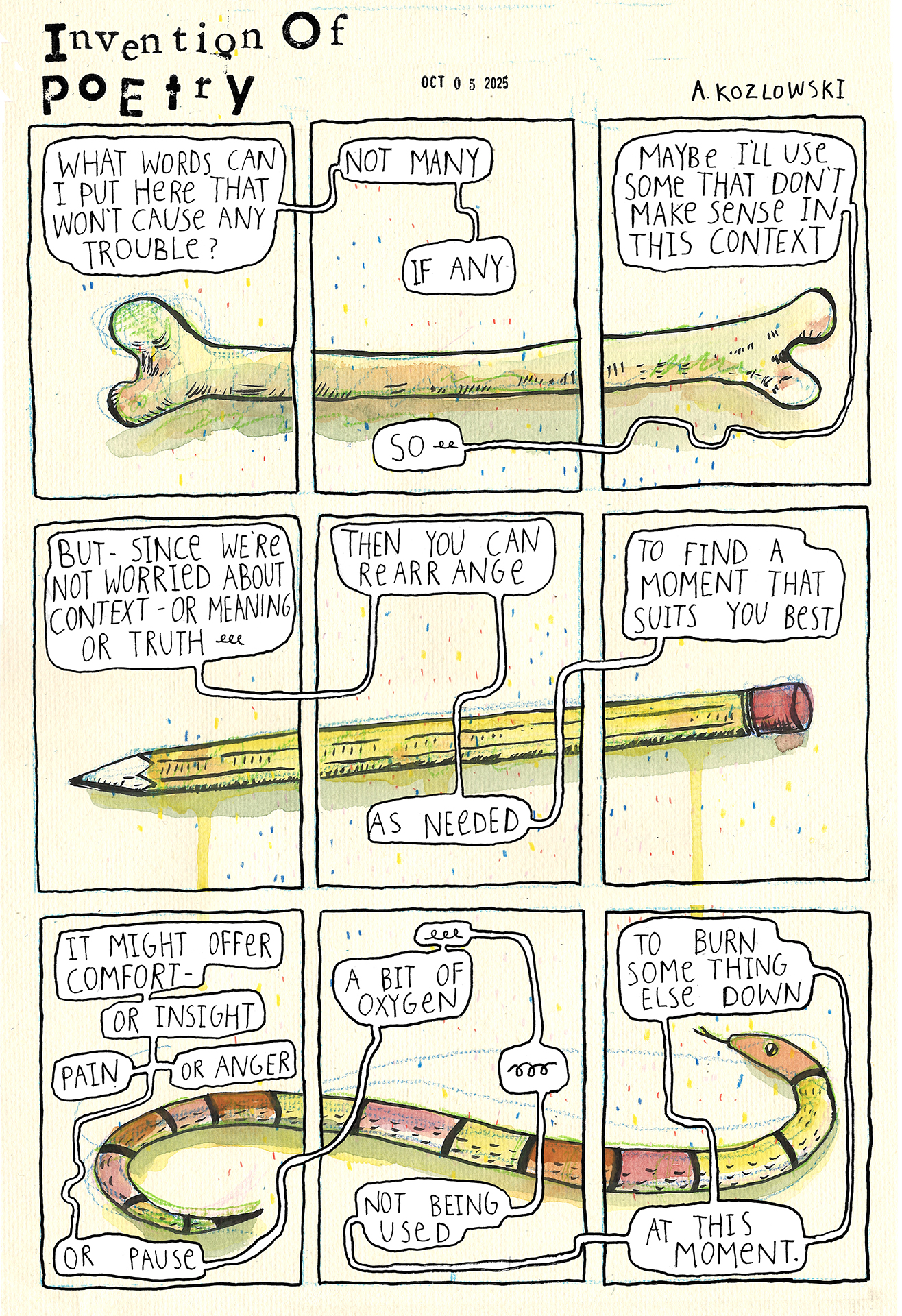
Invention of Poetry
Ink and water color on paper and vellum, digitally collaged
17” x 11”
2025
BS: You virtually publish a comic a week, some of which wind up developed into zines and other formats. How has that habit affected your broader practice? How has social media influenced your work and/or furthered your career?
AK: Creating a weekly comic has smoothed out the big ups and downs I used to feel early on, especially as a young artist/academic. During the school year I’d be caught up teaching. That time was for applying to shows and shipping out work and filling out applications. Summer (and part of Winter break) was for making new work- which was so stressful- if I didn’t make anything of consequence I wouldn’t have anything to send out the following year. I found that up and down, start and stop, hot and cold, really a detriment to the work – looking back I realize I was really hesitant and cautious in many ways- afraid to make a wrong step.
Now after so many years of this consistency through producing the weekly comic I don’t feel like I’ve had that “oh I forgot how to draw” moment that always seemed to plague me early on. I’m not saying all the weekly comics are good- but they’ve helped me be steady, and when an idea doesn’t come as easily I have to embrace it as a chance to try something different. I feel a lot more comfortable in who I am and what I make now.
Social media has been interesting- I resisted it for a long time, which I think was good- it helped me figure out how I wanted to use it. Ultimately I landed on a policy of sharing my work as a way to (hopefully) make the internet less terrible. I’m not sure how much I’ve moved the needle, but I’ve certainly found an audience of supportive folks. Having that avenue to share the work and get feedback and see how others responded to it was really amazing. Eventually it encouraged me as I started to make books and prints and sell my work, eventually opening my web store Paper City Publishing.
Thanks to the audience I’ve found I’m able to support the work I make, and in turn I’ve used that to help support the work of a few other artists- either through publishing their work, or supporting their projects. I think this has had a positive impact on my career- just as I feel more tied into the work I make, I feel tied in with the other artists and creators I’ve met online- some of those relationships have really developed into friendships and collaborations, invitations to projects- or just people I can reach out to with questions. Social media isn’t perfect at all, but this intentional approach has yielded a supportive network.
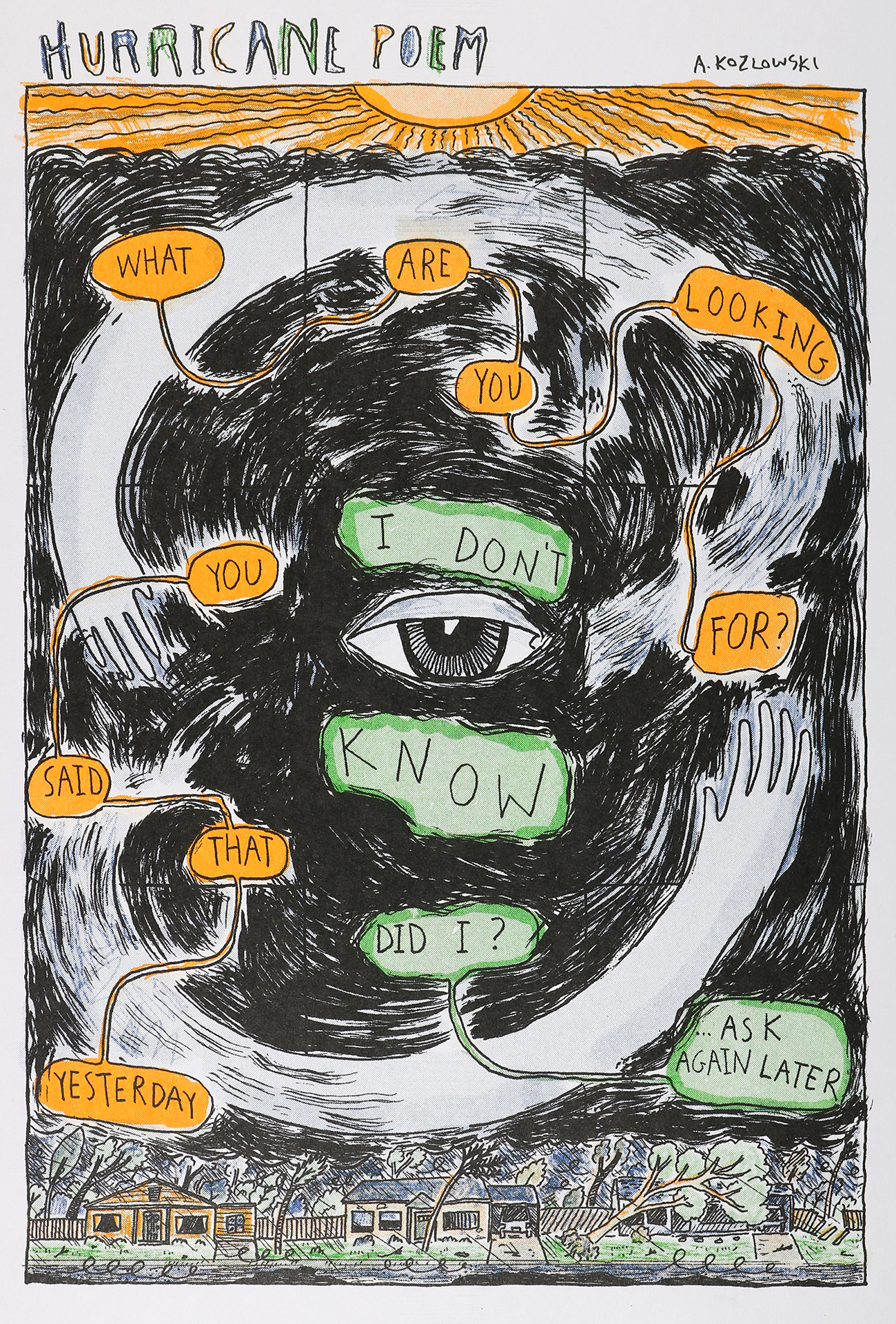
Hurricane Poem
Risograph (sunflower, kelly green, federal blue, black)
14” x 11”
2025
BS: Earlier this year you were recently commissioned to do a strip for MoMA magazine’s Drawn to MoMA series. How did that come to pass? How did your integrate the project into your voice and your body of work?
AK: In one of those “this can’t be real” moments I got an email from Arlette Hernandez who puts together the digital newsletter which includes the Drawn to MoMA series asking if I would be interested in creating a comic for an upcoming issue.
What I didn’t know is that Arlette was a student at UNF and worked with Hope McMath at Yellow House Galley here in Jacksonville. Arlette had been part of a group of students who curated a show around 2019(?) and they had graciously included my work. Not long after Arlette moved to NYC and their career took them to MoMA, and in that time she had stayed connected to my work via Instagram. I should note that while Arlette was a UNF student we never met in person (and still haven’t).
Lesson of the story: art karma is real, so be good- it can feel like when you show or share your work, nobody is taking notice, but really you never know who is looking at your work and when they might reach out.
Drawn to MoMA looks for work that responds to the collection/ the museum in some way- and with a publication date in April Arlette asked for something that dealt with nature for Earth day. Being totally honest the moment I said “of course I’ll do it!” all ideas seemed to leave my body and I really struggled. Mind you I’ve been making a weekly comic for 5 years, and so I’m used to working on a deadline- the parameters were comfortable for me and open enough to play around with and Arlette was very encouraging. I think the weight of MoMA just sort of slapped the ideas right out of my head though.
I came to think of the story as a way to talk about how artists often bring the landscape inside the museum to talk about the landscape outside. This was something familiar- those wheat pasted murals were landscapes- they just happened to be made with the objects left behind by people once the landscape was removed. I thought about the viewer who goes to the museum to find some respite, a place to take a step back from the world to try and put their thoughts in order, and the challenge a place like MoMA presents through its focus on modern and contemporary art. So I had this bubbling in my head but still struggled with the form.
As it happened Lynda Barry posted a comic where she used a pantoum poem as a form- a kind of structure that used repeated phrases to create a looping feeling. As she usually does the post ended with her encouragement to her audience “try it, why not?”.
So I did, and the piece just really started to fall into place. For me poem structures are a great way to give some guide rails to projects- a simple set of rules can help get past the tyranny of freedom. The pantoum uses stanzas of 4 lines, and given the structure I thought “ok- 4 lines makes 4 panels per page, and 4 pages for four seasons. Everything is square because it repeats, this is an ongoing question with no linear answer, we keep finding ourselves back in the museum trying to figure it out” and that was it- well sort of- a few drafts later and things finally settled into place.
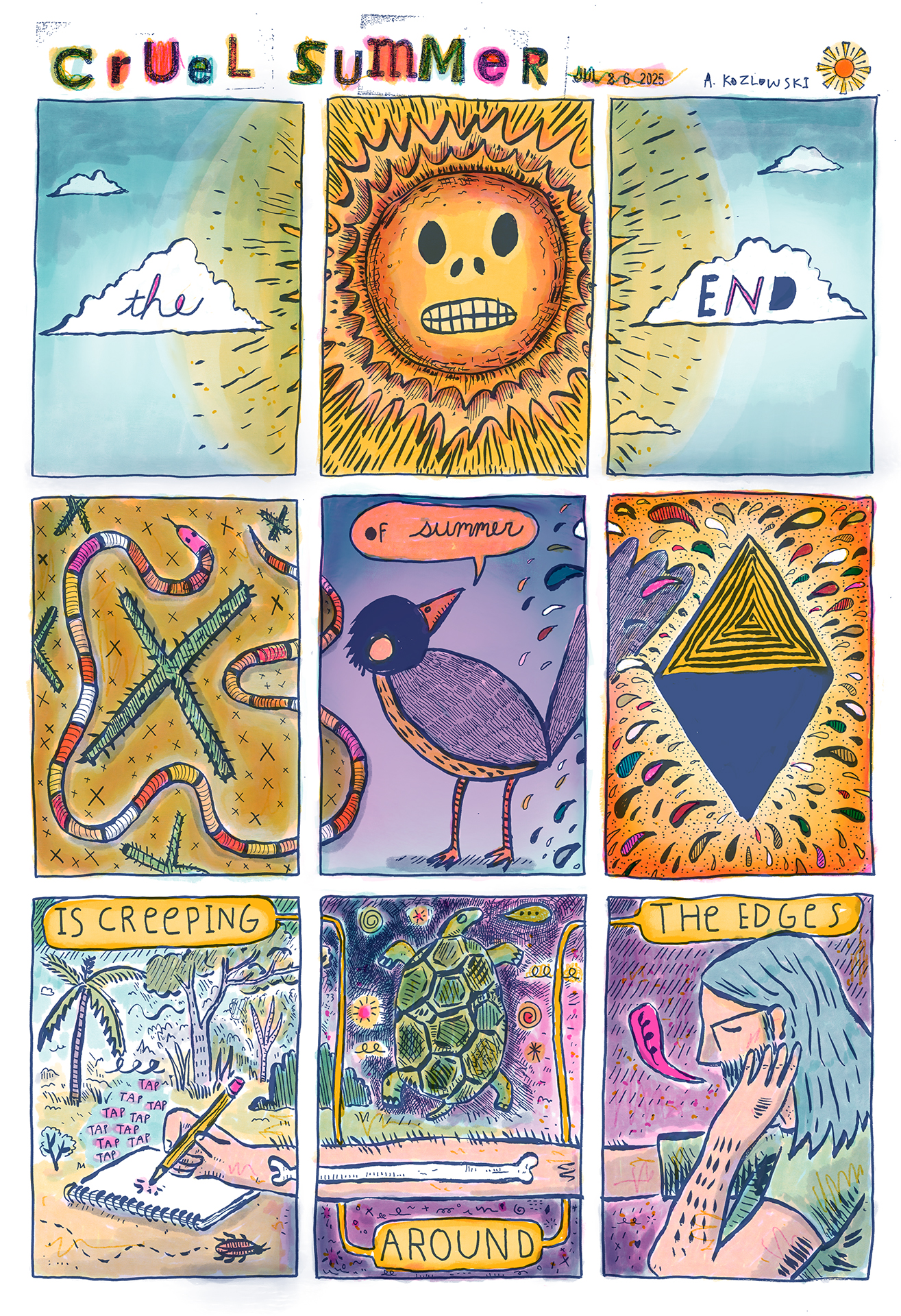
Cruel Summer
Ink on paper with digital color
17” x 11”
2025
BS: One more chance for exposure, what’s coming up next for you?
AK: I’m continuing to have way more ideas than I ever have time for. Some possible things on deck: a book collecting comics from the past 2 years with additional prints and drawings, another “how-to” book focused on sketchbooks, publishing more books/prints with returning and new artists.
I’ll be a visiting artist at Rice University this February and I’m working on a solo exhibition of my original pages for Lowe Mill Art Space in Huntsville for later in the year. I’m trying to get myself in order to set up more exhibitions and would love to expand my community based work Touchy/Feely to new places (in case anyone is interested!)
Small things I continue to do- producing my weekly comic, trying to put out my free printed newsletter, and writing a letter a week to someone.
We are working on another year of the Duval Comics and Zines fest and we hope to expand our programming here in Jacksonville- last year we had a live reading fundraiser and it was such a blast. I’m also working to get out to other fests in my area- I’ll be at SPICE in Savannah and Panel Palooza in Gainesville at SAW (Sequential Artists Workshop) in March.
My wife and I have been talking about building a studio at our house. Right now I’d say that I generously work on the same 3 feet of desk space to do all my work. My wife is completely right when she tells me “we’ve never really invested in our space” – and I think with all these projects it’s well past time that we figure out a studio space for ourselves. I’d love to purchase my own Risograph to work with at home and have even more freedom to collaborate and host workshops.
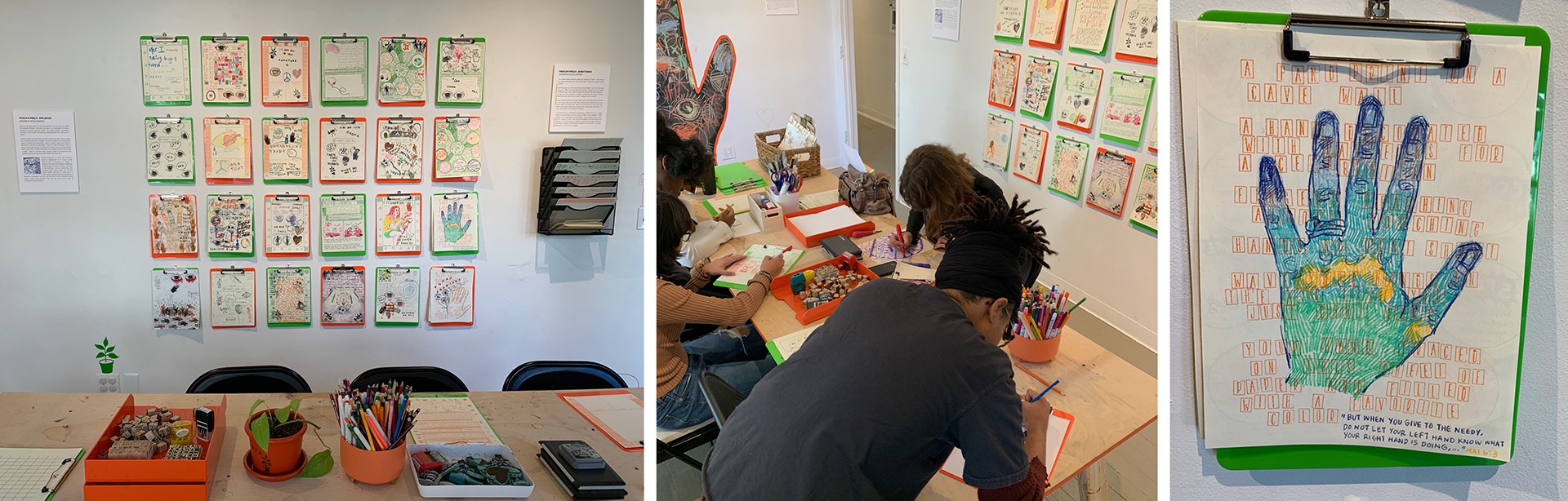
Touchy/Feely
Risograph printed worksheets, clipboards, drawing table drawing supplies, community engagement.
Part of the exhibition “What’s Going On” at Yellow House Gallery, Touchy/Feely was a worktable filled with prompt sheets that encouraged attendees to draw, color, and create to respond to one of seven different worksheets. Visitors were encouraged to share their creations by adding it to a display of clipboards. A free print was provided for participation. The piece grew and changed throughout the show as it was added to and curated by the community.
Dimensions variable
2024